The Fifty-three Stations of the Tokaido (Hoeido edition) ・ 50
Spring Rain at Tsuchiyama
東海道五拾三次之内 土山 春之雨
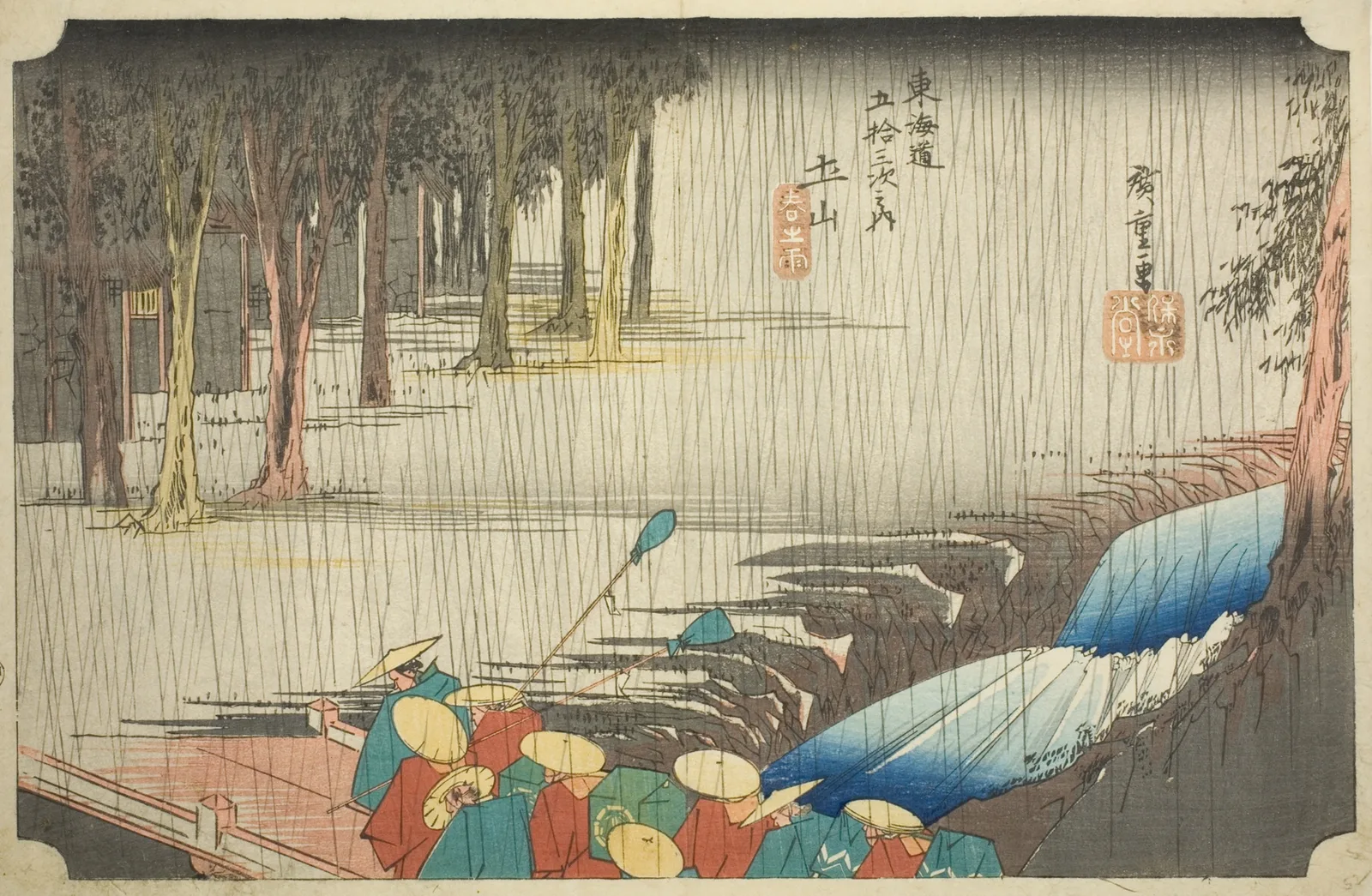
In the pouring spring rain, a daimyo procession crosses the bridge over the Tamura River. The countless lines of rain filling the picture and the line of hats of people advancing with bowed heads convey Tsuchiyama, a place known for its rain.
- Artist
- Utagawa Hiroshige
- Date
- c. 1833-34 (Tenpo 4-5)
- Medium / format
- Woodblock print (ukiyo-e)
- Series
- The Fifty-three Stations of the Tokaido (Hoeido edition) 55 prints
- Place depicted
- Tsuchiyama-juku(Shiga)
About this work
In the foreground, members of the procession in raincoats begin to cross the bridge in a single line, hats tilted. Faces are not seen; only hats and backs line up, and they are drawn proceeding silently through the rain. At the front of the procession the tip of a covered spear sticks out diagonally. The colors of the hats and raincoats vary among red, yellow, and green, standing out in the gray rain.
The rain is drawn in fine lines, with many lines crossing and covering the whole picture. The Tokyo Fuji Art Museum explains that, compared with Shono: Evening Shower, in which the rain meets the slope at right angles, here countless crossing lines show the intensity of the rain. The Tamura River on the right is white with waves and flows swiftly. The grass on the bank is pushed over by the current, making the force of the water look stronger.
Tsuchiyama is the first post station after crossing Suzuka Pass into Omi. A packhorse driver's song sang, The slope shines, Suzuka is cloudy, and at Tsuchiyama in between, it rains, and the place was known for its heavy rain. The grove at the back is expressed in shades of gray and vanishes into the distance, hazy with rain. Under the trees at back left, the shadow of a building can also be seen.
The place today
In Tsuchiyama-juku remains the honjin building established in 1634 (Kan'ei 11), which preserves the upper-level room where daimyo and court nobles stayed and the guest registers. On the post-town street is the Tokaido Denmakan, a renovated merchant house that introduces the history of the Tokaido and Tsuchiyama-juku.
Where can I see it?
Exhibitions change over time. Check each museum's exhibition information before you visit.
Museums that hold this work
- Tokyo National MuseumMuseum's page for this work (opens in a new tab)
Taito City, Tokyo Accession no. A-12499-55
Museums that hold this series (please check the museum's website for whether it holds this print)
- Shizuoka City Tokaido Hiroshige Museum of Art
Shimizu Ward, Shizuoka
All prints of the Hoeido edition were shown in the museum's collection exhibition Fifty-three Stations of the Tokaido (2024-25)
Museums abroad
- Art Institute of ChicagoMuseum's page for this work (opens in a new tab)
Chicago Accession no. 1925.3557
Frequently asked questions
- Who painted The Fifty-three Stations of the Tokaido: Spring Rain at Tsuchiyama, and when?
- The Fifty-three Stations of the Tokaido: Spring Rain at Tsuchiyama is by Utagawa Hiroshige, made in c. 1833-34 (Tenpo 4-5). Medium: Woodblock print (ukiyo-e).
- What place does The Fifty-three Stations of the Tokaido: Spring Rain at Tsuchiyama show?
- It shows Tsuchiyama-juku (Shiga).
- Where can I see The Fifty-three Stations of the Tokaido: Spring Rain at Tsuchiyama?
- It is held by Tokyo National Museum, Tokyo Fuji Art Museum, National Diet Library. Exhibitions change, so check each museum's information before you visit.
Sources and references
- Art Institute of Chicago: Tsuchiyama: Spring Shower (Tsuchiyama, haru no ame) (opens in a new tab) (checked 2026-10-18)
- ColBase(東京国立博物館): A-12499-55 (opens in a new tab) (checked 2026-10-18)
- 東京富士美術館 収蔵品: 東海道五拾三次之内 土山 春之雨 (opens in a new tab) (checked 2026-10-18)
- 国立国会図書館デジタルコレクション: 東海道五拾三次 土山・春之雨 (opens in a new tab) (checked 2026-10-18)
You may also like
More from Shiga
Discover more of the same region on our sister sites.
Matsuri Biyori
Festivals in Shiga
- Nagahama Hikiyama Festival Float Event
- Otsu Festival Hikiyama Float Event
- Omi Konan no San'yare Odori
- Omi no Kenketo Matsuri Naginata Furi