The Sixty-nine Stations of the Kisokaido ・ 64
Toriimoto
木曽海道六拾九次之内 鳥居本
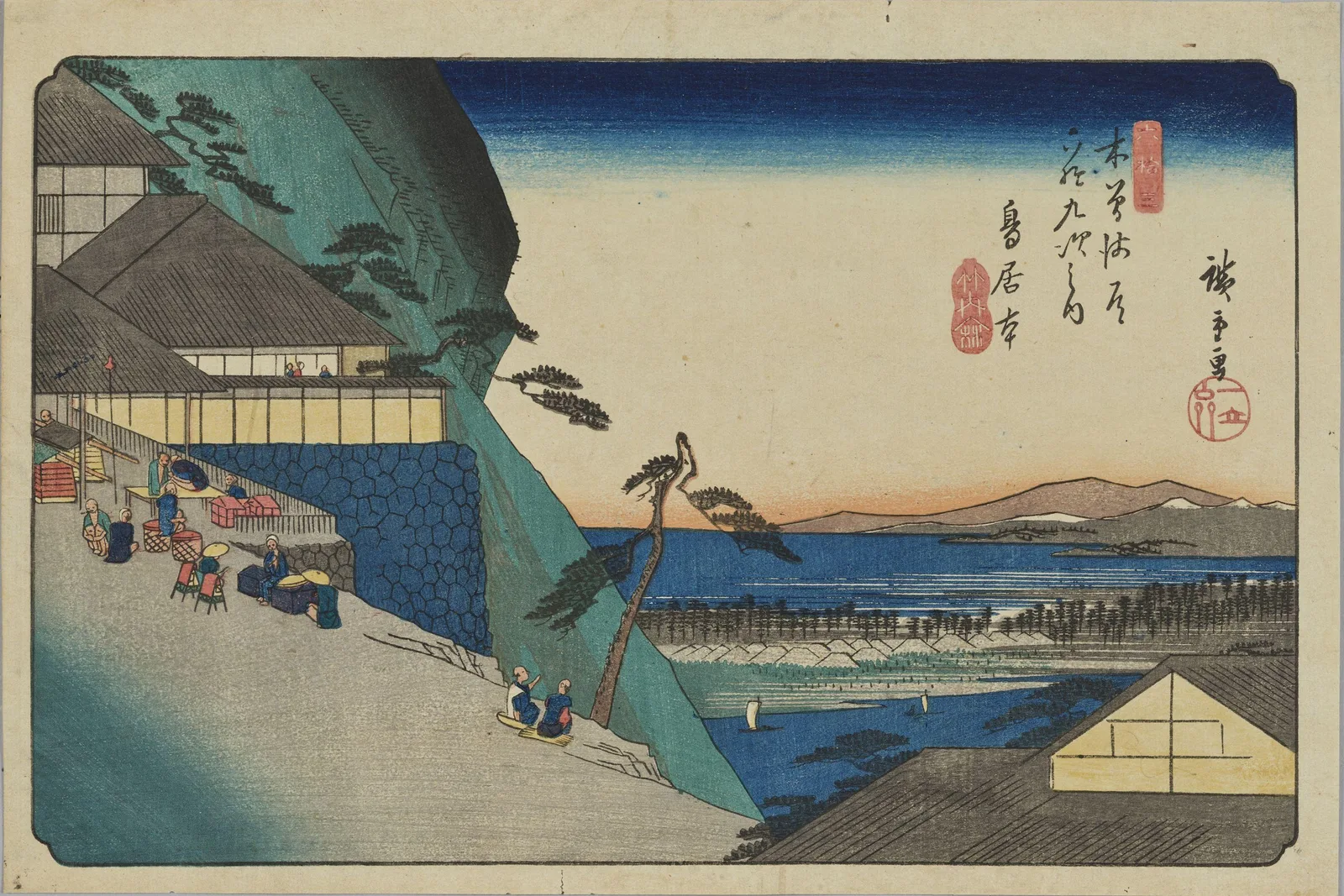
This looks down on Lake Biwa from a teahouse on Surihari Pass, just before Toriimoto-juku. Travelers relax at the teahouse on the cliff, while below, the lake, sailboats, and distant mountains spread out in the sunset. It conveys the superb view that made travelers stop.
- Artist
- Utagawa Hiroshige
- Date
- c. 1835-38 (Tenpo 6-9)
- Medium / format
- Woodblock print (ukiyo-e)
- Series
- The Sixty-nine Stations of the Kisokaido 71 prints
About this work
At left is a two-story teahouse built against the cliff, where travelers rest on benches atop a stone wall. Two men go down the slope below the cliff. At lower right the roofs of houses peek out, and beyond them Lake Biwa spreads out. Sailboats float on the lake, and low mountains line the far shore.
The cliff at left is cut diagonally across a large part of the picture, and the expanse of the lake opens at right in a bold composition. The sky shifts from indigo at the top to a pale vermilion at the bottom, echoing the blue of the lake. A single pine leaning out from the cliff toward the lake emphasizes height and depth.
Toriimoto-juku was a post town in Sakata District, Omi Province, whose specialties were the medicine Akadama Jinkyogan and rain capes. On Surihari Pass to the north of the town was a teahouse called Boko-do with a full view of Lake Biwa, which is said to have been famous as a resting place for travelers. The teahouse in the picture is thought to be this Boko-do.
This is a design by Hiroshige, and the vermilion seal is mistakenly stamped "sixty-three." Choosing a view from the pass rather than the town, it is the first design in this series to draw Lake Biwa on a large scale. The lake appears again in the design for the final station, Otsu.
The place today
Toriimoto-juku corresponds to today's Toriimoto-cho in Hikone City, Shiga Prefecture, where stately streets remain, including the head shop of Akadama Jinkyogan and a house with a "Honke Kappa-dokoro" signboard. The teahouse building on Surihari Pass is said to have been lost in a fire in 1991, but the lake can still be seen from the pass.
Where can I see it?
Exhibitions change over time. Check each museum's exhibition information before you visit.
Museums that hold this work
- Tokyo National MuseumMuseum's page for this work (opens in a new tab)
Taito City, Tokyo Accession no. A-12499-132
- National Diet LibraryMuseum's page for this work (opens in a new tab)
Chiyoda City, Tokyo Accession no. 寄別2-2-1-5
Included in Kisokaido Rokujukyu-tsugi
Museums abroad
Frequently asked questions
- Who painted The Sixty-nine Stations of the Kisokaido: Toriimoto, and when?
- The Sixty-nine Stations of the Kisokaido: Toriimoto is by Utagawa Hiroshige, made in c. 1835-38 (Tenpo 6-9). Medium: Woodblock print (ukiyo-e).
- What place does The Sixty-nine Stations of the Kisokaido: Toriimoto show?
- It shows Toriimoto-juku, Lake Biwa (Shiga).
- Where can I see The Sixty-nine Stations of the Kisokaido: Toriimoto?
- It is held by Tokyo National Museum, National Diet Library. Exhibitions change, so check each museum's information before you visit.
Sources and references
- ColBase(東京国立博物館): 木曽海道六拾九次之内 鳥居本 (opens in a new tab) (checked 2026-10-19)
- 国立国会図書館デジタルコレクション: 六拾三 木曽海道六拾九次之内鳥居本 (opens in a new tab) (checked 2026-10-19)
- Wikipedia: 木曽海道六十九次 (opens in a new tab) (checked 2026-10-19)
You may also like
More from Shiga
Discover more of the same region on our sister sites.
Matsuri Biyori
Festivals in Shiga
- Nagahama Hikiyama Festival Float Event
- Otsu Festival Hikiyama Float Event
- Omi Konan no San'yare Odori
- Omi no Kenketo Matsuri Naginata Furi