The Sixty-nine Stations of the Kisokaido ・ 63
Banba
木曽海道六拾九次之内 番場
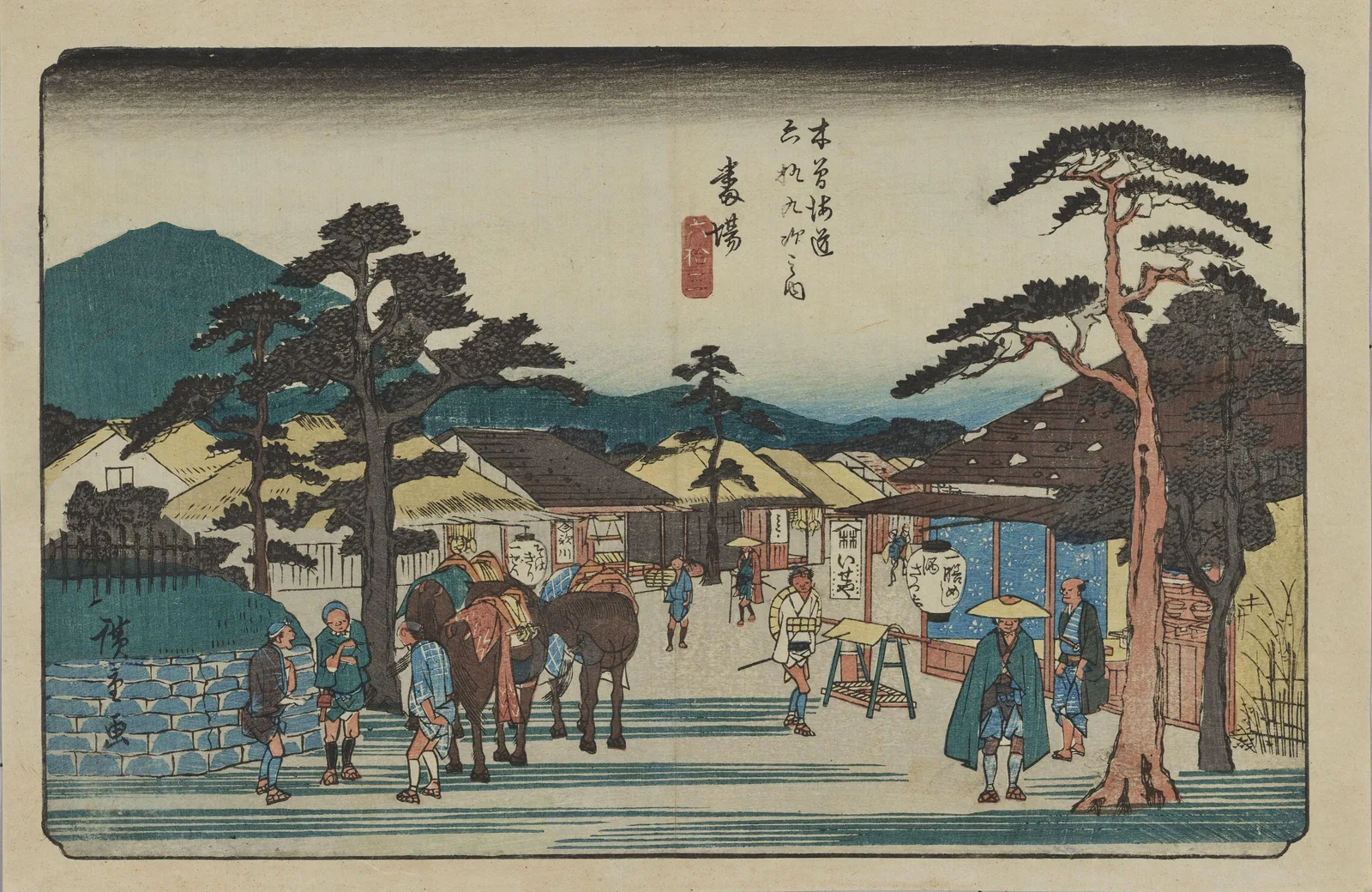
This shows horses loaded with baggage and travelers coming and going on the highway at Banba-juku. Teahouses and houses continue down a road lined with pines on both sides, with indigo mountains rising behind. The movement of people along the street conveys the liveliness of the post town.
- Artist
- Utagawa Hiroshige
- Date
- c. 1835-38 (Tenpo 6-9)
- Medium / format
- Woodblock print (ukiyo-e)
- Series
- The Sixty-nine Stations of the Kisokaido 71 prints
- Place depicted
- Banba-juku(Shiga)
About this work
At left in the foreground, men rest their loaded horses beside a stone wall. On the right side of the street is a teahouse, and travelers walk past the lanterns and signboards at its front. A man in a rain cape and hat stands in the foreground, seeming to head toward us. Farther down the street, more people and houses continue.
Finely shaped pines are placed at left and right, showing the street that continues into the distance between them. The mountain at upper left is drawn large in shades of indigo, contrasting with the yellow of the roofs of the houses in front. The reddish-brown of the pine trunks beats a rhythm along both sides of the street.
Banba-juku was a post town in Sakata District, Omi Province. When a cut through to Maibara and Maibara Port were opened in the early Edo period, it also became the fork for a shortcut to Kyoto by switching to a boat on Lake Biwa. Nearby Renge-ji temple is known as the place where Hojo Nakatoki, the Rokuhara Tandai, took his own life with his clan.
This is a design by Hiroshige. The number on the vermilion seal is "sixty-three," and the same number is mistakenly stamped on the next design, Toriimoto. This composition, looking straight down the street of a post town, was one Hiroshige used repeatedly for Nakasendo stations.
The place today
Banba-juku corresponds to today's Banba in Maibara City, Shiga Prefecture, where a stone monument to the post town and a Meiji-era signpost carved "Maibara: train, steamship, road" remain. At Renge-ji are the graves of Hojo Nakatoki and his clan and retainers, and the temple preserves a bell designated an Important Cultural Property. The post town is also known as the setting of the play "Mabuta no Haha."
Where can I see it?
Exhibitions change over time. Check each museum's exhibition information before you visit.
Museums that hold this work
- Tokyo National MuseumMuseum's page for this work (opens in a new tab)
Taito City, Tokyo Accession no. A-12499-131
- National Diet LibraryMuseum's page for this work (opens in a new tab)
Chiyoda City, Tokyo Accession no. 寄別2-2-1-5
Included in Kisokaido Rokujukyu-tsugi
Museums abroad
Frequently asked questions
- Who painted The Sixty-nine Stations of the Kisokaido: Banba, and when?
- The Sixty-nine Stations of the Kisokaido: Banba is by Utagawa Hiroshige, made in c. 1835-38 (Tenpo 6-9). Medium: Woodblock print (ukiyo-e).
- What place does The Sixty-nine Stations of the Kisokaido: Banba show?
- It shows Banba-juku (Shiga).
- Where can I see The Sixty-nine Stations of the Kisokaido: Banba?
- It is held by Tokyo National Museum, National Diet Library. Exhibitions change, so check each museum's information before you visit.
Sources and references
- ColBase(東京国立博物館): 木曽海道六拾九次之内 番場 (opens in a new tab) (checked 2026-10-19)
- 国立国会図書館デジタルコレクション: 六拾三 木曽海道六拾九次之内番場 (opens in a new tab) (checked 2026-10-19)
- Wikipedia: 木曽海道六十九次 (opens in a new tab) (checked 2026-10-19)
You may also like
More from Shiga
Discover more of the same region on our sister sites.
Matsuri Biyori
Festivals in Shiga
- Nagahama Hikiyama Festival Float Event
- Otsu Festival Hikiyama Float Event
- Omi Konan no San'yare Odori
- Omi no Kenketo Matsuri Naginata Furi