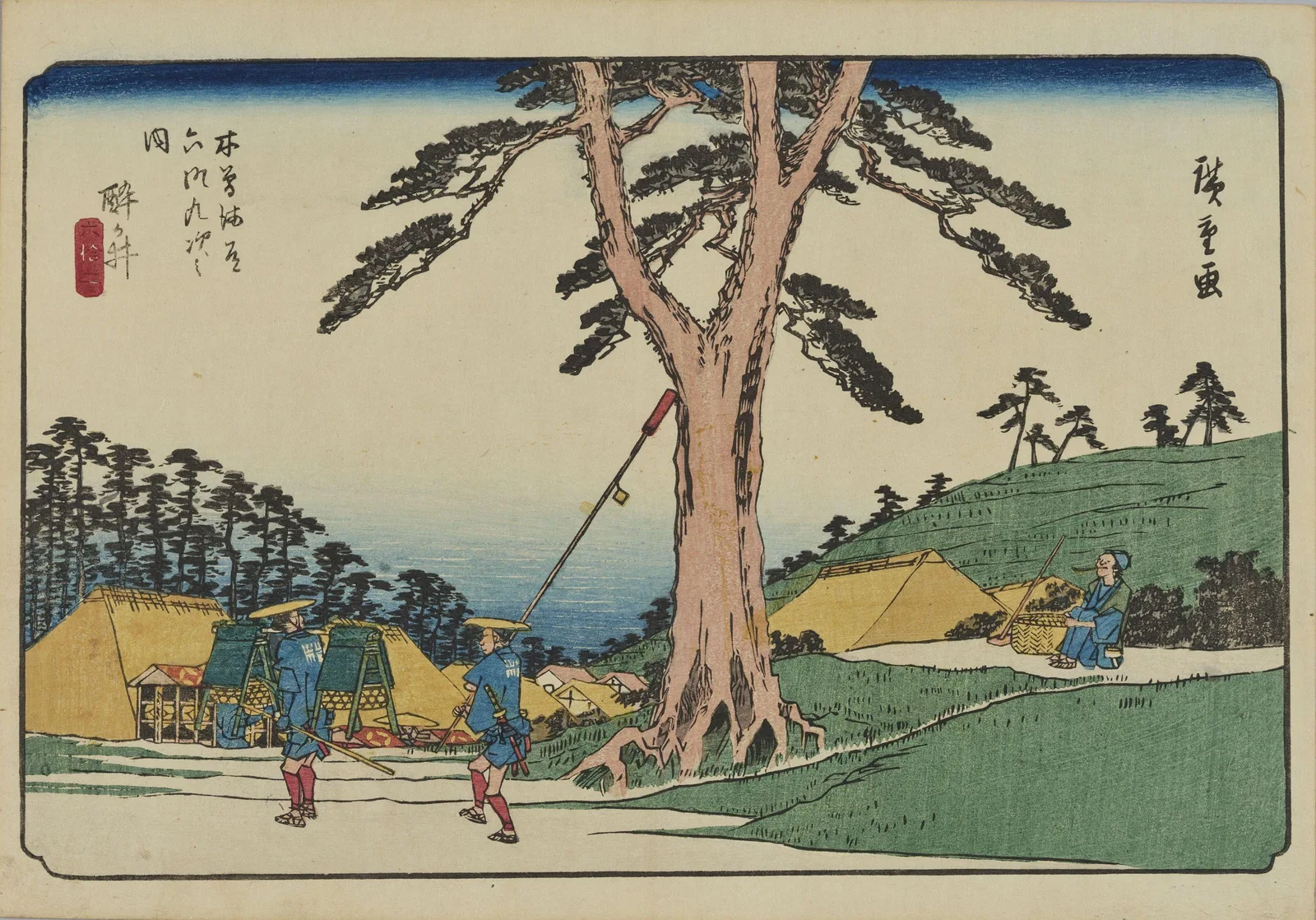
The Sixty-nine Stations of the Kisokaido ・ 62
Samegai
木曽海道六拾九次之内 酔か井
This shows travelers walking beneath a large pine on the outskirts of Samegai-juku. Beyond the hilltop teahouse and thatched houses, blue distant mountains lie hazy, conveying an easygoing afternoon on a highway in Omi.
- Artist
- Utagawa Hiroshige
- Date
- c. 1835-38 (Tenpo 6-9)
- Medium / format
- Woodblock print (ukiyo-e)
- Series
- The Sixty-nine Stations of the Kisokaido 71 prints
- Place depicted
- Samegai-juku(Shiga)
About this work
A large pine towers in the center of the picture, and beneath it walk a man carrying a spear and his attendant. On the hill at right is a thatched-roof teahouse, where someone seated looks this way. At back left stand thatched houses and groves of cedar and pine, and beyond them a blue, hazy distant view appears.
The pine trunk dividing the picture left and right is printed in pale red, with its twisting branches filling the sky. The green hill at right and the row of houses at left face each other diagonally, guiding the eye into the distance around the pine. The yellow thatched roof of the teahouse is a bright spot of color amid the green.
Samegai-juku was a post town in Sakata District, Omi Province, and its name is said to come from "Isame no Shimizu," a spring in the legend of Yamato Takeru. Abundant spring water from Mount Ryozen made it known as a resting place where travelers quenched their thirst. There was also a tradition that this spring was an underground flow from Yoro Falls.
This is a design by Hiroshige. The station name in the title is written "醉か井," a different character from today's 醒井. Choosing a highway scene at the edge of the town rather than the famous spring is a choice often seen in Hiroshige's designs for this series.
The place today
Samegai-juku corresponds to today's Samegai in Maibara City, Shiga Prefecture, and the spring-fed Jizo River flows through the townscape. Water buttercups (baikamo), which bear white flowers in summer, grow in the river, and the "Isame no Shimizu" also remains. The area is a constituent cultural property of the Japan Heritage site "Lake Biwa and Its Waterside Landscape."
Where can I see it?
Exhibitions change over time. Check each museum's exhibition information before you visit.
Museums that hold this work
- Tokyo National MuseumMuseum's page for this work (opens in a new tab)
Taito City, Tokyo Accession no. A-12499-130
- National Diet LibraryMuseum's page for this work (opens in a new tab)
Chiyoda City, Tokyo Accession no. 寄別2-2-1-5
Included in Kisokaido Rokujukyu-tsugi
Museums abroad
Frequently asked questions
- Who painted The Sixty-nine Stations of the Kisokaido: Samegai, and when?
- The Sixty-nine Stations of the Kisokaido: Samegai is by Utagawa Hiroshige, made in c. 1835-38 (Tenpo 6-9). Medium: Woodblock print (ukiyo-e).
- What place does The Sixty-nine Stations of the Kisokaido: Samegai show?
- It shows Samegai-juku (Shiga).
- Where can I see The Sixty-nine Stations of the Kisokaido: Samegai?
- It is held by Tokyo National Museum, National Diet Library. Exhibitions change, so check each museum's information before you visit.
Sources and references
- ColBase(東京国立博物館): 木曽海道六拾九次之内 酔か井 (opens in a new tab) (checked 2026-10-19)
- 国立国会図書館デジタルコレクション: 六拾二 木曽海道六拾九次之内醒か井 (opens in a new tab) (checked 2026-10-19)
- Wikipedia: 木曽海道六十九次 (opens in a new tab) (checked 2026-10-19)
You may also like
More from Shiga
Discover more of the same region on our sister sites.
Matsuri Biyori
Festivals in Shiga
- Nagahama Hikiyama Festival Float Event
- Otsu Festival Hikiyama Float Event
- Omi Konan no San'yare Odori
- Omi no Kenketo Matsuri Naginata Furi