The Sixty-nine Stations of the Kisokaido ・ 66
Echigawa
木曽海道六拾九次之内 恵智川
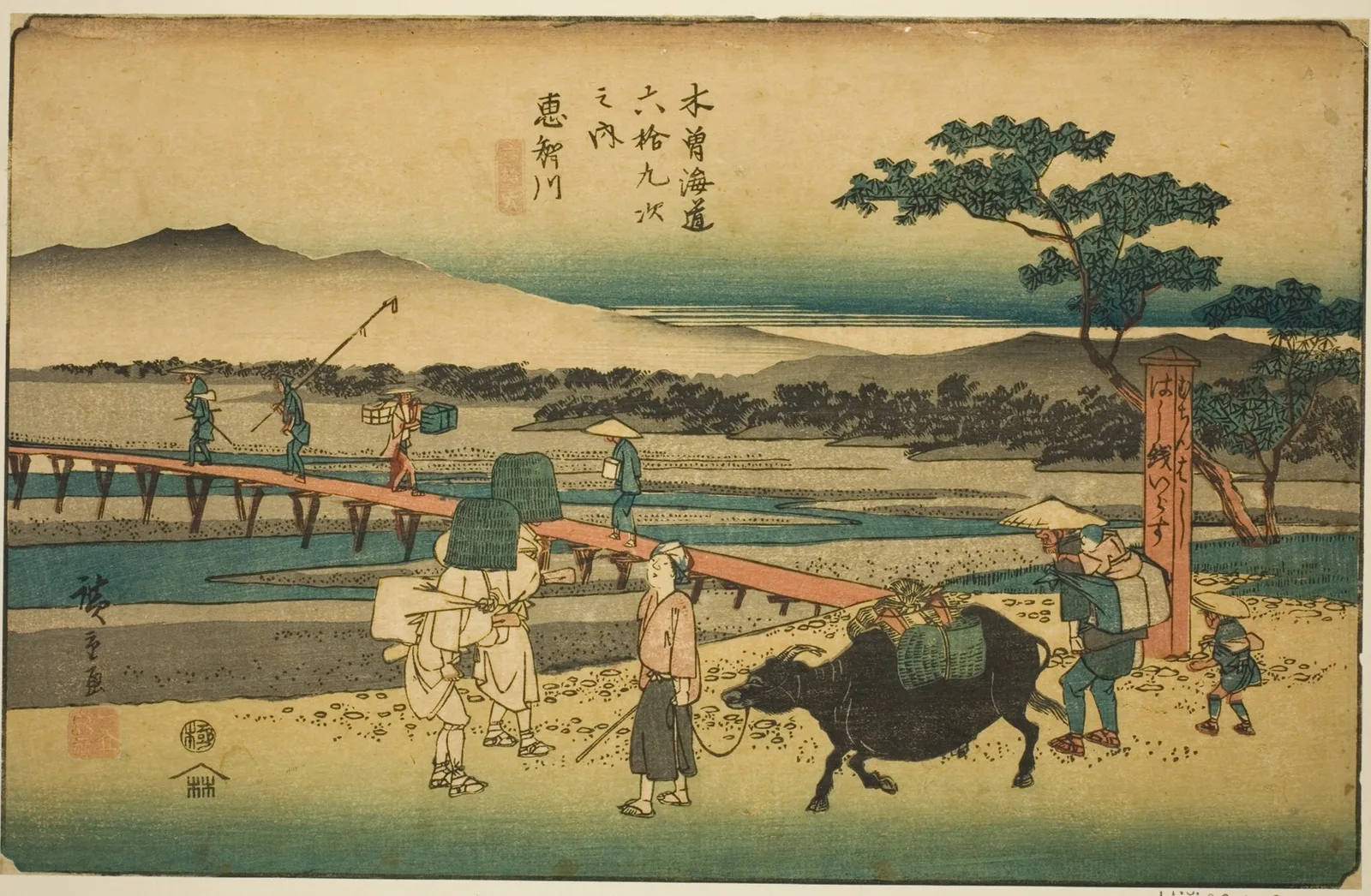
This shows the long bridge over the Echi River and a post at its foot inscribed "Muchin-bashi, no bridge toll." People leading an ox and travelers carrying loads head toward the bridge, and distant mountains lie faintly hazy.
- Artist
- Utagawa Hiroshige
- Date
- c. 1835-38 (Tenpo 6-9)
- Medium / format
- Woodblock print (ukiyo-e)
- Series
- The Sixty-nine Stations of the Kisokaido 71 prints
- Place depicted
- Echigawa-juku(Shiga)
About this work
In the foreground, a man leading an ox and travelers with large loads walk toward the bridge. The post at right is inscribed "Muchin-bashi, no bridge toll," and a child runs past it. At left a long wooden bridge extends across the river, and people carrying loads cross it.
The bridge running diagonally from left to right and the post standing at right give movement to the horizontal picture. The distant mountains and fields are blurred in gray and pale indigo, so that the black ox and white loads in front stand out strongly. The ridge of the far mountains is drawn almost in a single pale ink tone.
Echigawa-juku was a post town in Kanzaki District, Omi Province, on the east bank of the Echi River. In the second year of Tenpo (1831), a bridge was built through a plan by a local man, Narumiya Jiuemon, and because no crossing fee was charged it was called the "Muchin-bashi" (toll-free bridge). Until then, travelers are said to have crossed the river on foot or by boat.
This is a design by Hiroshige, and the station name in the title is written "恵智川." By stating the newly built Muchin-bashi clearly in the lettering on the post, he is thought to have worked a fresh topic for travelers into the picture.
The place today
Echigawa-juku corresponds to today's Aisho-cho in Echi District, Shiga Prefecture, and Chikuheiro, an inn founded in 1758 and now a restaurant, remains, with the room where the Meiji Emperor rested preserved. Many Japanese confectionery shops line the highway, and the Meiji-era iron bridge of the Omi Railway over the Echi River is a nationally registered tangible cultural property.
Where can I see it?
Exhibitions change over time. Check each museum's exhibition information before you visit.
Museums that hold this work
- Tokyo National MuseumMuseum's page for this work (opens in a new tab)
Taito City, Tokyo Accession no. A-12499-134
- National Diet LibraryMuseum's page for this work (opens in a new tab)
Chiyoda City, Tokyo Accession no. 寄別2-2-1-5
Included in Kisokaido Rokujukyu-tsugi
Museums abroad
- Art Institute of ChicagoMuseum's page for this work (opens in a new tab)
Chicago Accession no. 1928.1110
Frequently asked questions
- Who painted The Sixty-nine Stations of the Kisokaido: Echigawa, and when?
- The Sixty-nine Stations of the Kisokaido: Echigawa is by Utagawa Hiroshige, made in c. 1835-38 (Tenpo 6-9). Medium: Woodblock print (ukiyo-e).
- What place does The Sixty-nine Stations of the Kisokaido: Echigawa show?
- It shows Echigawa-juku (Shiga).
- Where can I see The Sixty-nine Stations of the Kisokaido: Echigawa?
- It is held by Tokyo National Museum, National Diet Library. Exhibitions change, so check each museum's information before you visit.
Sources and references
- Art Institute of Chicago: No. 66: Echikawa, from the series "Sixty-nine Stations of the Kisokaido (Kisokaido rokujukyu tsugi no uchi)" (opens in a new tab) (checked 2026-10-19)
- ColBase(東京国立博物館): 木曽海道六拾九次之内 恵智川 (opens in a new tab) (checked 2026-10-19)
- 国立国会図書館デジタルコレクション: 六拾六 木曽海道六拾九次之内恵智川 (opens in a new tab) (checked 2026-10-19)
You may also like
More from Shiga
Discover more of the same region on our sister sites.
Matsuri Biyori
Festivals in Shiga
- Nagahama Hikiyama Festival Float Event
- Otsu Festival Hikiyama Float Event
- Omi Konan no San'yare Odori
- Omi no Kenketo Matsuri Naginata Furi