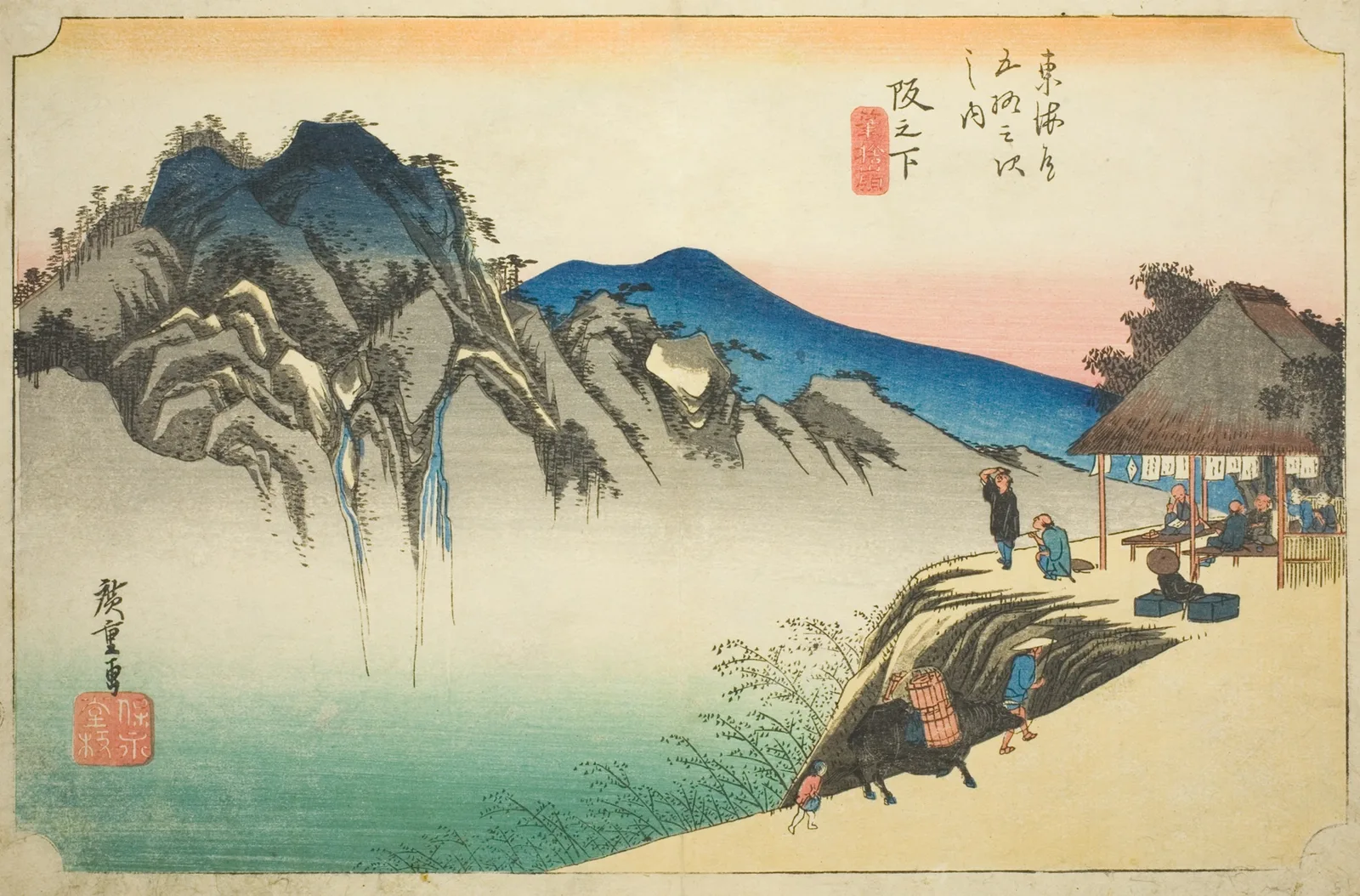
The Fifty-three Stations of the Tokaido (Hoeido edition) ・ 49
Fudesute Mountain near Sakanoshita
東海道五拾三次之内 阪之下 筆捨嶺
Travelers look out from a teahouse at Sakanoshita, at the foot of Suzuka Pass, toward Mount Fudesute with its strange rocks. The highlight is the contrast between the two waterfalls running down the rock face and the gently overlapping mountains in pale colors in the distance.
- Artist
- Utagawa Hiroshige
- Date
- c. 1833-34 (Tenpo 4-5)
- Medium / format
- Woodblock print (ukiyo-e)
- Series
- The Fifty-three Stations of the Tokaido (Hoeido edition) 55 prints
- Place depicted
- Sakanoshita-juku(Mie)
About this work
In the left half of the picture, a craggy rocky mountain is drawn large. Pines cling to the mountainside and two waterfalls run down in white. The valley is wrapped in mist, so that only the rocky mountain seems to float up. The rock is distinguished through ink shading and sharp lines, and the parts left white here and there set off the sheer rock faces.
On the cliff at right is a teahouse, where customers sit looking at the mountain. A traveler also stands at the edge of the cliff, absorbed in the view. On the road below, a packhorse driver and a horse with a load climb the slope. The teahouse stands jutting out over the cliff, an ideal place to view the mountain. The road winds down along the edge of the cliff.
The name Fudesute (Brush-Throwing) Mountain comes from a legend that the Muromachi-period painter Kano Motonobu tried to paint this mountain but could not, and threw away his brush. The Tokyo Fuji Art Museum identifies this mountain as the one called Iwane-yama. Set beside the gentle indigo mountain at the back, the steepness of Mount Fudesute's form stands out. The sky is pale yellow above, with a pale crimson at the edge of the mountains.
The place today
In the late Edo period, Sakanoshita-juku had three honjin, one waki-honjin, and 48 hatago. Sites of the Matsuya, Umeya, and Otakeya honjin remain, and the gate of Matsuya was moved to the kitchen entrance of Hoan-ji Temple and is a cultural property of Kameyama City. Mount Fudesute is designated a place of scenic beauty of Kameyama City.
Where can I see it?
Exhibitions change over time. Check each museum's exhibition information before you visit.
Museums that hold this work
- Tokyo National MuseumMuseum's page for this work (opens in a new tab)
Taito City, Tokyo Accession no. A-12499-54
Museums that hold this series (please check the museum's website for whether it holds this print)
- Shizuoka City Tokaido Hiroshige Museum of Art
Shimizu Ward, Shizuoka
All prints of the Hoeido edition were shown in the museum's collection exhibition Fifty-three Stations of the Tokaido (2024-25)
Museums abroad
- Art Institute of ChicagoMuseum's page for this work (opens in a new tab)
Chicago Accession no. 1925.3556
Frequently asked questions
- Who painted The Fifty-three Stations of the Tokaido: Fudesute Mountain near Sakanoshita, and when?
- The Fifty-three Stations of the Tokaido: Fudesute Mountain near Sakanoshita is by Utagawa Hiroshige, made in c. 1833-34 (Tenpo 4-5). Medium: Woodblock print (ukiyo-e).
- What place does The Fifty-three Stations of the Tokaido: Fudesute Mountain near Sakanoshita show?
- It shows Sakanoshita-juku (Mie).
- Where can I see The Fifty-three Stations of the Tokaido: Fudesute Mountain near Sakanoshita?
- It is held by Tokyo National Museum, Tokyo Fuji Art Museum, National Diet Library. Exhibitions change, so check each museum's information before you visit.
Sources and references
- Art Institute of Chicago: Sakanoshita: Peak of Fudesute Mountain (Sakanoshita, Fudesute mine) (opens in a new tab) (checked 2026-10-18)
- ColBase(東京国立博物館): A-12499-54 (opens in a new tab) (checked 2026-10-18)
- 東京富士美術館 収蔵品: 東海道五拾三次之内 阪之下 筆捨嶺 (opens in a new tab) (checked 2026-10-18)
- 国立国会図書館デジタルコレクション: 東海道五拾三次 阪之下・筆捨嶺 (opens in a new tab) (checked 2026-10-18)
You may also like
More from Mie
Discover more of the same region on our sister sites.
Matsuri Biyori
Festivals in Mie
- Toride Shrine Kujirabune Whale Boat Event
- Ueno Tenjin Festival Danjiri Float Event
- Kuwana Ishidori Festival Saisha Float Event
- Katte Jinja no Shinji Odori