The Fifty-three Stations of the Tokaido (Hoeido edition) ・ 54
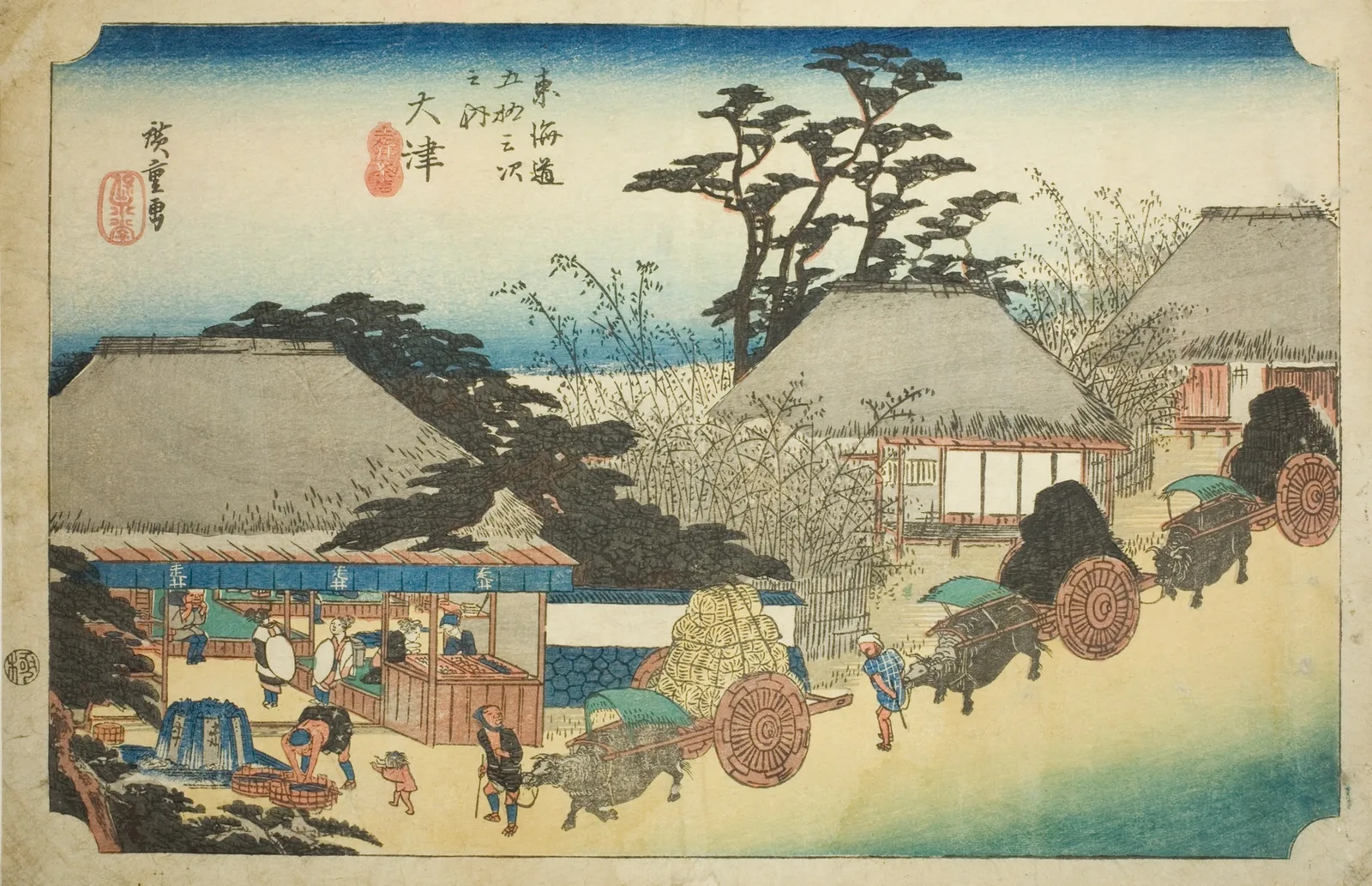
The Hashirii Teahouse at Otsu
東海道五拾三次之内 大津 走井茶店
Three ox carts loaded with rice bales and firewood descend in a line in front of a teahouse beside Hashirii, a spring at the foot of Osaka-yama. The highlights are the water overflowing from the well and the row of large wheels of the slowly advancing ox carts.
- Artist
- Utagawa Hiroshige
- Date
- c. 1833-34 (Tenpo 4-5)
- Medium / format
- Woodblock print (ukiyo-e)
- Series
- The Fifty-three Stations of the Tokaido (Hoeido edition) 55 prints
- Place depicted
- Otsu-juku(Shiga)
About this work
At the eaves of the teahouse at the lower left, water gushes vigorously from a well. Hashirii means a well that wells up with force. Hashirii mochi, made with this water, was popular as a travel souvenir. The water of the well overflows as if rising from inside the stonework, and the force is expressed with white lines. At the teahouse the shop people are busy, and a child can be seen in front of the shop.
On the highway, three ox carts loaded with rice bales and firewood continue with gaps between them. The circles of the large wheels line up at equal intervals, creating a pleasant rhythm in the picture. The figures leading the oxen are also drawn, conveying the weight of the loaded carts. A cover like a sunshade is hung over the oxen's backs.
Hashirii lay in the mountain pass of Osaka-yama between Otsu-juku and Kyoto. According to the Tokyo Fuji Art Museum, the road at Osaka-yama easily became muddy with spring water, and carrying loads by ox cart was hard work. Beyond this mountain lies Sanjo Ohashi in Kyoto, the end of the series. The teahouse and houses behind are thatched, and groves of pines and bamboo grow behind them.
The place today
The Hashirii well remains as the well curb of Hashirii on the grounds of Gesshin-ji Temple in Otani-cho, Otsu City. Gesshin-ji was the villa of the painter Hashimoto Kansetsu, and in the Edo period it was a teahouse bustling with travelers on the Tokaido. At nearby Osaka Pass stands a monument to the site of the Osakayama checkpoint.
Where can I see it?
Exhibitions change over time. Check each museum's exhibition information before you visit.
Museums that hold this work
- Tokyo National MuseumMuseum's page for this work (opens in a new tab)
Taito City, Tokyo Accession no. A-12499-60
Museums that hold this series (please check the museum's website for whether it holds this print)
- Shizuoka City Tokaido Hiroshige Museum of Art
Shimizu Ward, Shizuoka
All prints of the Hoeido edition were shown in the museum's collection exhibition Fifty-three Stations of the Tokaido (2024-25)
Museums abroad
- Art Institute of ChicagoMuseum's page for this work (opens in a new tab)
Chicago Accession no. 1925.3562
Frequently asked questions
- Who painted The Fifty-three Stations of the Tokaido: The Hashirii Teahouse at Otsu, and when?
- The Fifty-three Stations of the Tokaido: The Hashirii Teahouse at Otsu is by Utagawa Hiroshige, made in c. 1833-34 (Tenpo 4-5). Medium: Woodblock print (ukiyo-e).
- What place does The Fifty-three Stations of the Tokaido: The Hashirii Teahouse at Otsu show?
- It shows Otsu-juku (Shiga).
- Where can I see The Fifty-three Stations of the Tokaido: The Hashirii Teahouse at Otsu?
- It is held by Tokyo National Museum, Tokyo Fuji Art Museum, National Diet Library. Exhibitions change, so check each museum's information before you visit.
Sources and references
- Art Institute of Chicago: Otsu: Hashirii Teahouse (Otsu, Hashirii chaya) (opens in a new tab) (checked 2026-10-18)
- ColBase(東京国立博物館): A-12499-60 (opens in a new tab) (checked 2026-10-18)
- 東京富士美術館 収蔵品: 東海道五拾三次之内 大津 走井茶店 (opens in a new tab) (checked 2026-10-18)
- 国立国会図書館デジタルコレクション: 東海道五拾三次 大津・走井茶店 (opens in a new tab) (checked 2026-10-18)
You may also like
More from Shiga
Discover more of the same region on our sister sites.
Matsuri Biyori
Festivals in Shiga
- Nagahama Hikiyama Festival Float Event
- Otsu Festival Hikiyama Float Event
- Omi Konan no San'yare Odori
- Omi no Kenketo Matsuri Naginata Furi