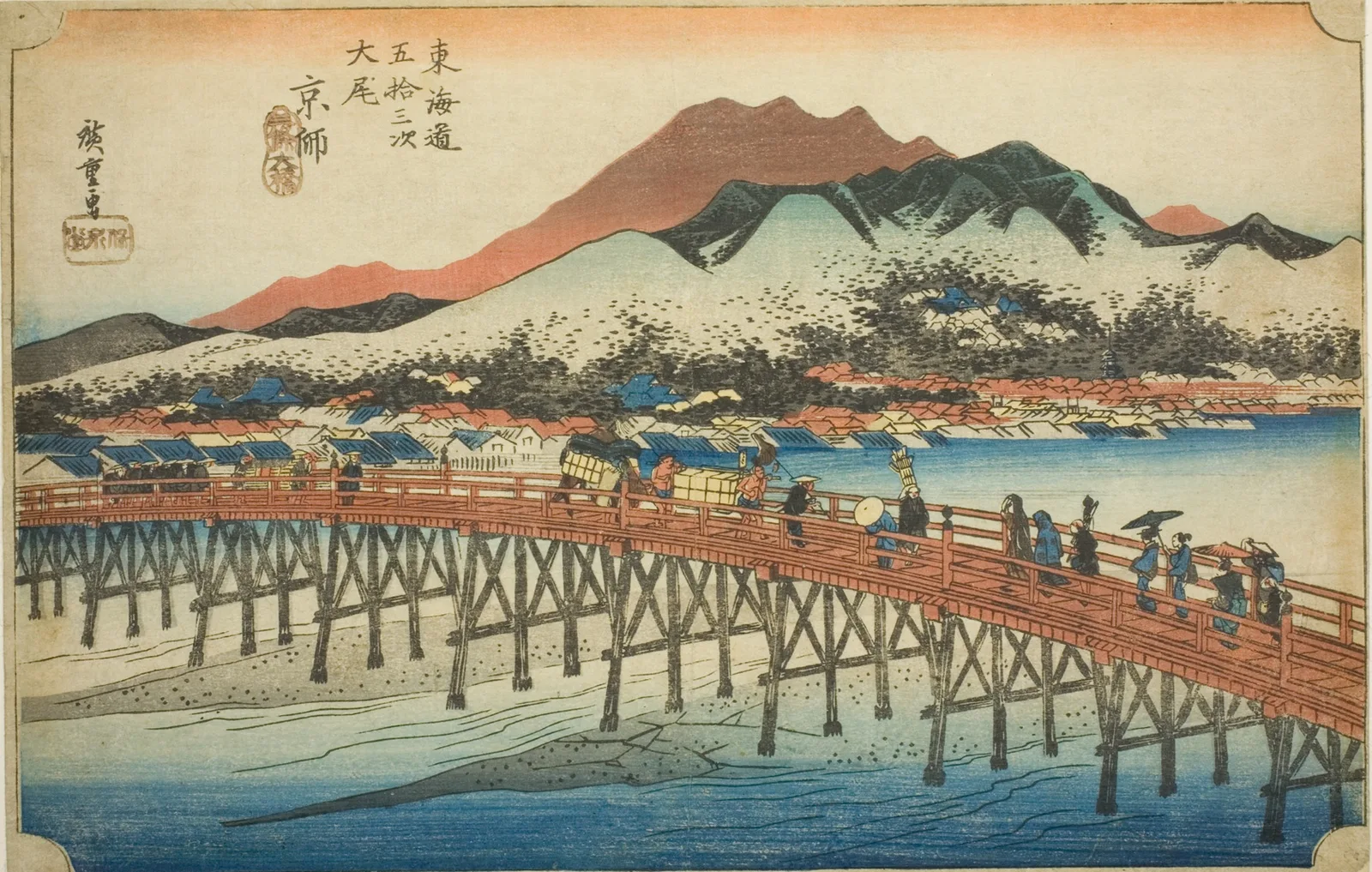
The Fifty-three Stations of the Tokaido (Hoeido edition) ・ 55
The Great Sanjo Bridge in Kyoto
東海道五拾三次之内 京師 三条大橋
Sanjo Ohashi in Kyoto, the end of the Tokaido, is drawn against the Higashiyama mountains. Palanquins and travelers going back and forth on the bridge, and women in kazuki, convey that the long journey from Edo has at last arrived at the capital.
- Artist
- Utagawa Hiroshige
- Date
- c. 1833-34 (Tenpo 4-5)
- Medium / format
- Woodblock print (ukiyo-e)
- Series
- The Fifty-three Stations of the Tokaido (Hoeido edition) 55 prints
- Place depicted
- Sanjo Ohashi Bridge(Kyoto)
About this work
Sanjo Ohashi, spanning the Kamo River, extends long from the left of the picture to the right. On the bridge, various people come and go: palanquin bearers, people carrying loads, women in kazuki (a garment worn by women going out, with a robe pulled over the head), and people holding umbrellas. The railings of the bridge are painted a color close to vermilion, contrasting with the blue of the river. The wooden bracing of the piers lines up regularly, and the bridge spans long over the shallow riverbed.
Beyond the river spreads the townscape of Kyoto, and the Higashiyama mountains overlap behind it. The tallest mountain is printed in a reddish color, and green trees are dotted on the nearer ranges. The Tokyo Fuji Art Museum takes these mountains to be the Thirty-six Peaks of Higashiyama. The roofs of the houses are distinguished in indigo and red.
The 55 prints of the Hoeido edition, which began at Nihonbashi in Edo, end at this Sanjo Ohashi. In this print the piers are built of wood, but according to the Tokyo Fuji Art Museum, the piers of the actual Sanjo Ohashi were of stone. Sanjo Ohashi was greatly rebuilt in 1590 (Tensho 18) on the orders of Toyotomi Hideyoshi, and in the Edo period it was a kogi-bashi, a bridge managed by the shogunate.
The place today
Sanjo Ohashi took its present form in a 1950 (Showa 25) reconstruction and is 74 meters long. Its giboshi (ornamental caps on the railing posts) mix those of the Tensho and Showa periods, and inscriptions convey the scale of the Tensho rebuilding. On the north side of the west end remains a stone pillar used in the Tensho rebuilding.
Where can I see it?
Exhibitions change over time. Check each museum's exhibition information before you visit.
Museums that hold this work
- Tokyo National MuseumMuseum's page for this work (opens in a new tab)
Taito City, Tokyo Accession no. A-12499-61
Museums that hold this series (please check the museum's website for whether it holds this print)
- Shizuoka City Tokaido Hiroshige Museum of Art
Shimizu Ward, Shizuoka
All prints of the Hoeido edition were shown in the museum's collection exhibition Fifty-three Stations of the Tokaido (2024-25)
Museums abroad
- Art Institute of ChicagoMuseum's page for this work (opens in a new tab)
Chicago Accession no. 1925.3563
Frequently asked questions
- Who painted The Fifty-three Stations of the Tokaido: The Great Sanjo Bridge in Kyoto, and when?
- The Fifty-three Stations of the Tokaido: The Great Sanjo Bridge in Kyoto is by Utagawa Hiroshige, made in c. 1833-34 (Tenpo 4-5). Medium: Woodblock print (ukiyo-e).
- What place does The Fifty-three Stations of the Tokaido: The Great Sanjo Bridge in Kyoto show?
- It shows Sanjo Ohashi Bridge (Kyoto).
- Where can I see The Fifty-three Stations of the Tokaido: The Great Sanjo Bridge in Kyoto?
- It is held by Tokyo National Museum, Tokyo Fuji Art Museum, National Diet Library. Exhibitions change, so check each museum's information before you visit.
Sources and references
- Art Institute of Chicago: Kyoto: The Great Bridge at Sanjo (Keishi, Sanjo ohashi) (opens in a new tab) (checked 2026-10-18)
- ColBase(東京国立博物館): A-12499-61 (opens in a new tab) (checked 2026-10-18)
- 東京富士美術館 収蔵品: 東海道五拾三次之内 京師 三条大橋 (opens in a new tab) (checked 2026-10-18)
- 国立国会図書館デジタルコレクション: 東海道五拾三次 大尾 京師・三條大橋 (opens in a new tab) (checked 2026-10-18)
You may also like
More from Kyoto
Discover more of the same region on our sister sites.
Matsuri Biyori
Festivals in Kyoto
- Yamahoko, the float ceremony of the Kyoto Gion festival
- Kyoto no Rokusai Nenbutsu
- Yasuraibana
- Kuta no Hanagasa Odori