The Sixty-nine Stations of the Kisokaido ・ 40
Suhara
木曽海道六拾九次之内 須原
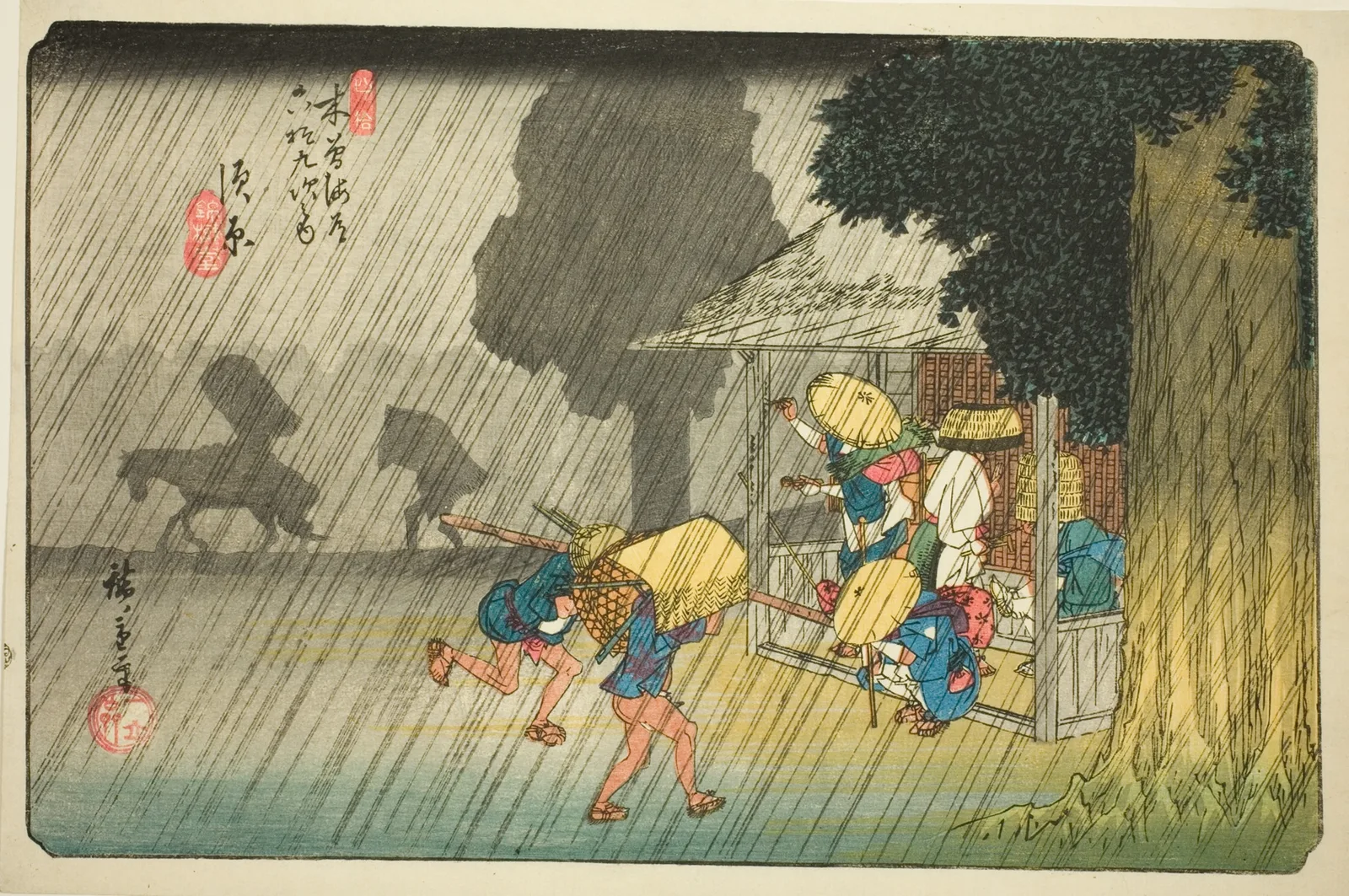
A violent sudden shower hits Suhara. Travelers dash into a small shrine at the roadside, and men carrying loads hurry through the rain. Countless slanting streaks of rain cover the whole picture in gray.
- Artist
- Utagawa Hiroshige
- Date
- c. 1835-38 (Tenpo 6-9)
- Medium / format
- Woodblock print (ukiyo-e)
- Series
- The Sixty-nine Stations of the Kisokaido 71 prints
- Place depicted
- Suhara-juku(Nagano)
About this work
Travelers in broad hats huddle in a small shrine at the base of a great tree at right, peering out through the lattice. In the foreground two men carrying loads on long poles run bent forward, and at left rear the shadows of a person on horseback and a packhorse driver float beyond the rain.
Streaks of rain carved in fine lines fill the picture diagonally, and the distant trees, people, and horses become only gray shadows. The green of the ground and the brightness of the shrine stand out in the dark rain, vividly conveying the movement of people flustered by the sudden evening shower.
Suhara was a post town along the Kiso River, and is said to have moved to its present location in 1717 (Kyoho 2) after being washed away by a flood. It lay in the middle of the Kiso Road, a place where travelers also rested to avoid rain or sun. A record of 1843 (Tenpo 14) gives it as a small post town with about 104 houses and 24 inns.
This is by Hiroshige, and its rendering of rain, which recalls Shono in the Tokaido series, is regarded as its highlight. The Metropolitan Museum of Art also has the same design, with a fine impression showing the rain lines clearly. By distinguishing the expressions and postures of those taking shelter, it skillfully captures a moment of travel subject to the weather.
The place today
In the townscape of Suhara-juku, mizubune, water troughs hollowed from logs, still remain with clear spring water flowing through them. Nearby, the Jokenji Temple's main hall, priests' quarters, and gate are designated Important Cultural Properties. The post town is also known as the setting of Koda Rohan's novel Furyu Butsu.
Where can I see it?
Exhibitions change over time. Check each museum's exhibition information before you visit.
Museums that hold this work
- Tokyo National MuseumMuseum's page for this work (opens in a new tab)
Taito City, Tokyo Accession no. A-12499-107
- National Diet LibraryMuseum's page for this work (opens in a new tab)
Chiyoda City, Tokyo Accession no. 寄別2-2-1-5
Included in Kisokaido Rokujukyu-tsugi
Museums abroad
- Art Institute of ChicagoMuseum's page for this work (opens in a new tab)
Chicago Accession no. 1925.3719
- The Metropolitan Museum of ArtMuseum's page for this work (opens in a new tab)
New York Accession no. JP2868
Frequently asked questions
- Who painted The Sixty-nine Stations of the Kisokaido: Suhara, and when?
- The Sixty-nine Stations of the Kisokaido: Suhara is by Utagawa Hiroshige, made in c. 1835-38 (Tenpo 6-9). Medium: Woodblock print (ukiyo-e).
- What place does The Sixty-nine Stations of the Kisokaido: Suhara show?
- It shows Suhara-juku (Nagano).
- Where can I see The Sixty-nine Stations of the Kisokaido: Suhara?
- It is held by Tokyo National Museum, National Diet Library. Exhibitions change, so check each museum's information before you visit.
Sources and references
- Art Institute of Chicago: No. 40: Suhara, from the series "Sixty-nine Stations of the Kisokaido (Kisokaido rokujukyu tsugi no uchi)" (opens in a new tab) (checked 2026-10-19)
- ColBase(東京国立博物館): 木曽海道六拾九次之内 須原 (opens in a new tab) (checked 2026-10-19)
- 国立国会図書館デジタルコレクション: 四拾 木曽海道六拾九次之内須原 (opens in a new tab) (checked 2026-10-19)
- The Metropolitan Museum of Art: Suhara, from The Sixty-nine Stations of the Kisokaidō (opens in a new tab) (checked 2026-10-19)
- Wikipedia: 木曽海道六十九次 (opens in a new tab) (checked 2026-10-19)
You may also like
More from Nagano
Discover more of the same region on our sister sites.