One Hundred Famous Views of Edo ・ 3
Hibiya and Soto-Sakurada from Yamashita-cho
名所江戸百景 山下町日比谷外さくら田
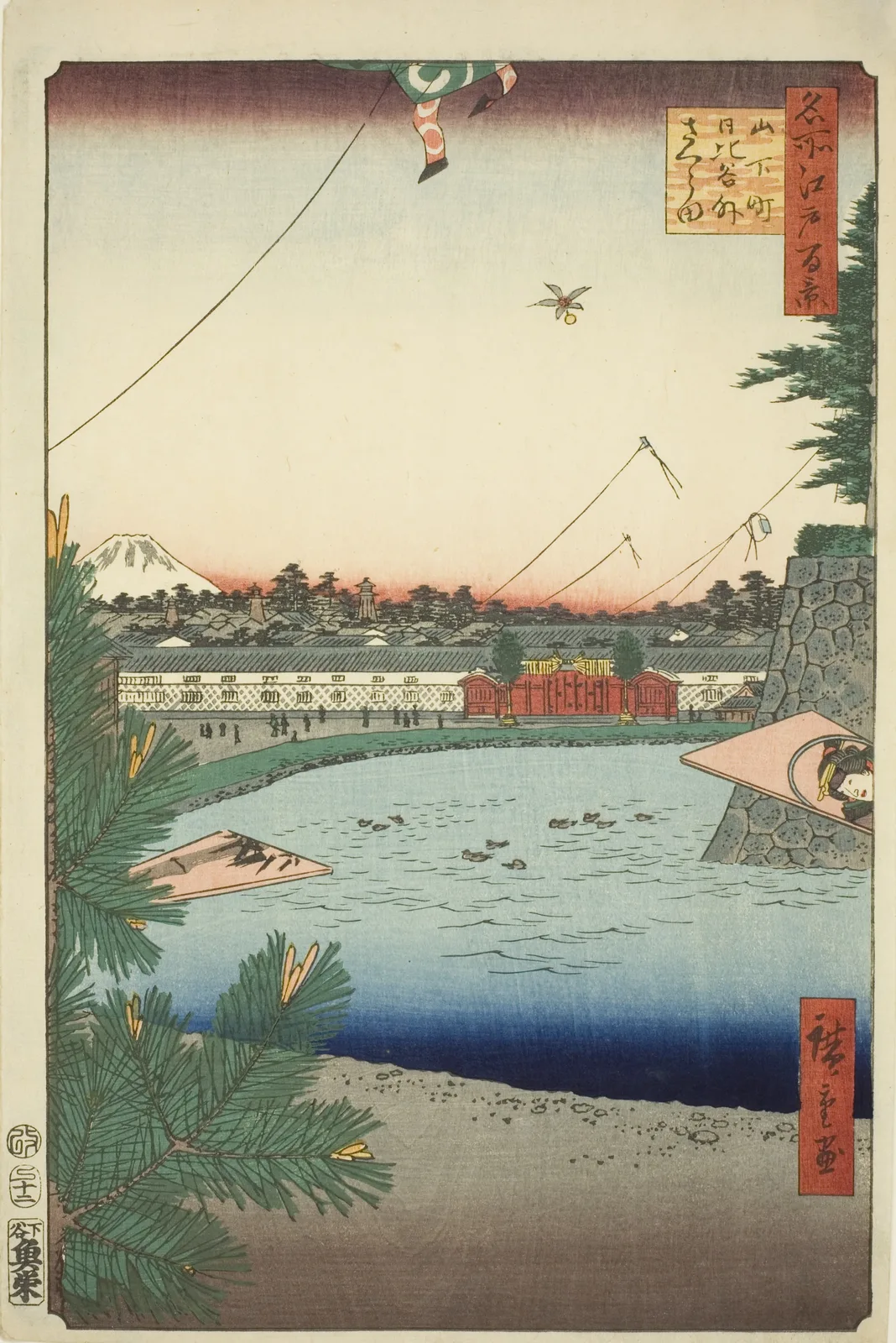
This print views Hibiya at New Year from the Yamashita-cho side, across the moat. A pine branch from a New Year decoration and a battledore are set large in the foreground, kites and shuttlecocks fill the sky, and beyond the moat appear daimyo mansions and, in the distance, Mount Fuji.
- Artist
- Utagawa Hiroshige
- Date
- December 1857 (Ansei 4)
- Medium / format
- Woodblock print (ukiyo-e)
- Series
- One Hundred Famous Views of Edo 119 prints
- Seen in the distance
- Mount Fuji
About this work
At lower left is a branch of New Year pine, at right the tip of a battledore decorated with a picture of a woman, and in the sky the legs of a kite shaped like a servant and a shuttlecock drift. Beyond them the outer moat of Edo Castle spreads out with ducks floating on it; on the far bank are the white walls and red gate of a daimyo mansion, and farther back rows of houses and Mount Fuji.
Objects in the foreground are boldly cropped at the edge of the picture, with the distant view peeking out between them, in a close-up composition. The deep green of the pine needles, the indigo of the moat and the red of a sky reminiscent of sunset add a festive New Year brightness.
Yamashita-cho was a townspeople's quarter outside Yamashita Gate of Edo Castle, facing the daimyo mansions of Hibiya and Soto-Sakurada across the moat. It shows clearly how in Edo samurai and townspeople districts were separated by a single moat.
This is the third print of the Spring section. The wit characteristic of the series is said to lie in expressing New Year pastimes such as battledore and kite flying through the tools alone, without depicting anyone playing. The censor's seal dates it to December 1857 (Ansei 4), so it is thought to have been put on sale for the following New Year. The way it crops foreground objects large was later received with astonishment by Western artists.
The place today
The moat in the picture is Hibiya Moat, which still holds water along the eastern edge of the Imperial Palace Outer Garden. The sites of the daimyo mansions on the far bank became Hibiya Park, opened in 1903, and other areas, and the Yamashita-cho district is now a busy area leading to Yurakucho and Ginza.
Where can I see it?
Exhibitions change over time. Check each museum's exhibition information before you visit.
Museums that hold this work
- Tokyo National MuseumMuseum's page for this work (opens in a new tab)
Taito City, Tokyo Accession no. A-12499-321
- National Diet LibraryMuseum's page for this work (opens in a new tab)
Chiyoda City, Tokyo Accession no. 寄別1-8-2-1イ
Another impression is also held under Yoribetsu 1-8-2-1 (pid 1312239)
Museums abroad
Frequently asked questions
- Who painted One Hundred Famous Views of Edo: Hibiya and Soto-Sakurada from Yamashita-cho, and when?
- One Hundred Famous Views of Edo: Hibiya and Soto-Sakurada from Yamashita-cho is by Utagawa Hiroshige, made in December 1857 (Ansei 4). Medium: Woodblock print (ukiyo-e).
- What place does One Hundred Famous Views of Edo: Hibiya and Soto-Sakurada from Yamashita-cho show?
- It shows Hibiya, Edo Castle (Tokyo).
- Where can I see One Hundred Famous Views of Edo: Hibiya and Soto-Sakurada from Yamashita-cho?
- It is held by Tokyo National Museum, National Diet Library. Exhibitions change, so check each museum's information before you visit.
Sources and references
- Art Institute of Chicago: Hibiya and Soto-Sakurada from Yamashita-cho (Yamashita-cho Hibiya Soto-Sakurada), from the series "One Hundred Famous Views of Edo (Meisho Edo hyakkei)" (opens in a new tab) (checked 2026-10-19)
- ColBase(東京国立博物館): 名所江戸百景 山下町日比谷外さくら田 (opens in a new tab) (checked 2026-10-19)
- 国立国会図書館デジタルコレクション: 名所江戸百景 山下町日比谷外さくら田 (opens in a new tab) (checked 2026-10-19)
You may also like
More from Tokyo
Discover more of the same region on our sister sites.