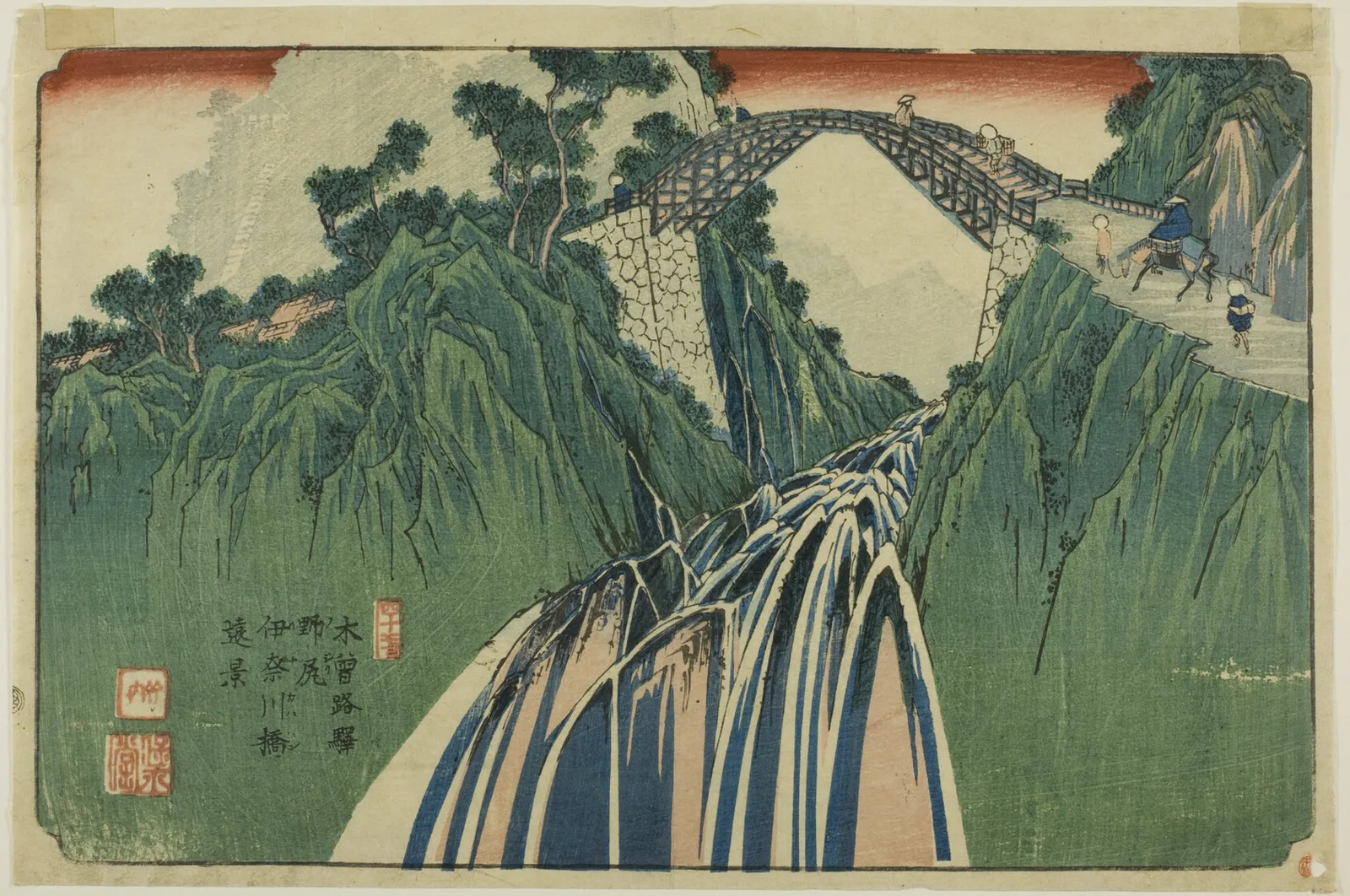
The Sixty-nine Stations of the Kisokaido ・ 41
Distant View of the Ina River Bridge at Nojiri
木曽路駅 野尻 伊奈川橋遠景
Eisen's print looks up from the bottom of the valley at the bridge over the Ina River near Nojiri. Beyond a violent rapids, a bow-shaped wooden bridge supported by stone walls spans high above, with travelers crossing it.
- Artist
- Keisai Eisen
- Date
- c. 1835-36 (Tenpo 6-7)
- Medium / format
- Woodblock print (ukiyo-e)
- Series
- The Sixty-nine Stations of the Kisokaido 71 prints
About this work
At the lower center of the picture, the water of the Ina River crashes white as it tumbles toward the viewer. High above it, a bow-shaped wooden bridge projects from the stone walls on both banks, and travelers on horseback and people carrying loads come and go on the bridge and on the road at right.
The steep rocky cliffs at both sides are painted deep green, with trees clinging to them. The indigo and white of the current and the red gradations of the sky are vivid, and the bold composition looking up from below strongly impresses the height of the bridge over the deep valley.
Nojiri was one of the eleven Kiso post towns, known for its winding street called Nanamagari ("seven bends"). The Ina River is a tributary of the Kiso River, and given the steepness of the valley, its bridge was probably one of the difficult points of the journey. The length of the post town street is said to be second only to Narai among the eleven Kiso post towns, and with about 108 houses it was a large post town in the middle of the Kiso Road.
Drawn by Eisen, its title is given as "Kiso Road Station," a different way of writing from Hiroshige's designs. Many of Eisen's designs are unsigned, and this one has no seal either. The bold perspective of placing the rapids large in front and the bridge small and distant is thought to show Eisen's individuality.
The place today
Nojiri-juku lost most of its old buildings to fires, but the winding street Nanamagari still remains. Beyond the post town lies Kakizore Gorge, known for its autumn leaves, and the path tracing the Nakasendo along the Kiso River continues. The Ina River flows into the Kiso River in Okuwa Village.
Where can I see it?
Exhibitions change over time. Check each museum's exhibition information before you visit.
Museums that hold this work
- Tokyo National MuseumMuseum's page for this work (opens in a new tab)
Taito City, Tokyo Accession no. A-12499-108
- National Diet LibraryMuseum's page for this work (opens in a new tab)
Chiyoda City, Tokyo Accession no. 寄別2-2-1-5
Included in Kisokaido Rokujukyu-tsugi
Museums abroad
- Art Institute of ChicagoMuseum's page for this work (opens in a new tab)
Chicago Accession no. 1990.607.191
Frequently asked questions
- Who painted The Sixty-nine Stations of the Kisokaido: Distant View of the Ina River Bridge at Nojiri, and when?
- The Sixty-nine Stations of the Kisokaido: Distant View of the Ina River Bridge at Nojiri is by Keisai Eisen, made in c. 1835-36 (Tenpo 6-7). Medium: Woodblock print (ukiyo-e).
- What place does The Sixty-nine Stations of the Kisokaido: Distant View of the Ina River Bridge at Nojiri show?
- It shows Nojiri-juku, Inagawa Bridge (Nagano).
- Where can I see The Sixty-nine Stations of the Kisokaido: Distant View of the Ina River Bridge at Nojiri?
- It is held by Tokyo National Museum, National Diet Library. Exhibitions change, so check each museum's information before you visit.
Sources and references
- Art Institute of Chicago: No. 41: Distant View of the Ina River Bridge at Nojiri (Yonjuichi: Noriji Inagawabashi enkei), from the series "[Sixty-nine Stations of the] Kisokaido" (opens in a new tab) (checked 2026-10-19)
- ColBase(東京国立博物館): 木曽路駅 野尻 伊奈川橋遠景 (opens in a new tab) (checked 2026-10-19)
- 国立国会図書館デジタルコレクション: 四十壱 木曽路駅野尻伊奈川橋遠景 (opens in a new tab) (checked 2026-10-19)
- Wikipedia: 木曽海道六十九次 (opens in a new tab) (checked 2026-10-19)
You may also like
More from Nagano
Discover more of the same region on our sister sites.