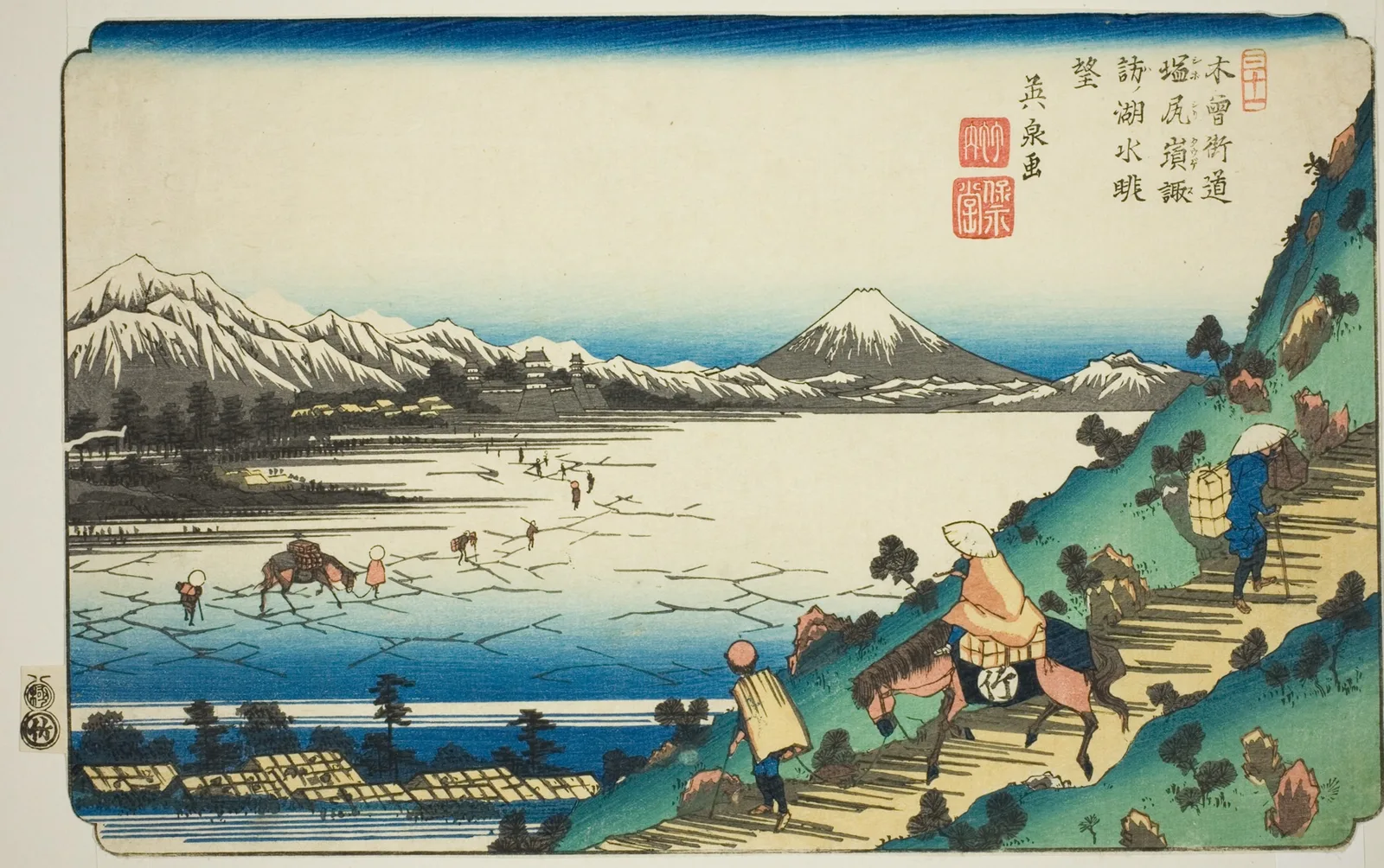
The Sixty-nine Stations of the Kisokaido ・ 31
View of Lake Suwa from Shiojiri Pass
木曽街道 塩尻嶺諏訪ノ湖水眺望
Eisen's print looks down on the frozen Lake Suwa from the Shiojiri Pass. Beyond the lake, where people and horses cross the ice, snowy mountains and Mount Fuji line up, with travelers on the pass road placed in the foreground to convey a broad winter view of Shinano.
- Artist
- Keisai Eisen
- Date
- c. 1835-36 (Tenpo 6-7)
- Medium / format
- Woodblock print (ukiyo-e)
- Series
- The Sixty-nine Stations of the Kisokaido 71 prints
- Seen in the distance
- Mount Fuji
About this work
Down the steep pass road at right foreground come a traveler on a loaded horse and people carrying loads. To their left spreads Lake Suwa, and horses and people walk across the white frozen surface. On the far shore can be seen a castle and townscape, and beyond them a chain of snow-capped mountains and Mount Fuji.
The lake surface is white with fine lines cut in to show cracks in the ice, leaving indigo water only near the shore. The mountains are drawn in pale gray and white, and the sky is shaded from indigo at the top to white below. By placing the green slope of the pass diagonally in the foreground, the artist creates height through its contrast with the breadth of lake and mountains.
The Shiojiri Pass lies between Shimosuwa and Shiojiri, and the view of Lake Suwa and Mount Fuji from the pass was considered among the finest on the Nakasendo. In winter Lake Suwa froze over entirely, and it is said that people and goods sometimes crossed on the ice. The castle on the far shore is thought to depict Takashima Castle.
This is one of the designs by Keisai Eisen, who handled the first half of the series. As the title "View" indicates, its subject is the scenery from the pass itself. The same design is also at the Art Institute of Chicago and the Metropolitan Museum of Art, and it is counted among Eisen's representative landscapes.
The place today
The site of Shiojiri-juku is in Shiojiri-cho, Shiojiri, where the Ono family residence, a former inn, survives as an Important Cultural Property. On the Shiojiri Pass east of the post town there is an observation deck, from which on clear days one can see Lake Suwa, the Yatsugatake range, Mount Fuji, and the Northern Alps. Part of the pass road can be walked as the old Nakasendo.
Where can I see it?
Exhibitions change over time. Check each museum's exhibition information before you visit.
Museums that hold this work
- Tokyo National MuseumMuseum's page for this work (opens in a new tab)
Taito City, Tokyo Accession no. A-12499-98
- National Diet LibraryMuseum's page for this work (opens in a new tab)
Chiyoda City, Tokyo Accession no. 寄別2-2-1-5
Included in Kisokaido Rokujukyu-tsugi
Museums abroad
- Art Institute of ChicagoMuseum's page for this work (opens in a new tab)
Chicago Accession no. 1939.2228
- The Metropolitan Museum of ArtMuseum's page for this work (opens in a new tab)
New York Accession no. JP1419
Frequently asked questions
- Who painted The Sixty-nine Stations of the Kisokaido: View of Lake Suwa from Shiojiri Pass, and when?
- The Sixty-nine Stations of the Kisokaido: View of Lake Suwa from Shiojiri Pass is by Keisai Eisen, made in c. 1835-36 (Tenpo 6-7). Medium: Woodblock print (ukiyo-e).
- What place does The Sixty-nine Stations of the Kisokaido: View of Lake Suwa from Shiojiri Pass show?
- It shows Shiojiri-juku, Lake Suwa (Nagano).
- Where can I see The Sixty-nine Stations of the Kisokaido: View of Lake Suwa from Shiojiri Pass?
- It is held by Tokyo National Museum, National Diet Library. Exhibitions change, so check each museum's information before you visit.
Sources and references
- Art Institute of Chicago: No. 31: View of Lake Suwa from Shiojiri Pass (Sanjuichi: Shiojiri toge Suwa no kosui chobo), from the series "[Sixty-nine Stations of the] Kisokaido" (opens in a new tab) (checked 2026-10-19)
- ColBase(東京国立博物館): 木曽街道 塩尻嶺諏訪ノ湖水眺望 (opens in a new tab) (checked 2026-10-19)
- 国立国会図書館デジタルコレクション: 三十一 木曽街道塩尻峠諏訪ノ湖水眺望 (opens in a new tab) (checked 2026-10-19)
- The Metropolitan Museum of Art: Lake Suwa from Shiojiri Pass (JP1419) (opens in a new tab) (checked 2026-10-19)
- Wikipedia: 木曽海道六十九次 (opens in a new tab) (checked 2026-10-19)
You may also like
More from Nagano
Discover more of the same region on our sister sites.