The Sixty-nine Stations of the Kisokaido ・ 30
Shimosuwa
木曽海道六拾九次之内 下諏訪
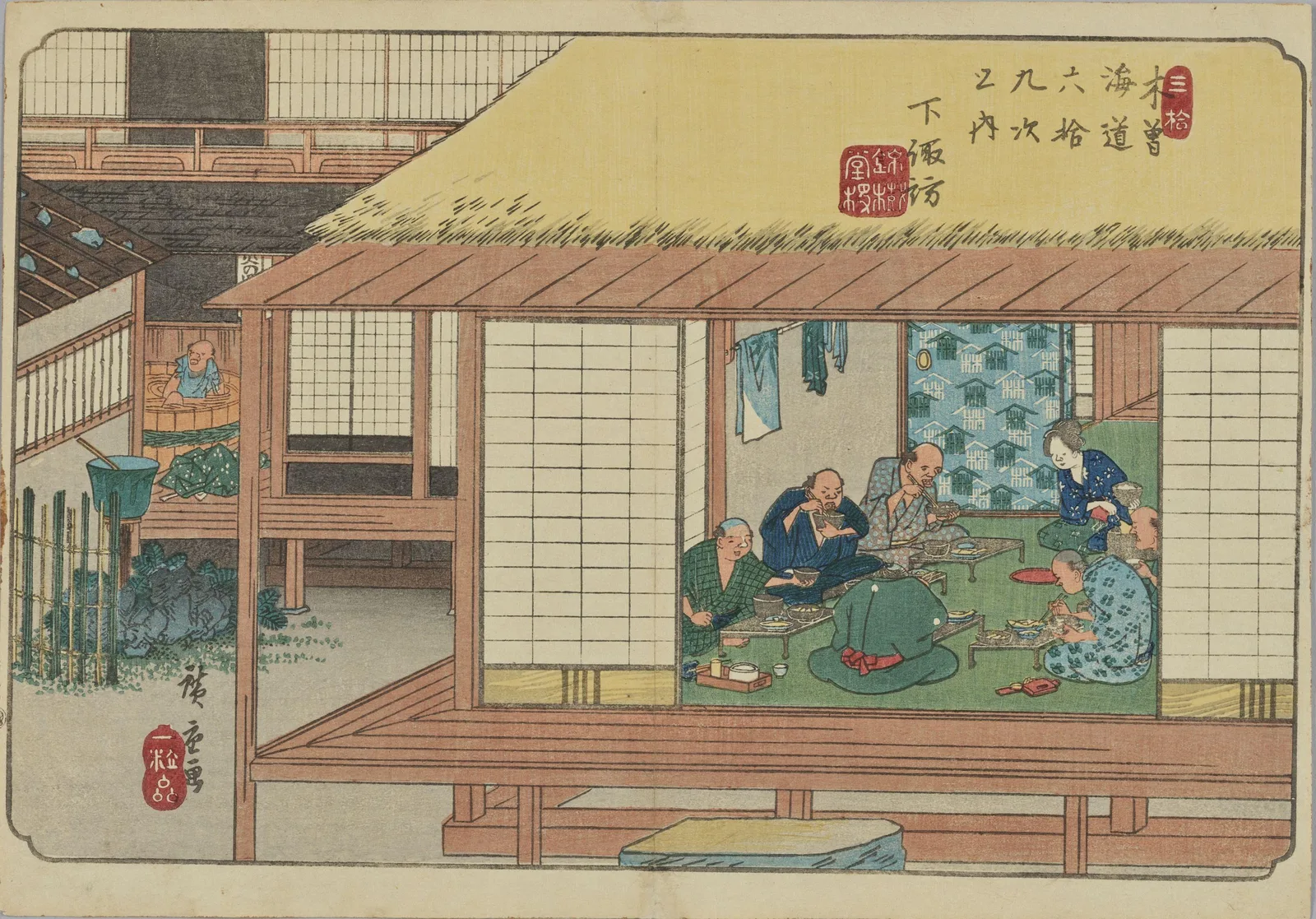
Hiroshige's print shows travelers gathered around dinner trays in a guest room of an inn at Shimosuwa. Guests relaxing behind open shoji screens and a figure soaking in a bath at the left rear convey the evening atmosphere of a post town with hot springs.
- Artist
- Utagawa Hiroshige
- Date
- c. 1835-38 (Tenpo 6-9)
- Medium / format
- Woodblock print (ukiyo-e)
- Series
- The Sixty-nine Stations of the Kisokaido 71 prints
- Place depicted
- Shimosuwa-juku(Nagano)
About this work
The center of the picture is the guest room of an inn, where four or five guests sit before their trays enjoying a meal behind the opened shoji. A serving woman attends to the guests, and cups and dishes are set out on the floor. At the left rear is a bathroom, and a person can be seen soaking in the tub. A veranda and garden are drawn in the foreground.
A large thatched roof covers the top of the picture, and the room below is cut out as if in a frame. The white of the shoji, the green of the tatami, and the brown of the pillars and veranda are neatly combined, and the blue pattern on the sliding doors at the back adds variety of color. The difference between the darkness outside and the brightness of the room conveys the night.
Shimosuwa was a temple town at the gates of the lower shrine of Suwa Taisha and a post town where the Nakasendo and the Koshu Kaido merged. Known as a post town with hot springs, it was probably a precious lodging where travelers who had crossed the difficult Wada Pass could bathe and relax.
This is a design by Utagawa Hiroshige. It is a rare print that depicts the interior of an inn rather than a landscape, showing the life of the post town up close. Hiroshige also drew the inside of inns in his Tokaido series, but here the subject is the relaxation typical of a hot-spring inn.
The place today
The site of Shimosuwa-juku is in Shimosuwa, where the townscape of the post town continues between Haruno-miya and Aki-no-miya of the lower shrine of Suwa Taisha. The Iwanami family honjin preserves its gate and garden and is also known as the inn where Princess Kazunomiya stayed. Hot springs such as the public bath Wata-no-yu continue to this day, and there is also a marker for the junction with the Koshu Kaido.
Where can I see it?
Exhibitions change over time. Check each museum's exhibition information before you visit.
Museums that hold this work
- Tokyo National MuseumMuseum's page for this work (opens in a new tab)
Taito City, Tokyo Accession no. A-12499-97
- National Diet LibraryMuseum's page for this work (opens in a new tab)
Chiyoda City, Tokyo Accession no. 寄別2-2-1-5
Included in Kisokaido Rokujukyu-tsugi
Museums abroad
Frequently asked questions
- Who painted The Sixty-nine Stations of the Kisokaido: Shimosuwa, and when?
- The Sixty-nine Stations of the Kisokaido: Shimosuwa is by Utagawa Hiroshige, made in c. 1835-38 (Tenpo 6-9). Medium: Woodblock print (ukiyo-e).
- What place does The Sixty-nine Stations of the Kisokaido: Shimosuwa show?
- It shows Shimosuwa-juku (Nagano).
- Where can I see The Sixty-nine Stations of the Kisokaido: Shimosuwa?
- It is held by Tokyo National Museum, National Diet Library. Exhibitions change, so check each museum's information before you visit.
Sources and references
- ColBase(東京国立博物館): 木曽海道六拾九次之内 下諏訪 (opens in a new tab) (checked 2026-10-19)
- 国立国会図書館デジタルコレクション: 三拾 木曽海道六拾九次之内下諏訪 (opens in a new tab) (checked 2026-10-19)
- Wikipedia: 木曽海道六十九次 (opens in a new tab) (checked 2026-10-19)
You may also like
More from Nagano
Discover more of the same region on our sister sites.