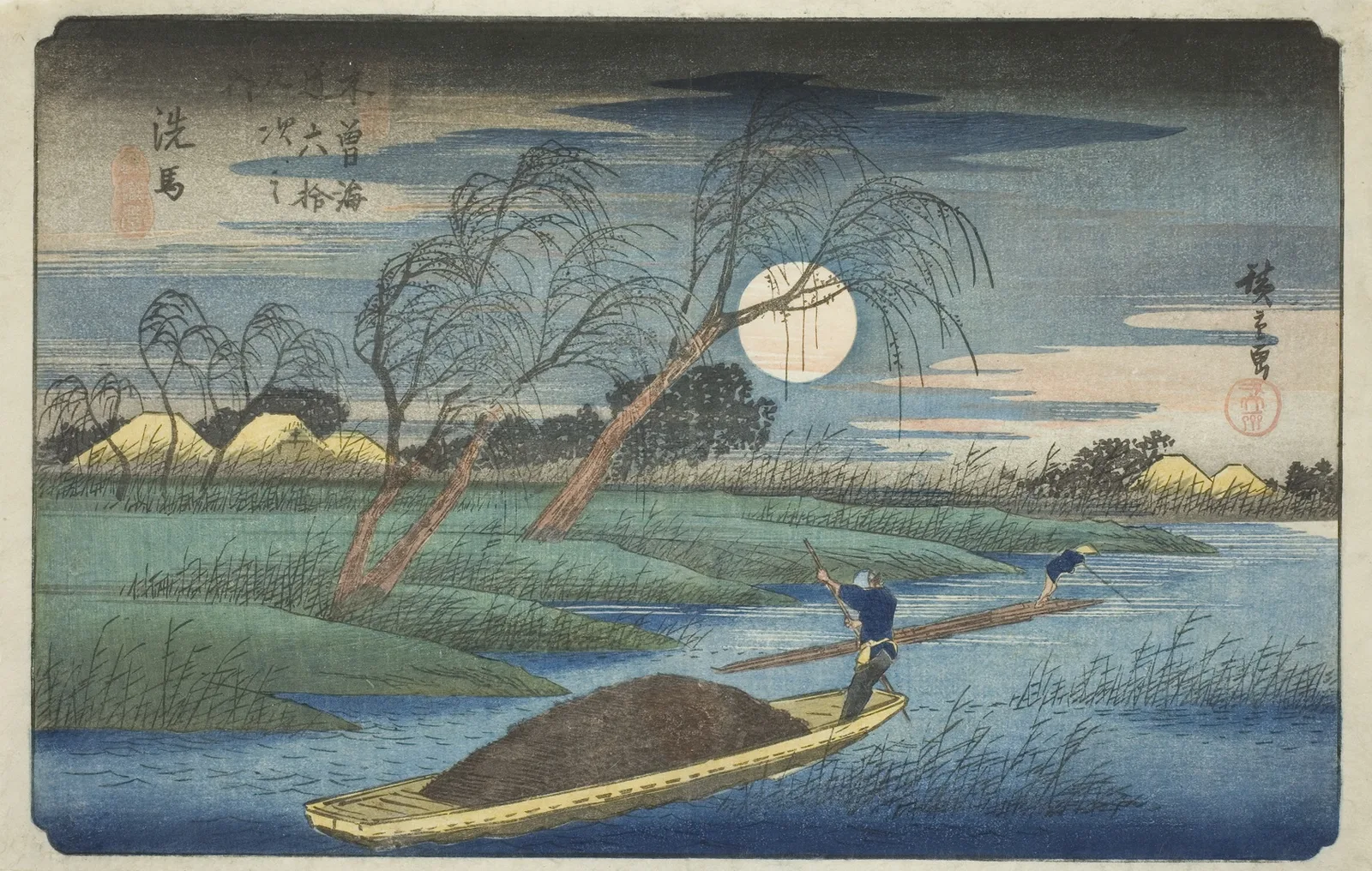
The Sixty-nine Stations of the Kisokaido ・ 32
Seba
木曽海道六拾九次之内 洗馬
This print of Seba shows a boat gliding slowly along a willow-lined riverbank on a full-moon night. Willows bending in the wind, a moon between clouds, and two boats on the water create a quiet and lonely night scene, regarded as one of the finest in the series.
- Artist
- Utagawa Hiroshige
- Date
- c. 1835-38 (Tenpo 6-9)
- Medium / format
- Woodblock print (ukiyo-e)
- Series
- The Sixty-nine Stations of the Kisokaido 71 prints
- Place depicted
- Seba-juku(Nagano)
About this work
On the river in the foreground, a boatman poles a boat loaded with what looks like brushwood toward the right rear. Beyond it another boat can be seen. On the bank at left stand several willows, their long branches streaming in the wind. Reeds grow along the shore, and in the embankment beyond are rows of thatched-roof houses.
In the sky, long horizontal clouds trail in layers of indigo and ink, and a white full moon floats in a gap between them. The river water is an indigo gradation, deepening toward the foreground. The fine lines of the willows, the horizontal flow of the clouds, and the diagonal lines of the boats combine to express both the movement of the wind and the stillness of the night.
Seba was a post town between Motoyama and Shiojiri, and the junction post town where the Nakasendo and the Hokkoku Nishi Kaido toward Zenkoji diverged. There is a legend that the name derives from a retainer of Kiso Yoshinaka washing his horse there, but the name also appears in older records.
This is a design by Utagawa Hiroshige. It does not depict the town and expresses the post town solely through a riverside night scene. The combination of moon, willow, and boat well shows the feature of Hiroshige's landscapes that valued poetic feeling, and it is regarded as one of the most highly rated prints in the series.
The place today
The site of Seba-juku is in Soga, Shiojiri, where along the old road one can see rows of houses that preserve traces of the post town. At the edge of the post town is the junction where the Nakasendo and the Hokkoku Nishi Kaido toward Zenkoji part, and a guidepost remains. The site of a spring connected with Yoshinaka, said to be the origin of the place name, is also handed down.
Where can I see it?
Exhibitions change over time. Check each museum's exhibition information before you visit.
Museums that hold this work
- Tokyo National MuseumMuseum's page for this work (opens in a new tab)
Taito City, Tokyo Accession no. A-12499-99
- National Diet LibraryMuseum's page for this work (opens in a new tab)
Chiyoda City, Tokyo Accession no. 寄別2-2-1-5
Included in Kisokaido Rokujukyu-tsugi
Museums abroad
- Art Institute of ChicagoMuseum's page for this work (opens in a new tab)
Chicago Accession no. 1932.212
Frequently asked questions
- Who painted The Sixty-nine Stations of the Kisokaido: Seba, and when?
- The Sixty-nine Stations of the Kisokaido: Seba is by Utagawa Hiroshige, made in c. 1835-38 (Tenpo 6-9). Medium: Woodblock print (ukiyo-e).
- What place does The Sixty-nine Stations of the Kisokaido: Seba show?
- It shows Seba-juku (Nagano).
- Where can I see The Sixty-nine Stations of the Kisokaido: Seba?
- It is held by Tokyo National Museum, National Diet Library. Exhibitions change, so check each museum's information before you visit.
Sources and references
- Art Institute of Chicago: No. 32: Seba, from the series "Sixty-nine Stations of the Kisokaido (Kisokaido rokujukyu tsugi no uchi)" (opens in a new tab) (checked 2026-10-19)
- ColBase(東京国立博物館): 木曽海道六拾九次之内 洗馬 (opens in a new tab) (checked 2026-10-19)
- 国立国会図書館デジタルコレクション: 三拾弐 木曽海道六拾九次之内洗馬 (opens in a new tab) (checked 2026-10-19)
- Wikipedia: 木曽海道六十九次 (opens in a new tab) (checked 2026-10-19)
You may also like
More from Nagano
Discover more of the same region on our sister sites.