The Sixty-nine Stations of the Kisokaido ・ 26
Mochizuki
木曽海道六拾九次之内 望月
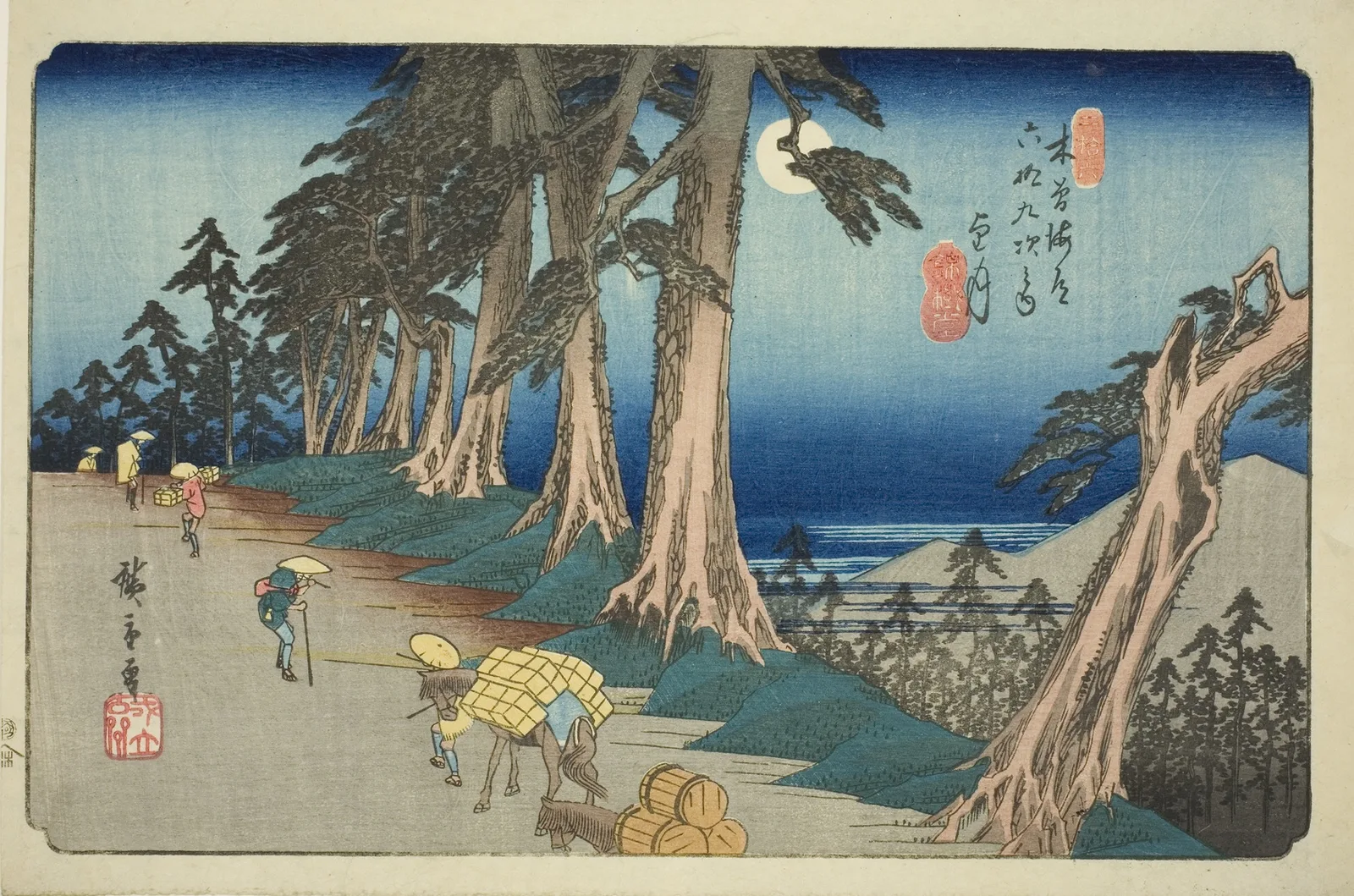
This print of Mochizuki shows travelers and packhorses on a pine-lined slope on a full-moon night. With a moon in the sky that echoes the post town's name, it depicts a quiet night journey through the great pine trunks floating in darkness and the silhouettes of mountains beyond the valley.
- Artist
- Utagawa Hiroshige
- Date
- c. 1835-38 (Tenpo 6-9)
- Medium / format
- Woodblock print (ukiyo-e)
- Series
- The Sixty-nine Stations of the Kisokaido 71 prints
- Place depicted
- Mochizuki-juku(Nagano)
About this work
A gently rising road runs from the left foreground into the distance. Thick pines line the road, and beneath them travelers with packs and a horse loaded with rice bales move along. To the right the ground drops into a valley, and beyond the diagonally reaching pine branches can be seen hazy mountains and the moon.
The sky is a deep indigo gradation, darker toward the top. The pine trunks are painted in pale pink, and in contrast with the ink-colored needles they seem to stand out in the light of the night. A gray road and a blue-green band of slope divide the picture diagonally, conveying the length of the slope continuing into the distance.
Mochizuki was a post town between Yawata and Ashida, known from ancient times for the Mochizuki pasture that supplied horses to the imperial court. Because horses were presented around the full moon of the eighth month each year, they were called "Mochizuki horses," and the name of the post town is said to derive from this.
This is a design by Utagawa Hiroshige. It is thought that he linked the post town's name Mochizuki ("full moon") to the moon and depicted the scene at night. The same design is also at the Art Institute of Chicago and the Metropolitan Museum of Art, and the shades of the gradation in the sky differ slightly from impression to impression.
The place today
The site of Mochizuki-juku is in Mochizuki, Saku, where Yamatoya (the Mayama family residence), which served as both an inn and wholesale office, survives as an Important Cultural Property. On the site of the honjin stands the Mochizuki Museum of History and Folklore, which conveys the history of the post town and materials on the imperial pastures. A building of the waki-honjin can also be seen along the old road.
Where can I see it?
Exhibitions change over time. Check each museum's exhibition information before you visit.
Museums that hold this work
- Tokyo National MuseumMuseum's page for this work (opens in a new tab)
Taito City, Tokyo Accession no. A-12499-92
- National Diet LibraryMuseum's page for this work (opens in a new tab)
Chiyoda City, Tokyo Accession no. 寄別2-2-1-5
Included in Kisokaido Rokujukyu-tsugi
Museums abroad
- Art Institute of ChicagoMuseum's page for this work (opens in a new tab)
Chicago Accession no. 1963.701
- The Metropolitan Museum of ArtMuseum's page for this work (opens in a new tab)
New York Accession no. JP585
Frequently asked questions
- Who painted The Sixty-nine Stations of the Kisokaido: Mochizuki, and when?
- The Sixty-nine Stations of the Kisokaido: Mochizuki is by Utagawa Hiroshige, made in c. 1835-38 (Tenpo 6-9). Medium: Woodblock print (ukiyo-e).
- What place does The Sixty-nine Stations of the Kisokaido: Mochizuki show?
- It shows Mochizuki-juku (Nagano).
- Where can I see The Sixty-nine Stations of the Kisokaido: Mochizuki?
- It is held by Tokyo National Museum, National Diet Library. Exhibitions change, so check each museum's information before you visit.
Sources and references
- Art Institute of Chicago: No. 26: Mochizuki, from the series "Sixty-nine Stations of the Kisokaido (Kisokaido rokujukyu tsugi no uchi)" (opens in a new tab) (checked 2026-10-19)
- ColBase(東京国立博物館): 木曽海道六拾九次之内 望月 (opens in a new tab) (checked 2026-10-19)
- 国立国会図書館デジタルコレクション: 二拾六 木曽海道六拾九次之内望月 (opens in a new tab) (checked 2026-10-19)
- The Metropolitan Museum of Art: Mochizuki Station (JP585) (opens in a new tab) (checked 2026-10-19)
- Wikipedia: 木曽海道六十九次 (opens in a new tab) (checked 2026-10-19)
You may also like
More from Nagano
Discover more of the same region on our sister sites.