The Sixty-nine Stations of the Kisokaido ・ 25
Yawata
木曽海道六拾九次之内 八幡
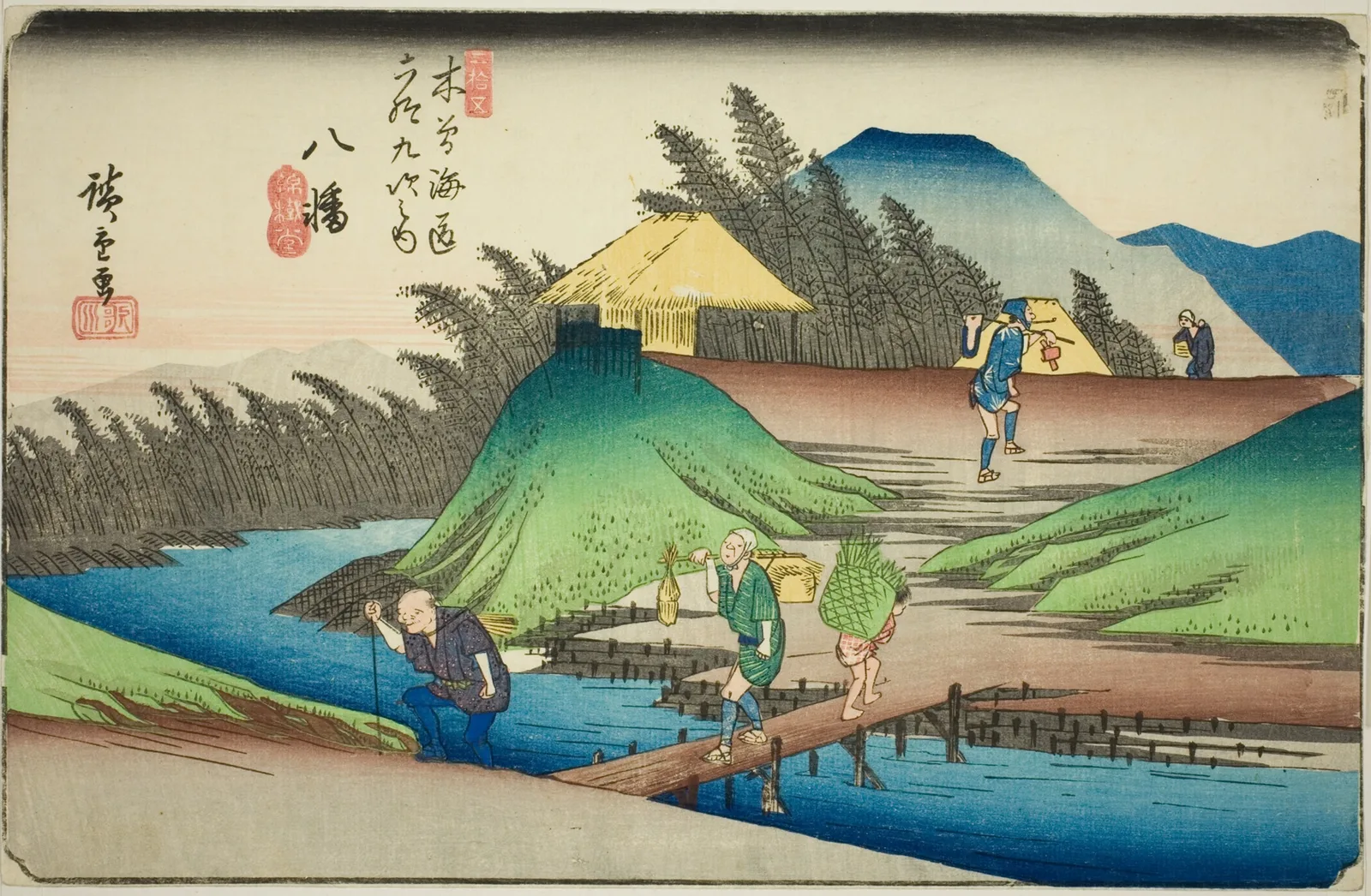
Hiroshige's print shows a farmer and travelers crossing a plank bridge over a small stream near Yawata. A thatched-roof house surrounded by bamboo, a green embankment, and a blue current overlap, conveying the pastoral calm of the Saku plain west of the Chikuma River.
- Artist
- Utagawa Hiroshige
- Date
- c. 1835-38 (Tenpo 6-9)
- Medium / format
- Woodblock print (ukiyo-e)
- Series
- The Sixty-nine Stations of the Kisokaido 71 prints
- Place depicted
- Yawata-juku(Nagano)
About this work
A blue stream flows from left to right in the foreground, with a narrow plank bridge laid across it at an angle. On the bridge an old man with a load and a person carrying a mountain of grass cross, while on the left bank an old man with a staff peers into the water. A thatched-roof house stands on the embankment in the middle ground, and a traveler walks along the road beyond.
The embankment is painted in bright green, deepening toward the top. Behind the house a bamboo grove thrives, and farther back two indigo mountains overlap. Within a calm palette of layered cool colors (the blue of the stream, the green of the bank, the indigo of the mountains), the yellow of the thatched roof glows brightly.
Yawata was a post town between Shionata and Mochizuki, and its name is said to derive from the local tutelary Hachiman Shrine. It lay among the farm villages of the Saku plain west of the Chikuma River, where travelers probably crossed one small stream after another among the rice fields.
This is a design by Utagawa Hiroshige. In this series Hiroshige often depicted people working in the countryside around a post town rather than the town's streets, and this print is one such example. The figures are small, shown as a moment in the gentle life of a village.
The place today
The site of Yawata-juku is in Yawata, Saku. In the precincts of Hachiman Shrine, the supposed source of the post town's name, stands the Korasha, the former main hall said to have been built in the Muromachi period, designated an Important Cultural Property. The site of the honjin is also a municipal historic site, and traces of the post town can be seen along the old road.
Where can I see it?
Exhibitions change over time. Check each museum's exhibition information before you visit.
Museums that hold this work
- Tokyo National MuseumMuseum's page for this work (opens in a new tab)
Taito City, Tokyo Accession no. A-12499-91
- National Diet LibraryMuseum's page for this work (opens in a new tab)
Chiyoda City, Tokyo Accession no. 寄別2-2-1-5
Included in Kisokaido Rokujukyu-tsugi
Museums abroad
- Art Institute of ChicagoMuseum's page for this work (opens in a new tab)
Chicago Accession no. 1939.2209
Frequently asked questions
- Who painted The Sixty-nine Stations of the Kisokaido: Yawata, and when?
- The Sixty-nine Stations of the Kisokaido: Yawata is by Utagawa Hiroshige, made in c. 1835-38 (Tenpo 6-9). Medium: Woodblock print (ukiyo-e).
- What place does The Sixty-nine Stations of the Kisokaido: Yawata show?
- It shows Yawata-juku (Nagano).
- Where can I see The Sixty-nine Stations of the Kisokaido: Yawata?
- It is held by Tokyo National Museum, National Diet Library. Exhibitions change, so check each museum's information before you visit.
Sources and references
- Art Institute of Chicago: No. 25: Yawata, from the series "Sixty-nine Stations of the Kisokaido (Kisokaido rokujukyu tsugi no uchi)" (opens in a new tab) (checked 2026-10-19)
- ColBase(東京国立博物館): 木曽海道六拾九次之内 八幡 (opens in a new tab) (checked 2026-10-19)
- 国立国会図書館デジタルコレクション: 二拾五 木曽海道六拾九次之内八幡 (opens in a new tab) (checked 2026-10-19)
- Wikipedia: 木曽海道六十九次 (opens in a new tab) (checked 2026-10-19)
You may also like
More from Nagano
Discover more of the same region on our sister sites.