The Sixty-nine Stations of the Kisokaido ・ 27
Ashida
木曽海道六拾九次之内 あし田
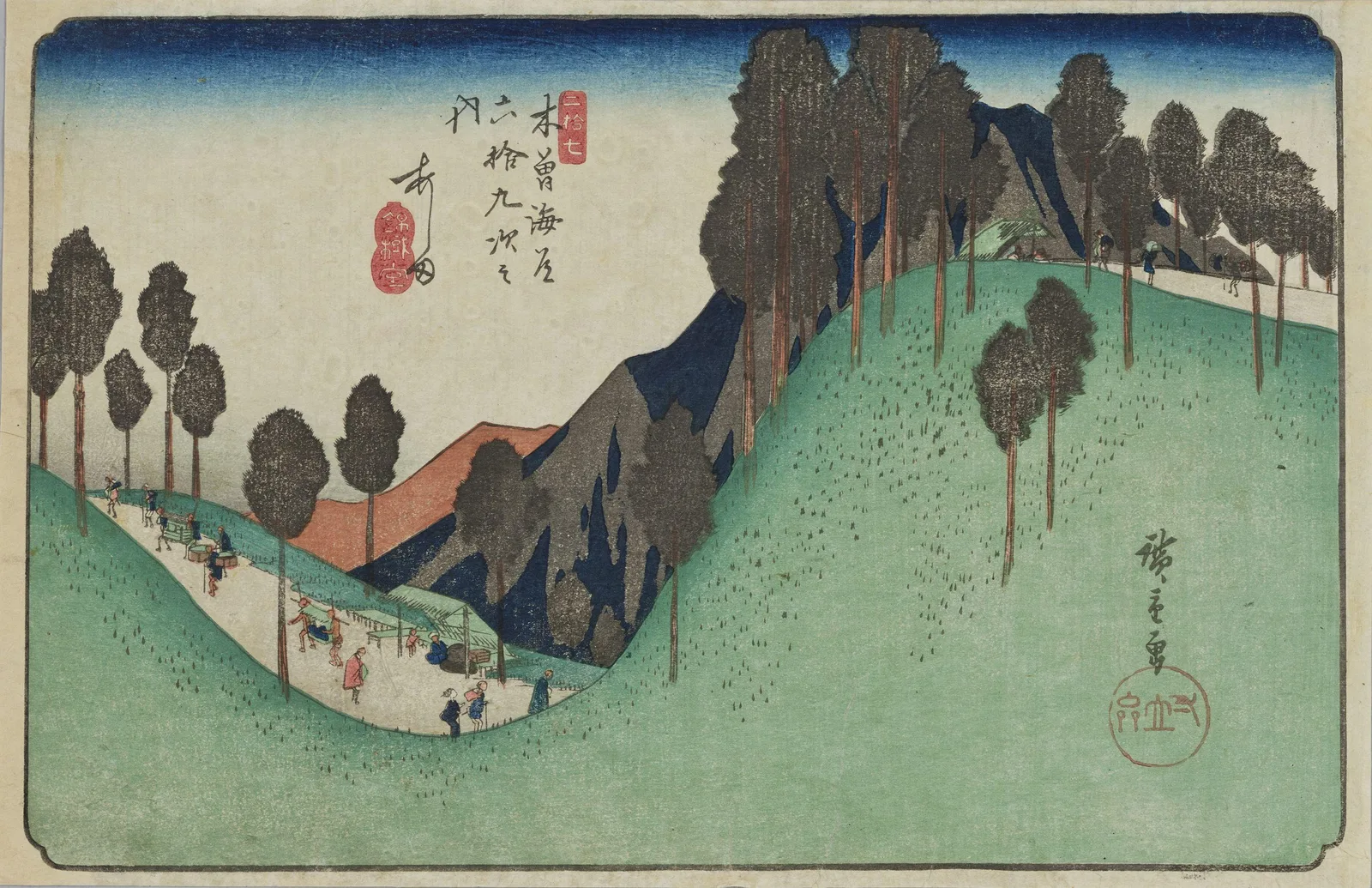
Hiroshige's print shows the slope leading from Ashida toward the Kasatori Pass. A line of pines continues over gently rolling green hills, and small travelers and horses crossing the pass, conveying the expansive openness of a Shinano mountain road.
- Artist
- Utagawa Hiroshige
- Date
- c. 1835-38 (Tenpo 6-9)
- Medium / format
- Woodblock print (ukiyo-e)
- Series
- The Sixty-nine Stations of the Kisokaido 71 prints
- Place depicted
- Ashida-juku(Nagano)
About this work
From the left to the middle of the picture, a white road winds up the hillside. Pines stand at intervals along the road, and travelers, loaded horses, and palanquins head toward the pass. At right is a large green hill, with figures visible on the road at its summit. In the middle distance a steep rocky mountain peeks out.
The hill is painted broadly in bright green, with fine dots indicating the grass. The rocky mountain behind is drawn heavily in indigo and gray, and a pale pink mountain looks out behind it. The pines, shaped like rounded clipped forms, are lined up regularly, and the contrast between the curved green surface and the straight trunks is the highlight of this print.
Ashida was a post town between Mochizuki and Nagakubo, with the Kasatori Pass looming to its west. Along the pass road ran a line of pines said to have been planted in the Edo period, probably giving travelers shade. The post town is also known for its honjin, which preserves items from when Princess Kazunomiya passed through.
This is a design by Utagawa Hiroshige. The impression at the Tokyo National Museum is shown here, but the Metropolitan Museum of Art also has the same design, and the colors of the sky and mountains differ between impressions. His choice of the scenery of the pass road over the post town itself shows Hiroshige's interests well.
The place today
The site of Ashida-juku is in Tateshina, where the Tsuchiya family residence, the honjin, is open to the public with its guest hall and other parts surviving, and is designated a Nagano Prefecture cultural property. At the Kasatori Pass west of the post town, an Edo-period pine avenue remains, designated a prefectural natural monument, and it conveys the look of the old Nakasendo to this day.
Where can I see it?
Exhibitions change over time. Check each museum's exhibition information before you visit.
Museums that hold this work
- Tokyo National MuseumMuseum's page for this work (opens in a new tab)
Taito City, Tokyo Accession no. A-12499-93
- National Diet LibraryMuseum's page for this work (opens in a new tab)
Chiyoda City, Tokyo Accession no. 寄別2-2-1-5
Included in Kisokaido Rokujukyu-tsugi
Museums abroad
Frequently asked questions
- Who painted The Sixty-nine Stations of the Kisokaido: Ashida, and when?
- The Sixty-nine Stations of the Kisokaido: Ashida is by Utagawa Hiroshige, made in c. 1835-38 (Tenpo 6-9). Medium: Woodblock print (ukiyo-e).
- What place does The Sixty-nine Stations of the Kisokaido: Ashida show?
- It shows Ashida-juku (Nagano).
- Where can I see The Sixty-nine Stations of the Kisokaido: Ashida?
- It is held by Tokyo National Museum, National Diet Library. Exhibitions change, so check each museum's information before you visit.
Sources and references
- ColBase(東京国立博物館): 木曽海道六拾九次之内 あし田 (opens in a new tab) (checked 2026-10-19)
- 国立国会図書館デジタルコレクション: 二拾七 木曽海道六拾九次之内あし田 (opens in a new tab) (checked 2026-10-19)
- The Metropolitan Museum of Art: Ashida Station (JP586) (opens in a new tab) (checked 2026-10-19)
- Wikipedia: 木曽海道六十九次 (opens in a new tab) (checked 2026-10-19)
You may also like
More from Nagano
Discover more of the same region on our sister sites.