The Sixty-nine Stations of the Kisokaido ・ 38
Fukushima
木曽海道六拾九次之内 福しま
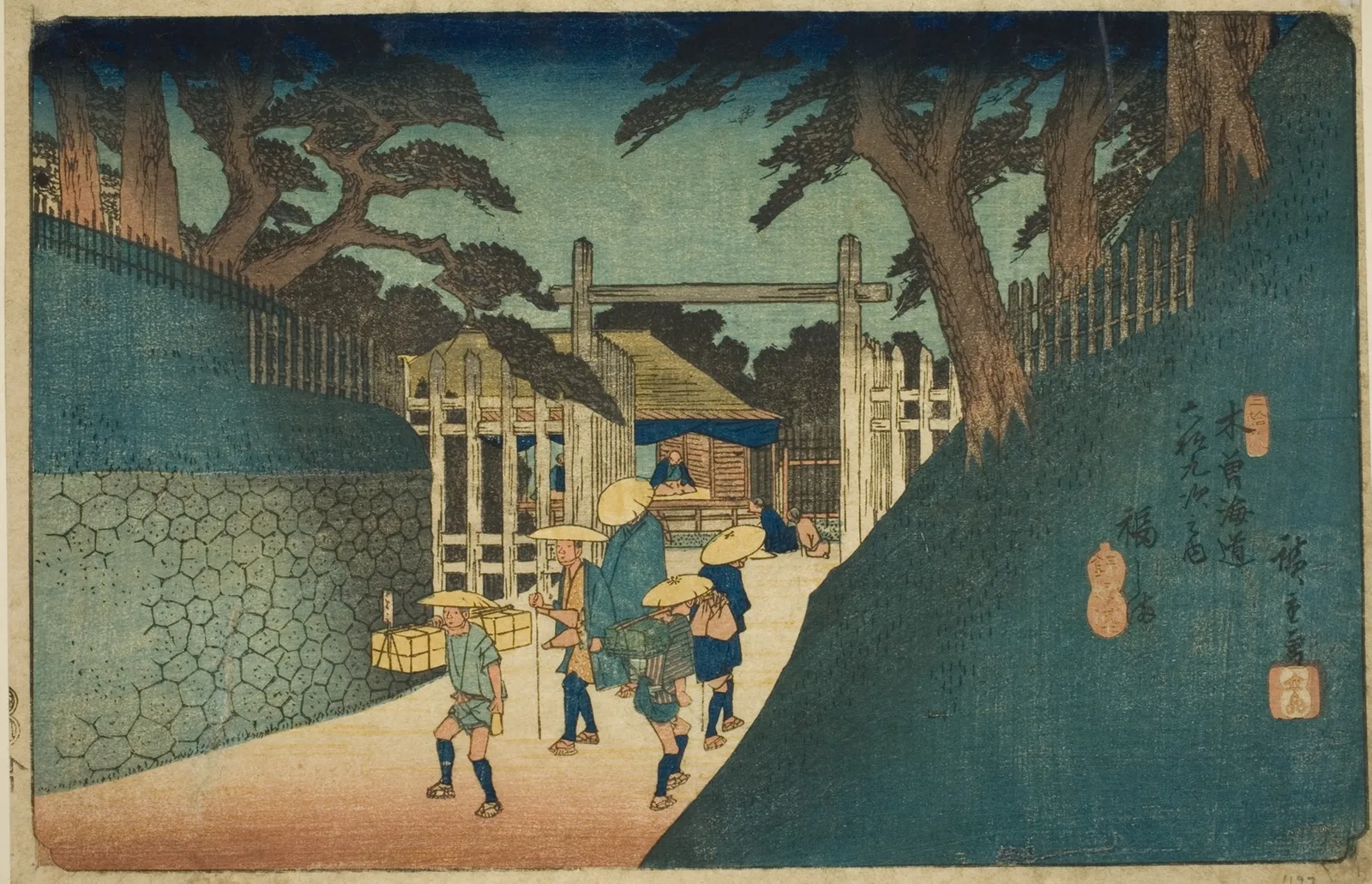
This print shows the Fukushima Checkpoint, counted as one of the four great checkpoints of the Nakasendo, from the traveler's side. At the end of a slope between a stone wall and an embankment stand a gate and a guardhouse, and a party in broad hats passes before them.
- Artist
- Utagawa Hiroshige
- Date
- c. 1835-38 (Tenpo 6-9)
- Medium / format
- Woodblock print (ukiyo-e)
- Series
- The Sixty-nine Stations of the Kisokaido 71 prints
About this work
Down the slope in the foreground come men carrying loads and travelers in broad hats toward the viewer. A stone wall and black board fence loom on the left and a high grassy embankment on the right, and at the end of the road one can see a timber gate and fence, with an official seated in the guardhouse inside.
Both embankments are painted in dark green and blue while only the central road is left bright, so the eye is naturally led to the gate in the back. Tall trees cover the top, and the oppressive feeling of looking down on those who pass through the gate conveys the severity of the checkpoint.
Fukushima lay roughly in the middle of the Kiso Valley and was a key point where a checkpoint was placed. The checkpoint controlled "guns coming in and women going out," and the Yamamura family, the Kiso magistrates, served generation after generation as its keepers. The checkpoint stood at the northern end of the post town, and travelers had their permits checked there before going on. The post town also had the magistrate's residence and was the political center of the Kiso Valley.
This is one of the designs by Hiroshige, and below the title the seal of Kinjudo can be seen. This is thought to be an impression showing that Kinjudo had replaced Hoeido as publisher. The Metropolitan Museum of Art also has the same design. The fact that it lets us peek beyond the gate yet does not clearly draw the inside of the guardhouse also expresses the checkpoint's forbidding air.
The place today
The ruins of the Fukushima Checkpoint became a national historic site in 1979, and based on excavations the guardhouse and gate have been reconstructed and are open as a museum. In the Kaminodan district of Fukushima in Kiso, a townscape retaining the look of the post town remains, and the magistrate's residence of the Yamamura family, who served as checkpoint keepers, is also open to the public.
Where can I see it?
Exhibitions change over time. Check each museum's exhibition information before you visit.
Museums that hold this work
- Tokyo National MuseumMuseum's page for this work (opens in a new tab)
Taito City, Tokyo Accession no. A-12499-105
- National Diet LibraryMuseum's page for this work (opens in a new tab)
Chiyoda City, Tokyo Accession no. 寄別2-2-1-5
Included in Kisokaido Rokujukyu-tsugi
Museums abroad
- Art Institute of ChicagoMuseum's page for this work (opens in a new tab)
Chicago Accession no. 1925.3728
- The Metropolitan Museum of ArtMuseum's page for this work (opens in a new tab)
New York Accession no. JP2499
Frequently asked questions
- Who painted The Sixty-nine Stations of the Kisokaido: Fukushima, and when?
- The Sixty-nine Stations of the Kisokaido: Fukushima is by Utagawa Hiroshige, made in c. 1835-38 (Tenpo 6-9). Medium: Woodblock print (ukiyo-e).
- What place does The Sixty-nine Stations of the Kisokaido: Fukushima show?
- It shows Fukushima-juku (Kiso), Fukushima Checkpoint Site (Nagano).
- Where can I see The Sixty-nine Stations of the Kisokaido: Fukushima?
- It is held by Tokyo National Museum, National Diet Library. Exhibitions change, so check each museum's information before you visit.
Sources and references
- Art Institute of Chicago: No. 38: Fukushima, from the series "Sixty-nine Stations of the Kisokaido (Kisokaido rokujukyu tsugi no uchi)" (opens in a new tab) (checked 2026-10-19)
- ColBase(東京国立博物館): 木曽海道六拾九次之内 福しま (opens in a new tab) (checked 2026-10-19)
- 国立国会図書館デジタルコレクション: 三拾八 木曽海道六拾九次之内福しま (opens in a new tab) (checked 2026-10-19)
- The Metropolitan Museum of Art: Fukushima Station (opens in a new tab) (checked 2026-10-19)
- Wikipedia: 木曽海道六十九次 (opens in a new tab) (checked 2026-10-19)
You may also like
More from Nagano
Discover more of the same region on our sister sites.