Thirty-six Views of Mount Fuji ・ 34
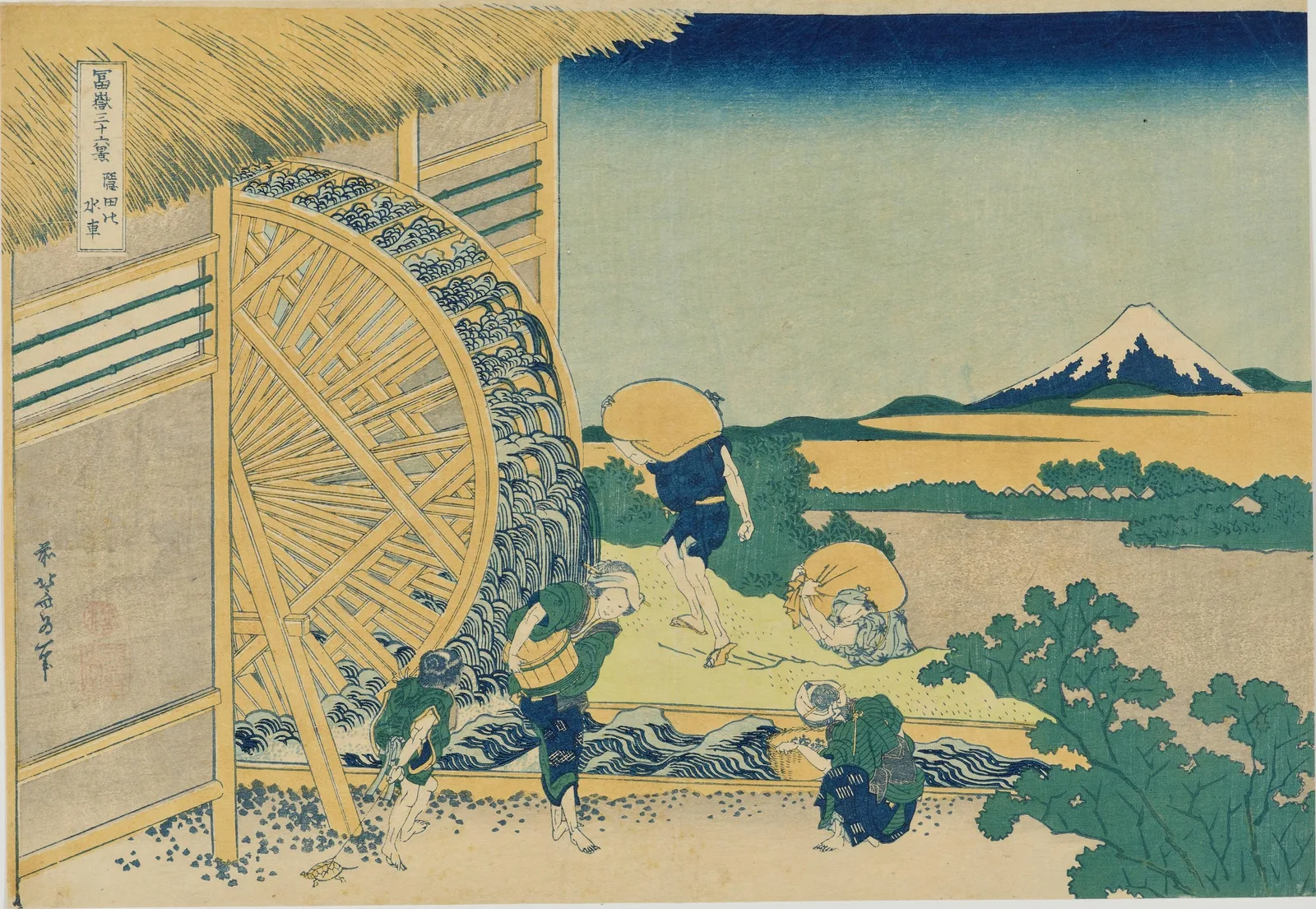
The Waterwheel at Onden
冨嶽三十六景 隠田の水車
A large waterwheel spills water with vigor while villagers carry sacks of grain and wash things in the river around it. Far beyond the lively foreground, snow-capped Fuji rises quietly.
- Artist
- Katsushika Hokusai
- Date
- c. 1830-33 (Tenpo 1-4)
- Medium / format
- Woodblock print (ukiyo-e)
- Series
- Thirty-six Views of Mount Fuji 46 prints
- Place depicted
- Onden(Tokyo)
- Seen in the distance
- Mount Fuji
About this work
The waterwheel occupying the left half of the picture lets water fall from each of its paddles, and the water flows on as waves made of layered fine lines. This is a way of showing the force of water through overlapping lines, and it is the most dynamic part of the picture. The roof of the mill is thatched, and even each strand of straw hanging from the eaves is drawn.
In front of the mill, a man carrying a large sack climbs a slope, another sets down a sack and rests, a woman holds a tub, and another washes a basket in the river. Beside the feet of a child at lower left there is a small turtle tied on a string, adding a touch of charm to the working scene. In the right foreground, plants with broad leaves grow thick and anchor the corner of the picture.
Onden (also written with different characters, 隠田/穏田) corresponds to today's Jingumae and Harajuku in Shibuya Ward, and at that time was a village of fields and farmland. According to Shibuya Ward materials, the nearby Shibuya River had waterwheels for pounding rice, which were used until the end of the Meiji era. However, it is not certain which waterwheel Hokusai drew. Away from the bustle in the foreground, Fuji is calmly drawn in the right distance.
The place today
According to Shibuya Ward, the Shibuya River (Onden River) that flowed through Jingumae is now mostly a culvert (underground waterway), and a road called Cat Street runs over it. The rural scenery where the waterwheels turned survives only in the valley lines of the terrain.
Where can I see it?
Exhibitions change over time. Check each museum's exhibition information before you visit.
Museums that hold this work
- Tokyo National MuseumMuseum's page for this work (opens in a new tab)
Taito City, Tokyo Accession no. A-11176
From the set of 12 sheets of Thirty-six Views of Mount Fuji
- Edo-Tokyo MuseumMuseum's page for this work (opens in a new tab)
Sumida City, Tokyo Accession no. 92202768
Museums that hold this series (please check the museum's website for whether it holds this print)
Frequently asked questions
- Who painted Thirty-six Views of Mount Fuji: The Waterwheel at Onden, and when?
- Thirty-six Views of Mount Fuji: The Waterwheel at Onden is by Katsushika Hokusai, made in c. 1830-33 (Tenpo 1-4). Medium: Woodblock print (ukiyo-e).
- What place does Thirty-six Views of Mount Fuji: The Waterwheel at Onden show?
- It shows Onden (Tokyo).
- Where can I see Thirty-six Views of Mount Fuji: The Waterwheel at Onden?
- It is held by Tokyo National Museum, Tokyo Fuji Art Museum, Edo-Tokyo Museum. Exhibitions change, so check each museum's information before you visit.
Sources and references
- ColBase 東京国立博物館 冨嶽三十六景(12枚) (opens in a new tab) (checked 2026-10-18)
- 山梨県立博物館「博物館資料のなかの『富士山』 葛飾北斎 冨嶽三十六景」 (opens in a new tab) (checked 2026-10-18)
- 江戸東京博物館デジタルアーカイブス 冨嶽三十六景 隠田の水車 (opens in a new tab) (checked 2026-10-18)
You may also like
More from Tokyo
Discover more of the same region on our sister sites.