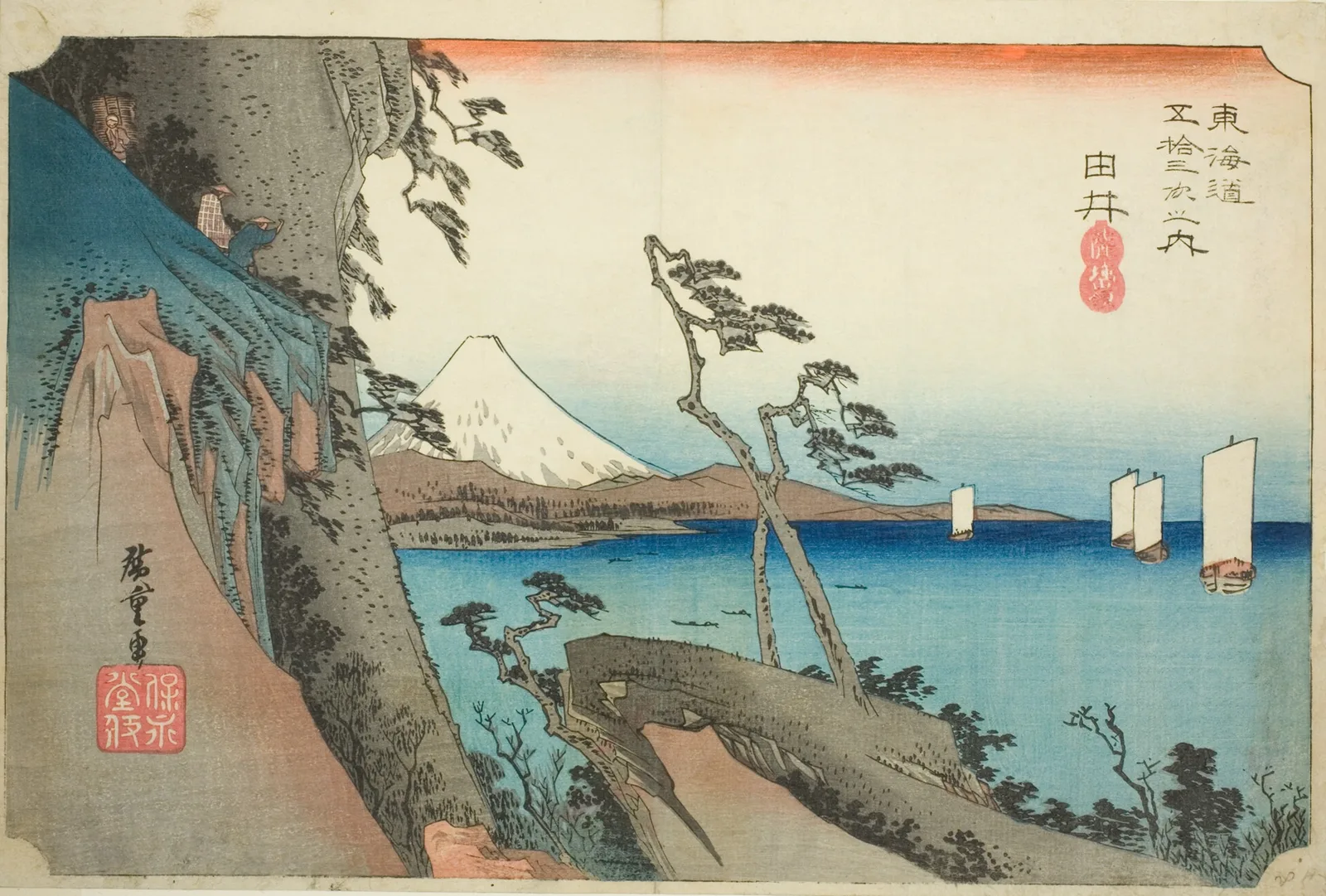
The Fifty-three Stations of the Tokaido (Hoeido edition) ・ 17
Satta Pass at Yui
東海道五拾三次之内 由井 薩埵嶺
From the top of the cliff of Satta Pass that presses against the sea, travelers lean out to look at Mount Fuji across Suruga Bay. The sheer cliff, the twisted pine, and the white sails on the sea lead the eye toward the distant Fuji.
- Artist
- Utagawa Hiroshige
- Date
- c. 1833-34 (Tenpo 4-5)
- Medium / format
- Woodblock print (ukiyo-e)
- Series
- The Fifty-three Stations of the Tokaido (Hoeido edition) 55 prints
- Place depicted
- Yui-juku(Shizuoka)
- Seen in the distance
- Mount Fuji
About this work
At the edge of the cliff in the upper left of the picture, two travelers hold onto a rock and peer down. Beyond their gaze spread the blue of Suruga Bay and the snow-capped white Mount Fuji. The contrast between the harshness of the pass road and the open view is the highlight of this print.
The rock jutting from the cliff and the pine stretching with a twisting trunk are arranged to echo the ridgeline of Fuji. On the sea, ships with white square sails line up, adding rhythm to the calm water.
Satta Pass lay between Yui and Okitsu, a difficult place where mountains press against the sea. The road along the water's edge before the pass was dangerous, and it is said that travelers were sometimes swept away by waves. From the road on the cliff, one could take in Fuji and the sea at a glance.
The title is written Yui with an older character form, but the present place name is written differently. Yui-juku was the 16th post station from Edo, and at the site of its honjin stands the Shizuoka City Tokaido Hiroshige Museum of Art, named for Hiroshige. The color scheme, with the dark color of the cliff, the bright blue of the sea, and the white of Fuji clearly separated, also holds the picture together. The distant mountains are pale brown, making the whiteness of Fuji stand out even more.
The place today
Satta Pass (elevation about 244 m) has observation spots developed, and you can still see Mount Fuji and Suruga Bay from there. On the narrow coast below, the Tokaido Main Line, National Route 1, and the Tomei Expressway run side by side. The site of the Yui-juku honjin is now Yui Honjin Park, which contains the Shizuoka City Tokaido Hiroshige Museum of Art.
Where can I see it?
Exhibitions change over time. Check each museum's exhibition information before you visit.
Museums that hold this work
- Tokyo National MuseumMuseum's page for this work (opens in a new tab)
Taito City, Tokyo Accession no. A-12499-20
Museums that hold this series (please check the museum's website for whether it holds this print)
- Shizuoka City Tokaido Hiroshige Museum of Art
Shimizu Ward, Shizuoka
All prints of the Hoeido edition were shown in the museum's collection exhibition Fifty-three Stations of the Tokaido (2024-25)
Museums abroad
- Art Institute of ChicagoMuseum's page for this work (opens in a new tab)
Chicago Accession no. 1925.3518
Frequently asked questions
- Who painted The Fifty-three Stations of the Tokaido: Satta Pass at Yui, and when?
- The Fifty-three Stations of the Tokaido: Satta Pass at Yui is by Utagawa Hiroshige, made in c. 1833-34 (Tenpo 4-5). Medium: Woodblock print (ukiyo-e).
- What place does The Fifty-three Stations of the Tokaido: Satta Pass at Yui show?
- It shows Yui-juku (Shizuoka).
- Where can I see The Fifty-three Stations of the Tokaido: Satta Pass at Yui?
- It is held by Tokyo National Museum, Tokyo Fuji Art Museum, National Diet Library. Exhibitions change, so check each museum's information before you visit.
Sources and references
- Art Institute of Chicago: Yui: Satta Peak (Yui, Satta mine) (opens in a new tab) (checked 2026-10-18)
- ColBase(東京国立博物館): A-12499-20 (opens in a new tab) (checked 2026-10-18)
- 東京富士美術館 収蔵品: 東海道五拾三次之内 由井 薩埵嶺 (opens in a new tab) (checked 2026-10-18)
- 国立国会図書館デジタルコレクション: 東海道五拾三次 由井・薩〔タ〕嶺 (opens in a new tab) (checked 2026-10-18)
You may also like
More from Shizuoka
Discover more of the same region on our sister sites.