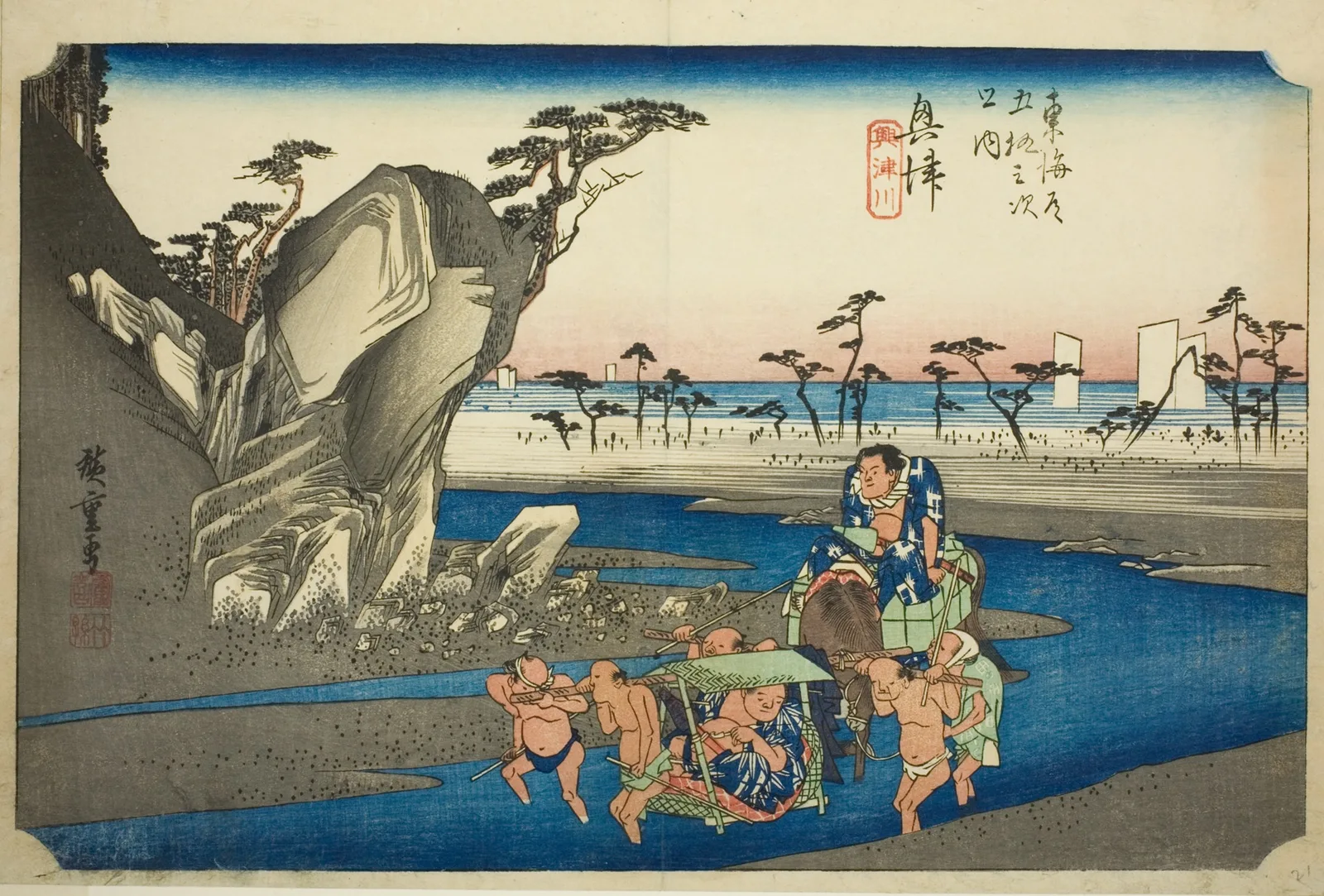
The Fifty-three Stations of the Tokaido (Hoeido edition) ・ 18
Okitsu River at Okitsu
東海道五拾三次之内 興津 興津川
This print shows two sumo wrestlers crossing the Okitsu River, one in a palanquin carried by porters and the other on horseback, with both porters and horse struggling under the weight. Beyond them spread the sea and Miho no Matsubara.
- Artist
- Utagawa Hiroshige
- Date
- c. 1833-34 (Tenpo 4-5)
- Medium / format
- Woodblock print (ukiyo-e)
- Series
- The Fifty-three Stations of the Tokaido (Hoeido edition) 55 prints
- Place depicted
- Okitsu-juku(Shizuoka)
About this work
At the center of the picture, a large wrestler sits heavily in a palanquin, and the porters carry him with difficulty. Behind them, another wrestler is mounted on a horse, and the horse hangs its head under the weight. The gap between the wrestlers' relaxed expressions and the toil of those carrying them draws a laugh.
In the Edo period, sumo was staged around the country as kanjin sumo, held to raise funds for building and repairing temples and shrines. This print depicts one scene from the travels of such wrestlers.
On the left, a rugged rocky cliff rises, and in the back a seashore with a white beach and a line of pines continues. This is Miho no Matsubara, and white sails float offshore. Incidentally, the station name written in the picture is a different spelling of Okitsu.
Okitsu-juku was the 17th post station from Edo and an important point where the road to Kai (present-day Yamanashi Prefecture) branched off. The Okitsu River flows nearby and empties into Suruga Bay. By choosing the unexpected travelers of sumo wrestlers for a scene of crossing a river, Hiroshige humorously depicts the hardships of river crossings. The large pattern on the wrestlers' kimono also stands out in the picture.
The place today
Seikenji Temple remains in Okitsu, with its grounds designated a national historic site for its association with the Joseon missions and its garden a national place of scenic beauty. After the Meiji era the area became a villa district, and Saionji Kinmochi's villa, Zagyoso, has been restored as a memorial museum. The site of the east honjin has been developed as Okitsu-juku Park.
Where can I see it?
Exhibitions change over time. Check each museum's exhibition information before you visit.
Museums that hold this work
- Tokyo National MuseumMuseum's page for this work (opens in a new tab)
Taito City, Tokyo Accession no. A-12499-21
Museums that hold this series (please check the museum's website for whether it holds this print)
- Shizuoka City Tokaido Hiroshige Museum of Art
Shimizu Ward, Shizuoka
All prints of the Hoeido edition were shown in the museum's collection exhibition Fifty-three Stations of the Tokaido (2024-25)
Museums abroad
- Art Institute of ChicagoMuseum's page for this work (opens in a new tab)
Chicago Accession no. 1925.3519
Frequently asked questions
- Who painted The Fifty-three Stations of the Tokaido: Okitsu River at Okitsu, and when?
- The Fifty-three Stations of the Tokaido: Okitsu River at Okitsu is by Utagawa Hiroshige, made in c. 1833-34 (Tenpo 4-5). Medium: Woodblock print (ukiyo-e).
- What place does The Fifty-three Stations of the Tokaido: Okitsu River at Okitsu show?
- It shows Okitsu-juku (Shizuoka).
- Where can I see The Fifty-three Stations of the Tokaido: Okitsu River at Okitsu?
- It is held by Tokyo National Museum, Tokyo Fuji Art Museum, National Diet Library. Exhibitions change, so check each museum's information before you visit.
Sources and references
- Art Institute of Chicago: Okitsu: The Okitsu River (Okitsu, Okitsugawa) (opens in a new tab) (checked 2026-10-18)
- ColBase(東京国立博物館): A-12499-21 (opens in a new tab) (checked 2026-10-18)
- 東京富士美術館 収蔵品: 東海道五拾三次之内 奥津 興津川 (opens in a new tab) (checked 2026-10-18)
- 国立国会図書館デジタルコレクション: 東海道五拾三次 興津・興津川 (opens in a new tab) (checked 2026-10-18)
You may also like
More from Shizuoka
Discover more of the same region on our sister sites.