The Fifty-three Stations of the Tokaido (Hoeido edition) ・ 16
Night Snow at Kambara
東海道五拾三次之内 蒲原 夜之雪
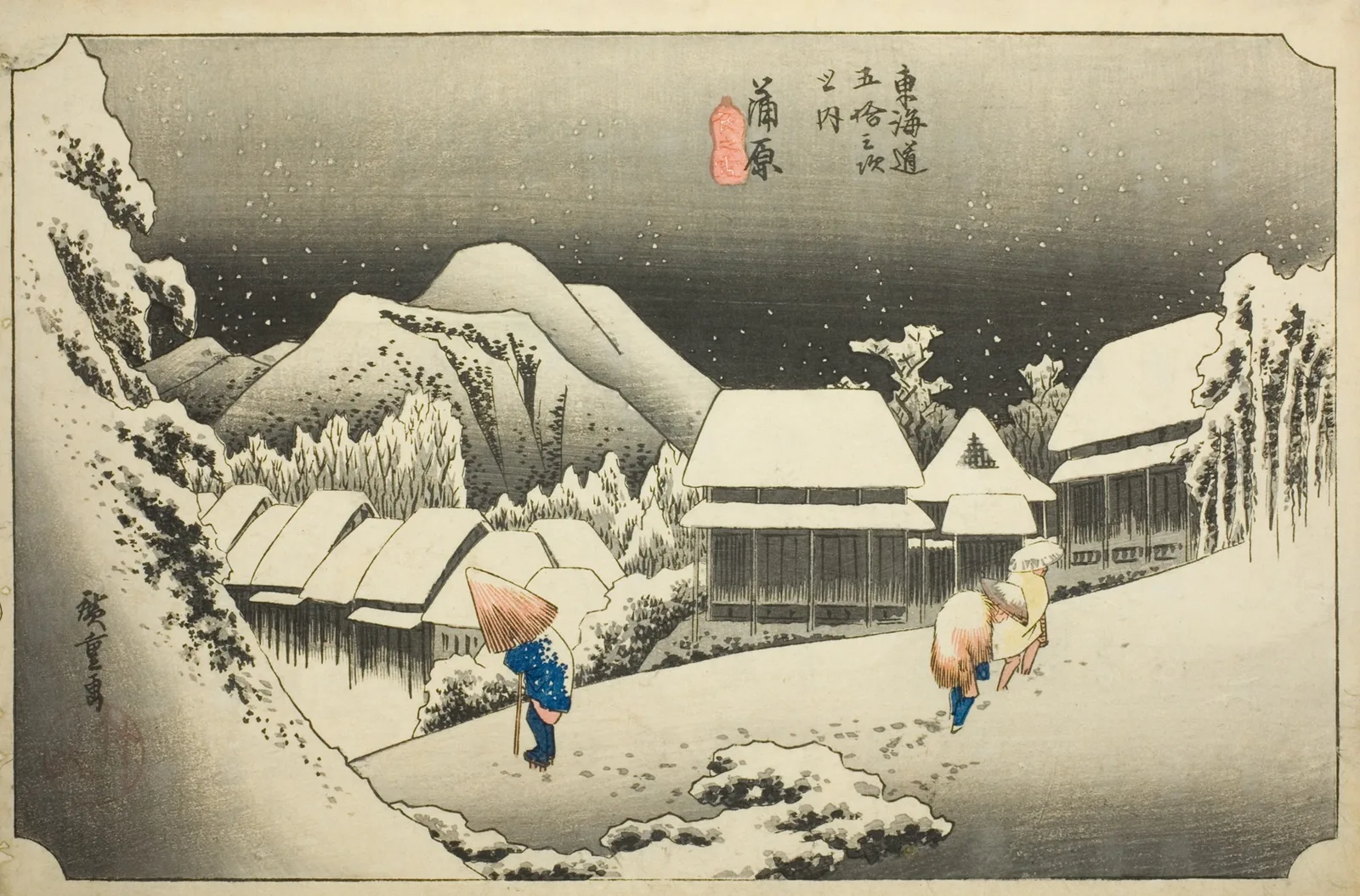
On a night when snow falls steadily, three people in hats and straw raincoats walk carefully down the slope of the hushed Kambara-juku. In a snowscape drawn only in shades of white and ink, only the colors of the figures stand out slightly.
- Artist
- Utagawa Hiroshige
- Date
- c. 1833-34 (Tenpo 4-5)
- Medium / format
- Woodblock print (ukiyo-e)
- Series
- The Fifty-three Stations of the Tokaido (Hoeido edition) 55 prints
- Place depicted
- Kambara-juku(Shizuoka)
About this work
The sky is darkened with ink gradation, and white snowflakes dot it as they dance. Mountains, houses, and trees are all covered in thick snow, drawn only in shades of white, gray, and black. It is a picture in which one almost hears only the sound of falling snow in a post station emptied of human presence.
There are three figures on the slope: one with a staff at left, and two huddled together at right. Their hats and straw raincoats are lightly covered with snow, showing them walking carefully on the snowy road. Blue and yellow are used only on the figures, catching the eye within the monochrome picture.
Kambara is a mild place near Suruga Bay, and heavy snow like this is rare. For that reason, it is thought that Hiroshige drew it as a snowscape to add variety to the series. It can be said to be a print that gives priority to conveying the stillness of a snowy night over the actual scenery.
The sky is expressed darkly with ink bokashi (a technique of printing while gradually changing the thickness of the pigment on the block), and in contrast with the white piled snow, the depth of night and the glow of snow are felt. The doors of the houses are all shut and no lights can be seen. It is a print that fully depicts the stillness of a snow-buried post station through a restrained palette.
The place today
Along the old Tokaido in Kambara-juku stand namako-kabe walls, lattice-front houses, and the former Igarashi residence (a nationally registered tangible cultural property), a townhouse remodeled in Western style in the Taisho era, giving a feel of the post town streetscape. A Taisho-era building remains at the site of the west honjin, but it is a private residence and not open to the public.
Where can I see it?
Exhibitions change over time. Check each museum's exhibition information before you visit.
Museums that hold this work
- Tokyo National MuseumMuseum's page for this work (opens in a new tab)
Taito City, Tokyo Accession no. A-12499-19
Museums that hold this series (please check the museum's website for whether it holds this print)
- Shizuoka City Tokaido Hiroshige Museum of Art
Shimizu Ward, Shizuoka
All prints of the Hoeido edition were shown in the museum's collection exhibition Fifty-three Stations of the Tokaido (2024-25)
Museums abroad
- Art Institute of ChicagoMuseum's page for this work (opens in a new tab)
Chicago Accession no. 1939.1361
Frequently asked questions
- Who painted The Fifty-three Stations of the Tokaido: Night Snow at Kambara, and when?
- The Fifty-three Stations of the Tokaido: Night Snow at Kambara is by Utagawa Hiroshige, made in c. 1833-34 (Tenpo 4-5). Medium: Woodblock print (ukiyo-e).
- What place does The Fifty-three Stations of the Tokaido: Night Snow at Kambara show?
- It shows Kambara-juku (Shizuoka).
- Where can I see The Fifty-three Stations of the Tokaido: Night Snow at Kambara?
- It is held by Tokyo National Museum, Tokyo Fuji Art Museum, National Diet Library. Exhibitions change, so check each museum's information before you visit.
Sources and references
- Art Institute of Chicago: Kanbara: Evening Snow (Kanbara, yoru no yuki) (opens in a new tab) (checked 2026-10-18)
- ColBase(東京国立博物館): A-12499-19 (opens in a new tab) (checked 2026-10-18)
- 東京富士美術館 収蔵品: 東海道五拾三次之内 蒲原 夜之雪 (opens in a new tab) (checked 2026-10-18)
- 国立国会図書館デジタルコレクション: 東海道五拾三次 蒲原・夜之雪 (opens in a new tab) (checked 2026-10-18)
You may also like
More from Shizuoka
Discover more of the same region on our sister sites.