Thirty-six Views of Mount Fuji ・ 19
Ejiri in Suruga Province
冨嶽三十六景 駿州江尻
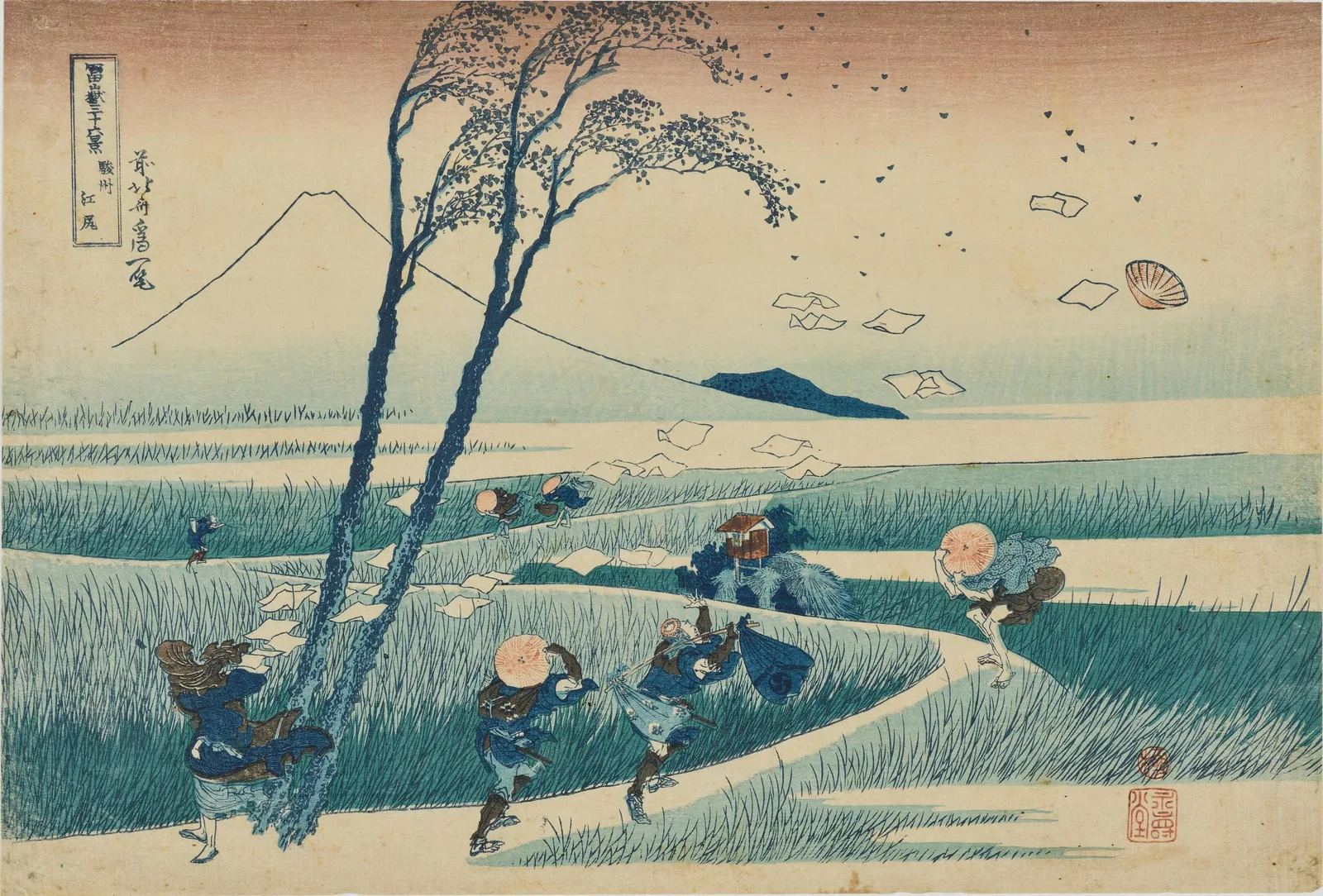
A gust sweeps along a single road through the fields, sending travelers' paper and sedge hats flying into the air. Beyond the people bending to withstand the strong wind, a Fuji drawn in outline alone lies quietly.
- Artist
- Katsushika Hokusai
- Date
- c. 1830-33 (Tenpo 1-4)
- Medium / format
- Woodblock print (ukiyo-e)
- Series
- Thirty-six Views of Mount Fuji 46 prints
- Place depicted
- Ejiri-juku(Shizuoka)
- Seen in the distance
- Mount Fuji
About this work
The protagonist of this print is the invisible wind. Trees lean sharply and scatter their leaves, and paper that has slipped from a traveler's kimono is drawn up like a ribbon from the lower left of the picture to the upper right. A person holding his hat and bending over, another whose kimono is whipped by the wind, and other fleeting movements are captured as if in a photograph.
Fuji is uncolored and drawn with fine outlines alone. The contrast between the violently moving foreground and the utterly unmoved Fuji is the key to this print. The sky is dark as if dimmed by dust, and at the end of the winding road is a small shrine, behind which the surface of a pond shows white. At the right of Fuji a black, flat mountain shadow is placed, setting off the outline-only Fuji.
Ejiri-juku was a post station on the Tokaido at the lower reaches of the Tomoe River, which flows into Suruga Bay, and was a key point of transport together with the port of Shimizu to the south. According to Shizuoka City materials, there were two honjin, three waki-honjin, and fifty inns. Using the central shrine as a clue, the Yamanashi Prefectural Museum sees the scene as a view of Fuji to the northeast from near Ubagaike, west of the station.
The place today
Ejiri-juku was in today's Shimizu Ward, Shizuoka City. Shizuoka City introduces Ejiri as a post station that flourished through the river transport of the Tomoe River. A legend remains that a kappa appeared on the day of the first crossing of Chigo Bridge over the Tomoe River.
Where can I see it?
Exhibitions change over time. Check each museum's exhibition information before you visit.
Museums that hold this work
- Tokyo National MuseumMuseum's page for this work (opens in a new tab)
Taito City, Tokyo Accession no. A-11177
From the set of 34 sheets of Thirty-six Views of Mount Fuji
- Edo-Tokyo MuseumMuseum's page for this work (opens in a new tab)
Sumida City, Tokyo Accession no. 92202760
Museums that hold this series (please check the museum's website for whether it holds this print)
Frequently asked questions
- Who painted Thirty-six Views of Mount Fuji: Ejiri in Suruga Province, and when?
- Thirty-six Views of Mount Fuji: Ejiri in Suruga Province is by Katsushika Hokusai, made in c. 1830-33 (Tenpo 1-4). Medium: Woodblock print (ukiyo-e).
- What place does Thirty-six Views of Mount Fuji: Ejiri in Suruga Province show?
- It shows Ejiri-juku (Shizuoka).
- Where can I see Thirty-six Views of Mount Fuji: Ejiri in Suruga Province?
- It is held by Tokyo National Museum, Tokyo Fuji Art Museum, Edo-Tokyo Museum. Exhibitions change, so check each museum's information before you visit.
Sources and references
- ColBase 東京国立博物館 冨嶽三十六景(34枚) (opens in a new tab) (checked 2026-10-18)
- 山梨県立博物館「博物館資料のなかの『富士山』 葛飾北斎 冨嶽三十六景」 (opens in a new tab) (checked 2026-10-18)
- 江戸東京博物館デジタルアーカイブス 冨嶽三十六景 駿州江尻 (opens in a new tab) (checked 2026-10-18)
You may also like
More from Shizuoka
Discover more of the same region on our sister sites.