The Fifty-three Stations of the Tokaido (Hoeido edition) ・ 48
Early Departure from the Main Camp at Seki
東海道五拾三次之内 関 本陣早立
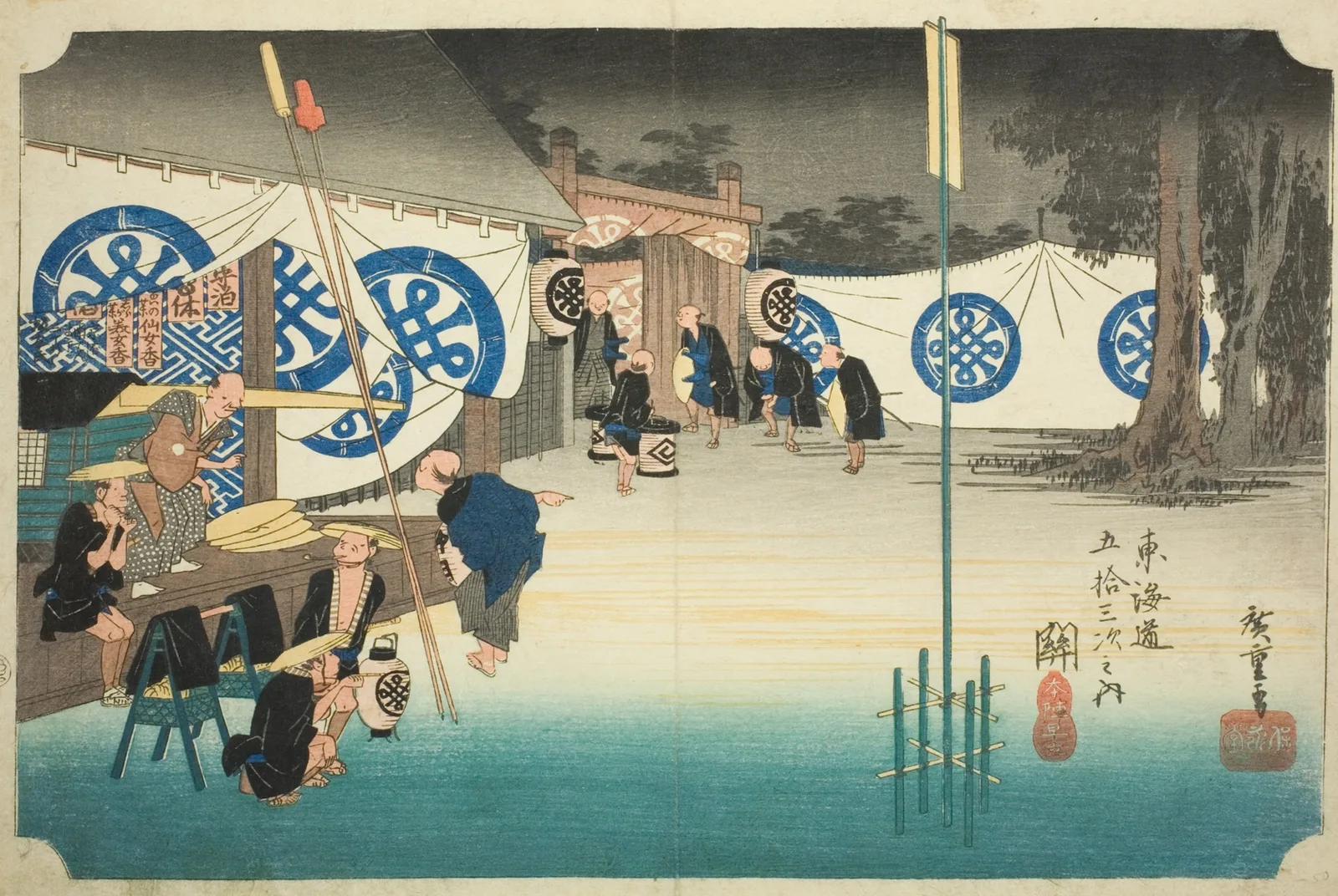
In the early morning, a daimyo party prepares to set out from the honjin of Seki-juku. In front of the honjin, hung with curtains dyed with large crests, attendants holding lanterns and palanquin bearers wait.
- Artist
- Utagawa Hiroshige
- Date
- c. 1833-34 (Tenpo 4-5)
- Medium / format
- Woodblock print (ukiyo-e)
- Series
- The Fifty-three Stations of the Tokaido (Hoeido edition) 55 prints
- Place depicted
- Seki-juku(Mie)
About this work
Curtains dyed with large crests are stretched all over the picture. This is a honjin where a daimyo on sankin-kotai stayed, and Hayadachi in the title means an early-morning departure. In front of the gate, attendants with lanterns bow their heads and wait for their master to set out. The large crest is repeatedly dyed on the curtains, giving the picture a strong rhythm of pattern.
In the left foreground, palanquin bearers sit or chat as they prepare to depart. Each one's expression is distinguished, conveying the bustle before departure. The notice board at the right foreground is drawn so that its upper part spills out of the picture. Crests are drawn on the lanterns, showing it is still an hour when lights are needed.
Seki is a place where the ancient Suzuka Barrier was placed, one of the Three Barriers along with Fuwa and Osaka. Honjin were assigned to the houses of influential people in the post station. The sky is still dark, and the trees at the back are expressed in deep ink, conveying the cold air before dawn. Beyond the gate the roof of the honjin building peeks out, and on the right a large tree spreads its branches.
The place today
Seki-juku retains more than 200 townhouses from the Edo to Meiji periods along about 1.8 km from the east oiwake to the west oiwake, and it was selected as a Nationally Important Preservation District for Groups of Traditional Buildings in 1984 (Showa 59). Kameyama City introduces it as the only townscape that retains the look of a Tokaido post station.
Where can I see it?
Exhibitions change over time. Check each museum's exhibition information before you visit.
Museums that hold this work
- Tokyo National MuseumMuseum's page for this work (opens in a new tab)
Taito City, Tokyo Accession no. A-12499-53
Museums that hold this series (please check the museum's website for whether it holds this print)
- Shizuoka City Tokaido Hiroshige Museum of Art
Shimizu Ward, Shizuoka
All prints of the Hoeido edition were shown in the museum's collection exhibition Fifty-three Stations of the Tokaido (2024-25)
Museums abroad
- Art Institute of ChicagoMuseum's page for this work (opens in a new tab)
Chicago Accession no. 1925.3555
Frequently asked questions
- Who painted The Fifty-three Stations of the Tokaido: Early Departure from the Main Camp at Seki, and when?
- The Fifty-three Stations of the Tokaido: Early Departure from the Main Camp at Seki is by Utagawa Hiroshige, made in c. 1833-34 (Tenpo 4-5). Medium: Woodblock print (ukiyo-e).
- What place does The Fifty-three Stations of the Tokaido: Early Departure from the Main Camp at Seki show?
- It shows Seki-juku (Mie).
- Where can I see The Fifty-three Stations of the Tokaido: Early Departure from the Main Camp at Seki?
- It is held by Tokyo National Museum, Tokyo Fuji Art Museum, National Diet Library. Exhibitions change, so check each museum's information before you visit.
Sources and references
- Art Institute of Chicago: Seki: Early Departure from the Main Camp (Seki, honjin hayadachi) (opens in a new tab) (checked 2026-10-18)
- ColBase(東京国立博物館): A-12499-53 (opens in a new tab) (checked 2026-10-18)
- 東京富士美術館 収蔵品: 東海道五拾三次之内 関 本陣早立 (opens in a new tab) (checked 2026-10-18)
- 国立国会図書館デジタルコレクション: 東海道五拾三次 関・本陣早立 (opens in a new tab) (checked 2026-10-18)
You may also like
More from Mie
Discover more of the same region on our sister sites.
Matsuri Biyori
Festivals in Mie
- Toride Shrine Kujirabune Whale Boat Event
- Ueno Tenjin Festival Danjiri Float Event
- Kuwana Ishidori Festival Saisha Float Event
- Katte Jinja no Shinji Odori