The Fifty-three Stations of the Tokaido (Hoeido edition) ・ 47
Clear Weather After Snow at Kameyama
東海道五拾三次之内 亀山 雪晴
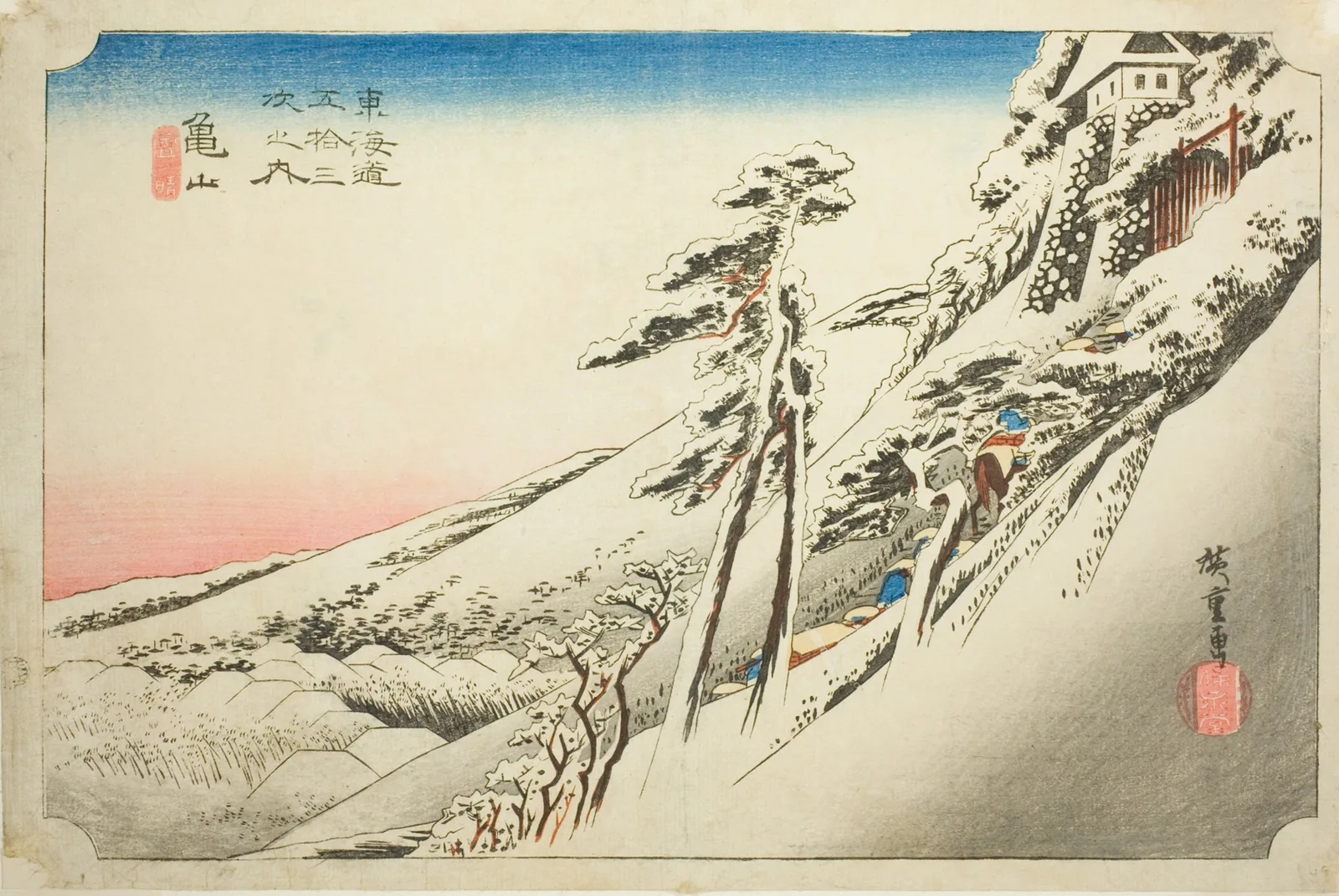
On a morning after the snow has cleared, a daimyo procession climbs the steep slope leading to the Kyoguchi Gate of Kameyama Castle. The contrast between the snowy cliff dividing the picture diagonally and the sky dyed by the dawn glow conveys the clear air of a winter morning.
- Artist
- Utagawa Hiroshige
- Date
- c. 1833-34 (Tenpo 4-5)
- Medium / format
- Woodblock print (ukiyo-e)
- Series
- The Fifty-three Stations of the Tokaido (Hoeido edition) 55 prints
- Place depicted
- Kameyama-juku(Mie)
About this work
A snow-covered cliff cuts the picture diagonally from upper right to lower left and occupies the right half. Up the steep slope, a daimyo procession climbs in a line. At the top of the cliff is drawn the Kyoguchi Gate, the western entrance of Kameyama-juku. Snow-laden pines jut diagonally from the cliff, and through their branches the hats and loads of the procession can be seen. A stone wall can also be seen in front of the gate.
In the left half, snow-covered houses and fields spread low. The sky shifts from red to white and then indigo, from bottom to top. In the snowscape put together in white and gray, the color of the sky and the small touches of color given to the people in the procession catch the eye. At the left foreground of the cliff, the thin branches of leafless trees are drawn in reddish lines.
The Tokyo Fuji Art Museum regards this print as a representative snowscape of the Hoeido edition, second only to Night Snow at Kambara. Whereas Kambara depicts the stillness of night, Kameyama depicts the clear air of a morning after snow has stopped. The Kyoguchi Gate was built in 1672 (Kanbun 12) as the western defense of Kameyama-juku and was known for its appearance with a gate and turret.
The place today
The Kyoguchi Gate was demolished in the early Meiji era, and because a bridge was later built and the position of the road changed, its exact location is not known. Part of the earthworks associated with the gate remains in the graveyard of nearby Baigan-ji Temple. At the Kameyama Castle site stands the Tamon Yagura, the only turret in Mie Prefecture that survives atop a castle stone wall.
Where can I see it?
Exhibitions change over time. Check each museum's exhibition information before you visit.
Museums that hold this work
- Tokyo National MuseumMuseum's page for this work (opens in a new tab)
Taito City, Tokyo Accession no. A-12499-52
Museums that hold this series (please check the museum's website for whether it holds this print)
- Shizuoka City Tokaido Hiroshige Museum of Art
Shimizu Ward, Shizuoka
All prints of the Hoeido edition were shown in the museum's collection exhibition Fifty-three Stations of the Tokaido (2024-25)
Museums abroad
- Art Institute of ChicagoMuseum's page for this work (opens in a new tab)
Chicago Accession no. 1925.3554
Frequently asked questions
- Who painted The Fifty-three Stations of the Tokaido: Clear Weather After Snow at Kameyama, and when?
- The Fifty-three Stations of the Tokaido: Clear Weather After Snow at Kameyama is by Utagawa Hiroshige, made in c. 1833-34 (Tenpo 4-5). Medium: Woodblock print (ukiyo-e).
- What place does The Fifty-three Stations of the Tokaido: Clear Weather After Snow at Kameyama show?
- It shows Kameyama-juku (Mie).
- Where can I see The Fifty-three Stations of the Tokaido: Clear Weather After Snow at Kameyama?
- It is held by Tokyo National Museum, Tokyo Fuji Art Museum, National Diet Library. Exhibitions change, so check each museum's information before you visit.
Sources and references
- Art Institute of Chicago: Kameyama: Weather Clearing after Snow (Kameyama, yukibare) (opens in a new tab) (checked 2026-10-18)
- ColBase(東京国立博物館): A-12499-52 (opens in a new tab) (checked 2026-10-18)
- 東京富士美術館 収蔵品: 東海道五拾三次之内 亀山 雪晴 (opens in a new tab) (checked 2026-10-18)
- 国立国会図書館デジタルコレクション: 東海道五拾三次 亀山・雪晴 (opens in a new tab) (checked 2026-10-18)
You may also like
More from Mie
Discover more of the same region on our sister sites.
Matsuri Biyori
Festivals in Mie
- Toride Shrine Kujirabune Whale Boat Event
- Ueno Tenjin Festival Danjiri Float Event
- Kuwana Ishidori Festival Saisha Float Event
- Katte Jinja no Shinji Odori