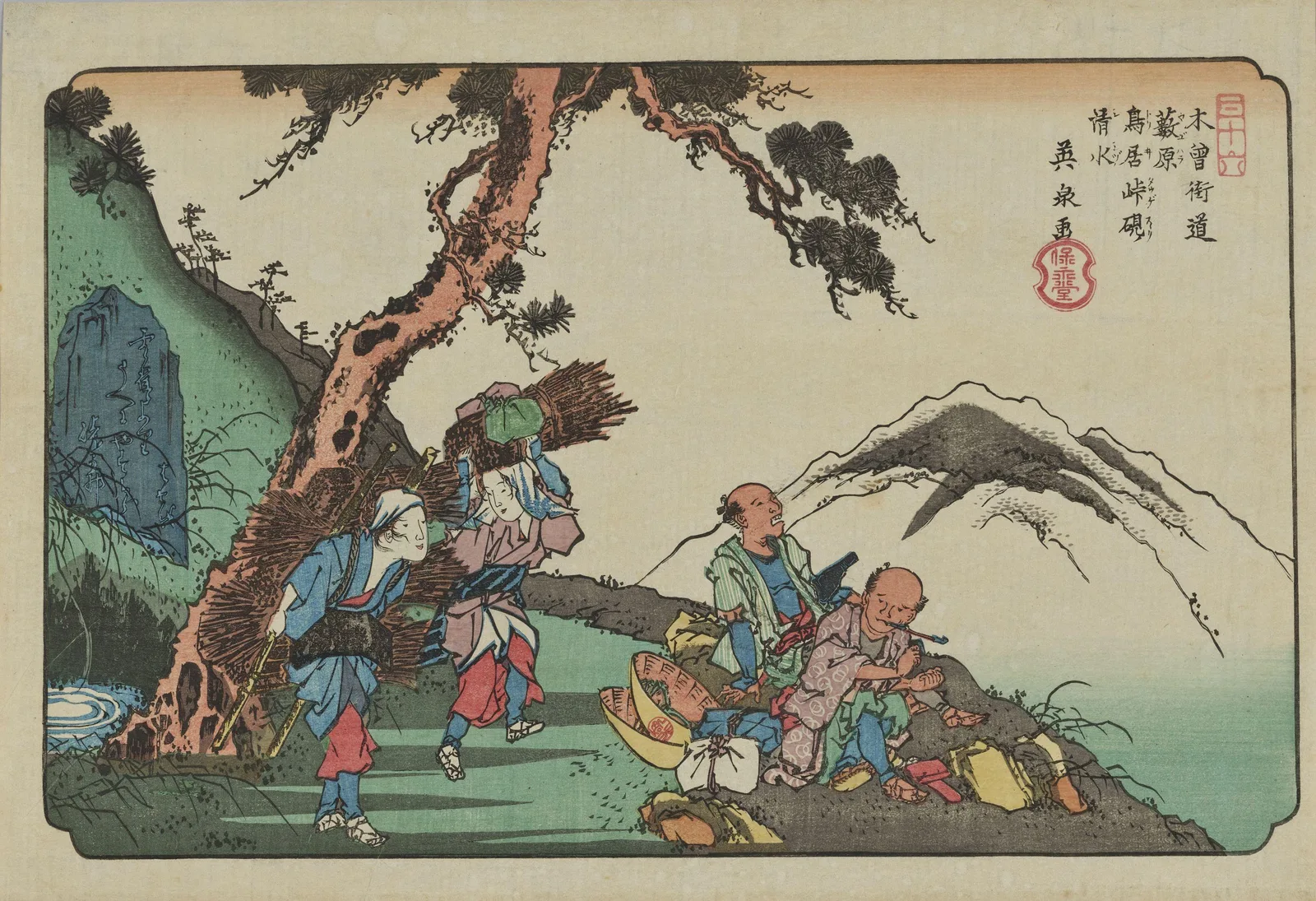
The Sixty-nine Stations of the Kisokaido ・ 36
The Suzuri Spring at Torii Pass near Yabuhara
木曽街道 藪原 鳥居峠硯ノ清水
Eisen's print shows travelers resting beside the Suzuri-no-Shimizu spring and women carrying firewood on the Torii Pass between Yabuhara and Narai. A large pine, a stone monument, and distant snowy mountains convey the clear air of the deep mountain pass.
- Artist
- Keisai Eisen
- Date
- c. 1835-36 (Tenpo 6-7)
- Medium / format
- Woodblock print (ukiyo-e)
- Series
- The Sixty-nine Stations of the Kisokaido 71 prints
About this work
A thick pine stands at the left of the picture, and two women carrying firewood walk at its base. At the far left is a large stone monument, and the pool beneath it is thought to be the Suzuri-no-Shimizu spring. In the right foreground two travelers sit with their loads set down, resting with pipes in hand. In the distance a snow-capped mountain looks out.
The pine trunk is drawn thick in red-brown, and its branches spread across the whole top of the picture. The sky at right is left pale, and the snowy mountain is rendered with ink lines and white. The indigo and red of the women's robes and the pale colors of the travelers' robes stand out against the green slope of the pass.
The Torii Pass divides the Kiso River and Shinano River watersheds and was one of the difficult passes on the Nakasendo. The pass is said to be named for a torii gate erected to pray for victory in battle. Suzuri-no-Shimizu is regarded as a spring with a legend connected to Kiso Yoshinaka, and historic sites associated with Yoshinaka still remain at the pass.
This is one of the designs by Keisai Eisen, who handled the first half of the series. Eisen's share becomes sparse around here, and from this point Utagawa Hiroshige's designs predominate. The distant snowy mountain may depict Mount Ontake, which is clearly visible from the pass.
The place today
The site of Yabuhara-juku is in Kiso Village (Nagano), near the source of the Kiso River, where shops making and selling Oroku combs still remain along the old road. A pass road leading to Narai-juku has been developed on the Torii Pass north of the post town, and one can walk it past stone paving, a great horse chestnut tree, and the remains of the Yoshinaka inkstone spring.
Where can I see it?
Exhibitions change over time. Check each museum's exhibition information before you visit.
Museums that hold this work
- Tokyo National MuseumMuseum's page for this work (opens in a new tab)
Taito City, Tokyo Accession no. A-12499-103
- National Diet LibraryMuseum's page for this work (opens in a new tab)
Chiyoda City, Tokyo Accession no. 寄別2-2-1-5
Included in Kisokaido Rokujukyu-tsugi
Museums abroad
Frequently asked questions
- Who painted The Sixty-nine Stations of the Kisokaido: The Suzuri Spring at Torii Pass near Yabuhara, and when?
- The Sixty-nine Stations of the Kisokaido: The Suzuri Spring at Torii Pass near Yabuhara is by Keisai Eisen, made in c. 1835-36 (Tenpo 6-7). Medium: Woodblock print (ukiyo-e).
- What place does The Sixty-nine Stations of the Kisokaido: The Suzuri Spring at Torii Pass near Yabuhara show?
- It shows Yabuhara-juku, Torii Pass (Nagano).
- Where can I see The Sixty-nine Stations of the Kisokaido: The Suzuri Spring at Torii Pass near Yabuhara?
- It is held by Tokyo National Museum, National Diet Library. Exhibitions change, so check each museum's information before you visit.
Sources and references
- ColBase(東京国立博物館): 木曽街道 藪原 鳥居峠硯ノ清水 (opens in a new tab) (checked 2026-10-19)
- 国立国会図書館デジタルコレクション: 三十六 木曽海道薮原鳥居峠硯ノ清水 (opens in a new tab) (checked 2026-10-19)
- Wikipedia: 木曽海道六十九次 (opens in a new tab) (checked 2026-10-19)
You may also like
More from Nagano
Discover more of the same region on our sister sites.