The Sixty-nine Stations of the Kisokaido ・ 35
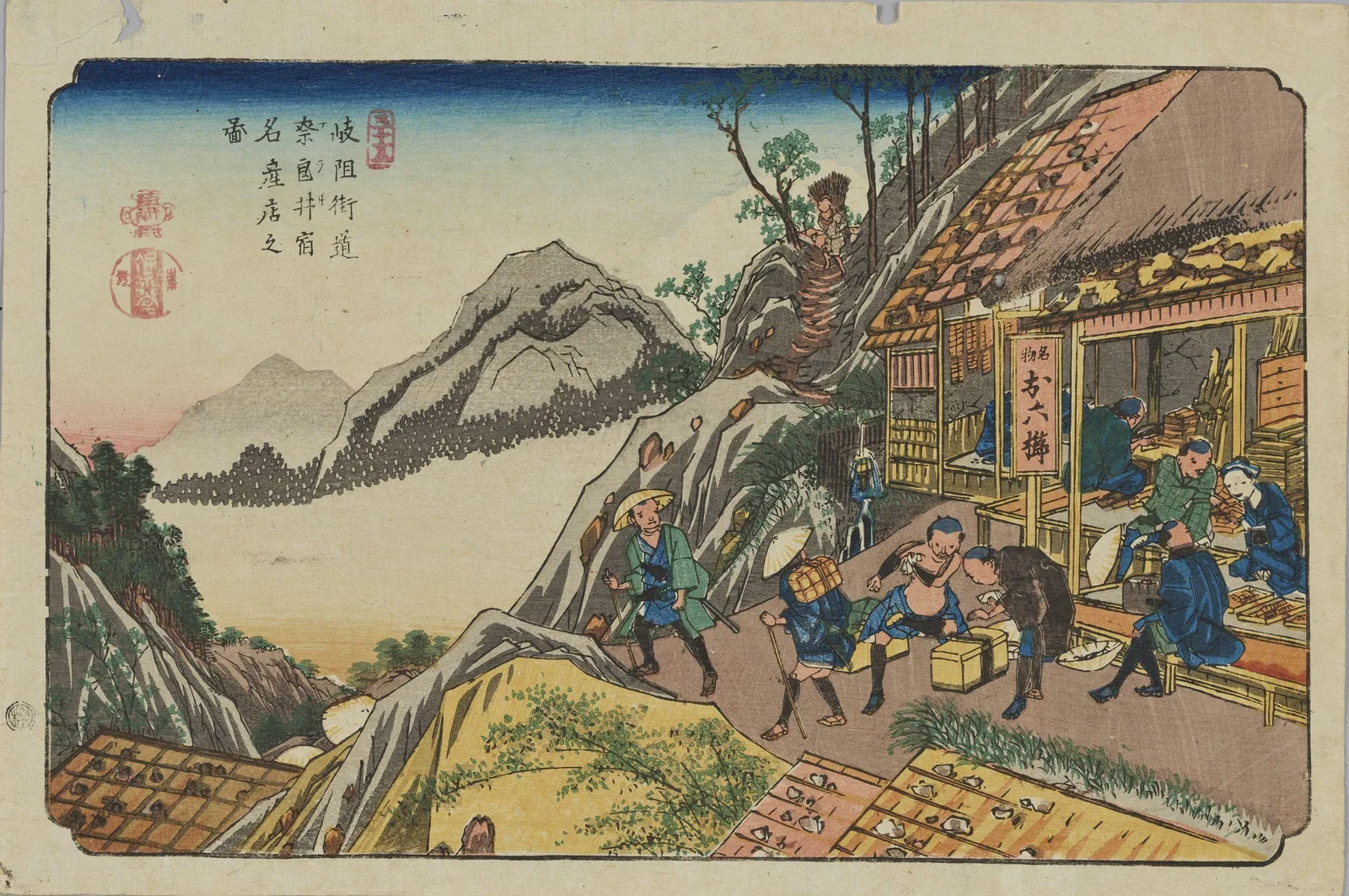
Shop Selling Local Specialties at Narai Station
岐阻街道 奈良井宿 名産店之図
Eisen's print shows a shop selling Narai's specialties and travelers on the mountain road. Customers browse at a shop with an "Oroku comb" signboard, and behind them rise the steep mountains of the Kiso Valley, showing life in a mountain post town.
- Artist
- Keisai Eisen
- Date
- c. 1835-36 (Tenpo 6-7)
- Medium / format
- Woodblock print (ukiyo-e)
- Series
- The Sixty-nine Stations of the Kisokaido 71 prints
- Place depicted
- Narai-juku(Nagano)
About this work
At right is a shingle-roofed shop, with a signboard reading "Oroku comb" hanging from its eaves. Inside, craftsmen and shop staff lay out their wares, and in front travelers stop to pick up the goods. Up the slope at left climb a traveler in a broad hat and a person carrying a load, and stones are placed on the roof in the foreground.
The left half of the picture is layered with mountains wrapped in mist, their depth created by gray and ink gradations. The red-brown roof of the shop and the indigo and green of the figures color the right half, contrasting with the pale mountains at left. Trees grow on the cliff, conveying the post town clinging to the mountainside.
Narai was a post town between Niekawa and Yabuhara, at the northern foot of the Torii Pass. It prospered with travelers staying before and after crossing the pass and is said to have been so lively that it was called "Narai of a thousand houses." The Oroku comb was a Kiso specialty, probably sold as a souvenir at the post town across the pass.
This is one of the designs by Keisai Eisen, who handled the first half of the series, and the impression at the Tokyo National Museum bears no signature. Eisen often wrote specialties and famous sites into his titles, and here too the subject is the post town's specialty. The shingle-roofed house with stones on the roof is typical of Kiso mountain villages.
The place today
Narai-juku is in Shiojiri, where a row of houses with projecting beams continues for about one kilometer, and in 1978 it was selected as an Important Preservation District for Groups of Traditional Buildings. Many houses run lacquerware and bentwood shops or inns, and one can also walk the stone-paved pass road toward the Torii Pass.
Where can I see it?
Exhibitions change over time. Check each museum's exhibition information before you visit.
Museums that hold this work
- Tokyo National MuseumMuseum's page for this work (opens in a new tab)
Taito City, Tokyo Accession no. A-12499-102
- National Diet LibraryMuseum's page for this work (opens in a new tab)
Chiyoda City, Tokyo Accession no. 寄別2-2-1-5
Included in Kisokaido Rokujukyu-tsugi
Museums abroad
Frequently asked questions
- Who painted The Sixty-nine Stations of the Kisokaido: Shop Selling Local Specialties at Narai Station, and when?
- The Sixty-nine Stations of the Kisokaido: Shop Selling Local Specialties at Narai Station is by Keisai Eisen, made in c. 1835-36 (Tenpo 6-7). Medium: Woodblock print (ukiyo-e).
- What place does The Sixty-nine Stations of the Kisokaido: Shop Selling Local Specialties at Narai Station show?
- It shows Narai-juku (Nagano).
- Where can I see The Sixty-nine Stations of the Kisokaido: Shop Selling Local Specialties at Narai Station?
- It is held by Tokyo National Museum, National Diet Library. Exhibitions change, so check each museum's information before you visit.
Sources and references
- ColBase(東京国立博物館): 岐阻街道 奈良井宿 名産店之図 (opens in a new tab) (checked 2026-10-19)
- 国立国会図書館デジタルコレクション: 三十五 岐阻街道奈良井宿名産店之図 (opens in a new tab) (checked 2026-10-19)
- Wikipedia: 木曽海道六十九次 (opens in a new tab) (checked 2026-10-19)
You may also like
More from Nagano
Discover more of the same region on our sister sites.