The Sixty-nine Stations of the Kisokaido ・ 29
Wada
木曽海道六拾九次之内 和田
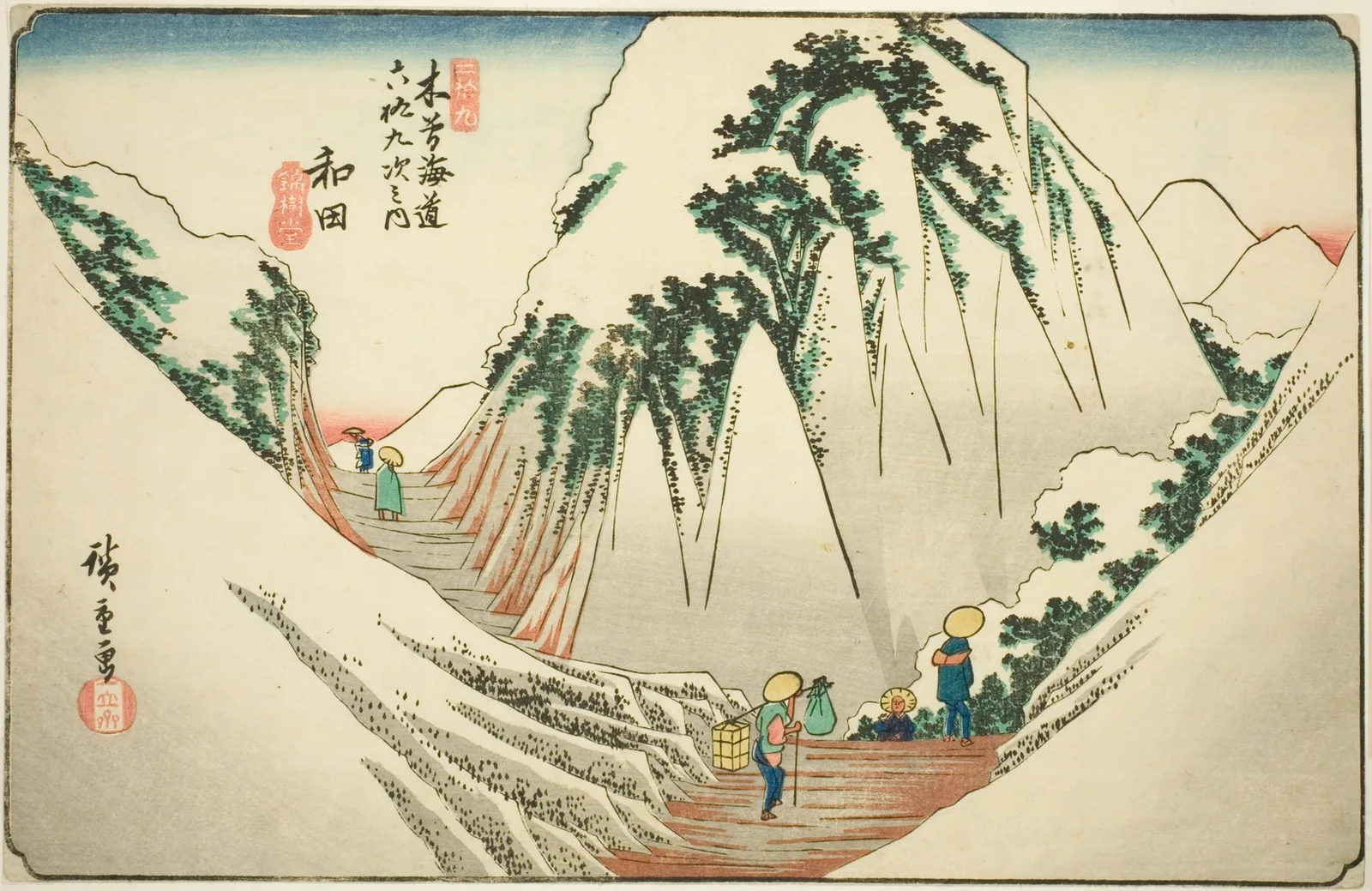
Hiroshige's print shows travelers making their way slowly over the snow-covered Wada Pass. The green of pines and the pink of rocks are etched into the white mountainside, conveying the severity and silence of the winter pass, regarded as the hardest on the Nakasendo.
- Artist
- Utagawa Hiroshige
- Date
- c. 1835-38 (Tenpo 6-9)
- Medium / format
- Woodblock print (ukiyo-e)
- Series
- The Sixty-nine Stations of the Kisokaido 71 prints
- Place depicted
- Wada-juku(Nagano)
About this work
In the center of the picture rises a steep snow-covered mountain. A road threads through the valley, where in the foreground travelers with loads and men in broad hats rest, and small figures can also be seen on the slope beyond. Snow lies on the slopes at left and right as well, and the road is squeezed between mountains closing in from both sides.
The snowy mountain is expressed by leaving most of the picture in the white of the paper. Only the green of the pines along the mountainside and the pale pink touched on the rock faces add color, and the indigo of the sky closes the top. The road is layered diagonally from front to back, emphasizing the depth and height of the mountain.
Wada was a post town between Nagakubo and Shimosuwa, with the Wada Pass, over 1,500 meters high, looming to its west. One of the highest passes on the Nakasendo, it was known as a difficult crossing closed by snow in winter, and facilities to help travelers are said to have been placed there.
This is a design by Utagawa Hiroshige. While the title is the name of the post town, it depicts the snowy scenery of the pass, not the town. The same design is also at the Art Institute of Chicago and the Metropolitan Museum of Art, and the tones of the sky and snow gradations differ between impressions.
The place today
The site of Wada-juku is in Wada, Nagawa, where the honjin building rebuilt after a great fire at the end of the Edo period has been preserved and restored and is open to the public. Inn buildings also remain along the old road. The Wada Pass to the west has long been known as a source of obsidian, and part of the pass road can still be walked.
Where can I see it?
Exhibitions change over time. Check each museum's exhibition information before you visit.
Museums that hold this work
- Tokyo National MuseumMuseum's page for this work (opens in a new tab)
Taito City, Tokyo Accession no. A-12499-96
- National Diet LibraryMuseum's page for this work (opens in a new tab)
Chiyoda City, Tokyo Accession no. 寄別2-2-1-5
Included in Kisokaido Rokujukyu-tsugi
Museums abroad
- Art Institute of ChicagoMuseum's page for this work (opens in a new tab)
Chicago Accession no. 1939.2226
- The Metropolitan Museum of ArtMuseum's page for this work (opens in a new tab)
New York Accession no. JP42
Frequently asked questions
- Who painted The Sixty-nine Stations of the Kisokaido: Wada, and when?
- The Sixty-nine Stations of the Kisokaido: Wada is by Utagawa Hiroshige, made in c. 1835-38 (Tenpo 6-9). Medium: Woodblock print (ukiyo-e).
- What place does The Sixty-nine Stations of the Kisokaido: Wada show?
- It shows Wada-juku (Nagano).
- Where can I see The Sixty-nine Stations of the Kisokaido: Wada?
- It is held by Tokyo National Museum, National Diet Library. Exhibitions change, so check each museum's information before you visit.
Sources and references
- Art Institute of Chicago: No. 29: Wada, from the series "Sixty-nine Stations of the Kisokaido (Kisokaido rokujukyu tsugi no uchi)" (opens in a new tab) (checked 2026-10-19)
- ColBase(東京国立博物館): 木曽海道六拾九次之内 和田 (opens in a new tab) (checked 2026-10-19)
- 国立国会図書館デジタルコレクション: 二拾九 木曽海道六拾九次之内和田 (opens in a new tab) (checked 2026-10-19)
- The Metropolitan Museum of Art: Wada Station (JP42) (opens in a new tab) (checked 2026-10-19)
- Wikipedia: 木曽海道六十九次 (opens in a new tab) (checked 2026-10-19)
You may also like
More from Nagano
Discover more of the same region on our sister sites.