The Sixty-nine Stations of the Kisokaido ・ 43
Tsumago
木曽海道六拾九次之内 妻籠
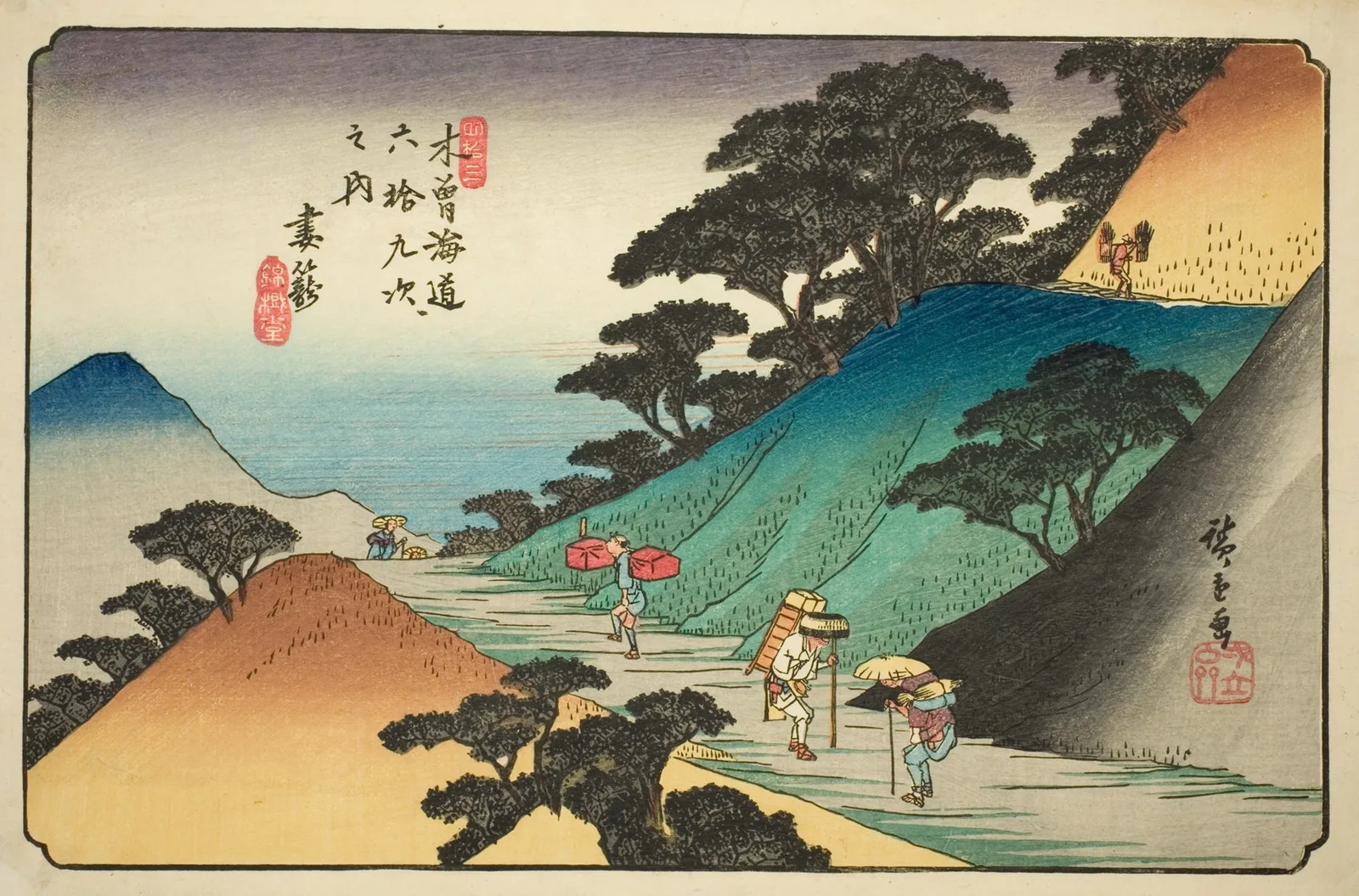
Travelers carrying loads go along a mountain road toward Tsumago. Mountainsides of blue, green, and ocher overlap, and a road dotted with pines leads into the depths of the valley, conveying the deep mountains of the Kiso Road.
- Artist
- Utagawa Hiroshige
- Date
- c. 1835-38 (Tenpo 6-9)
- Medium / format
- Woodblock print (ukiyo-e)
- Series
- The Sixty-nine Stations of the Kisokaido 71 prints
- Place depicted
- Tsumago-juku(Nagano)
About this work
Up the slope in the foreground climb a traveler with a staff and a person carrying a pack frame, and ahead of them a man shoulders a red load on a pole. The road threads between the mountains into the distance, where tiny travelers can also be seen. On the slope at upper right a person carrying firewood is about to cross the ridge.
The picture is striking for its mountainsides painted in bands of color: ocher in the left foreground, blue and green in the middle, and gray at right. Black pine branches are placed at key points, and the indigo of distant mountains and the gradations of the sky create a quiet depth.
Tsumago lay at a key point where the Nakasendo and the road to Ina diverged. Located in the southern part of the Kiso Valley, it is said that many travelers crossing the Magome Pass toward Mino rested here. A record of 1843 (Tenpo 14) gives it as a small post town with about 31 houses and 31 inns.
This is a design by Hiroshige. Rather than the rows of houses in the post town, it depicts the mountain road leading to it and the toil of travel, a composition common in Hiroshige's Kiso Road designs. The method of dividing mountains into bands of color is thought to be Hiroshige's device that valued the composition of the picture over realism.
The place today
Tsumago-juku preserved the townscape of the Edo period through a residents' preservation movement, and in 1976 it became one of the first areas selected as an Important Preservation District for Groups of Traditional Buildings. The waki-honjin Okuya and the reconstructed honjin are open to the public, and the landscape including the surrounding forests and farmland is maintained.
Where can I see it?
Exhibitions change over time. Check each museum's exhibition information before you visit.
Museums that hold this work
- Tokyo National MuseumMuseum's page for this work (opens in a new tab)
Taito City, Tokyo Accession no. A-12499-110
- National Diet LibraryMuseum's page for this work (opens in a new tab)
Chiyoda City, Tokyo Accession no. 寄別2-2-1-5
Included in Kisokaido Rokujukyu-tsugi
Museums abroad
- Art Institute of ChicagoMuseum's page for this work (opens in a new tab)
Chicago Accession no. 1939.2208
Frequently asked questions
- Who painted The Sixty-nine Stations of the Kisokaido: Tsumago, and when?
- The Sixty-nine Stations of the Kisokaido: Tsumago is by Utagawa Hiroshige, made in c. 1835-38 (Tenpo 6-9). Medium: Woodblock print (ukiyo-e).
- What place does The Sixty-nine Stations of the Kisokaido: Tsumago show?
- It shows Tsumago-juku (Nagano).
- Where can I see The Sixty-nine Stations of the Kisokaido: Tsumago?
- It is held by Tokyo National Museum, National Diet Library. Exhibitions change, so check each museum's information before you visit.
Sources and references
- Art Institute of Chicago: No. 43: Tsumagome, from the series "Sixty-nine Stations of the Kisokaido (Kisokaido rokujukyu tsugi no uchi)" (opens in a new tab) (checked 2026-10-19)
- ColBase(東京国立博物館): 木曽海道六拾九次之内 妻籠 (opens in a new tab) (checked 2026-10-19)
- 国立国会図書館デジタルコレクション: 四拾三 木曽海道六拾九次之内妻篭 (opens in a new tab) (checked 2026-10-19)
- Wikipedia: 木曽海道六十九次 (opens in a new tab) (checked 2026-10-19)
You may also like
More from Nagano
Discover more of the same region on our sister sites.