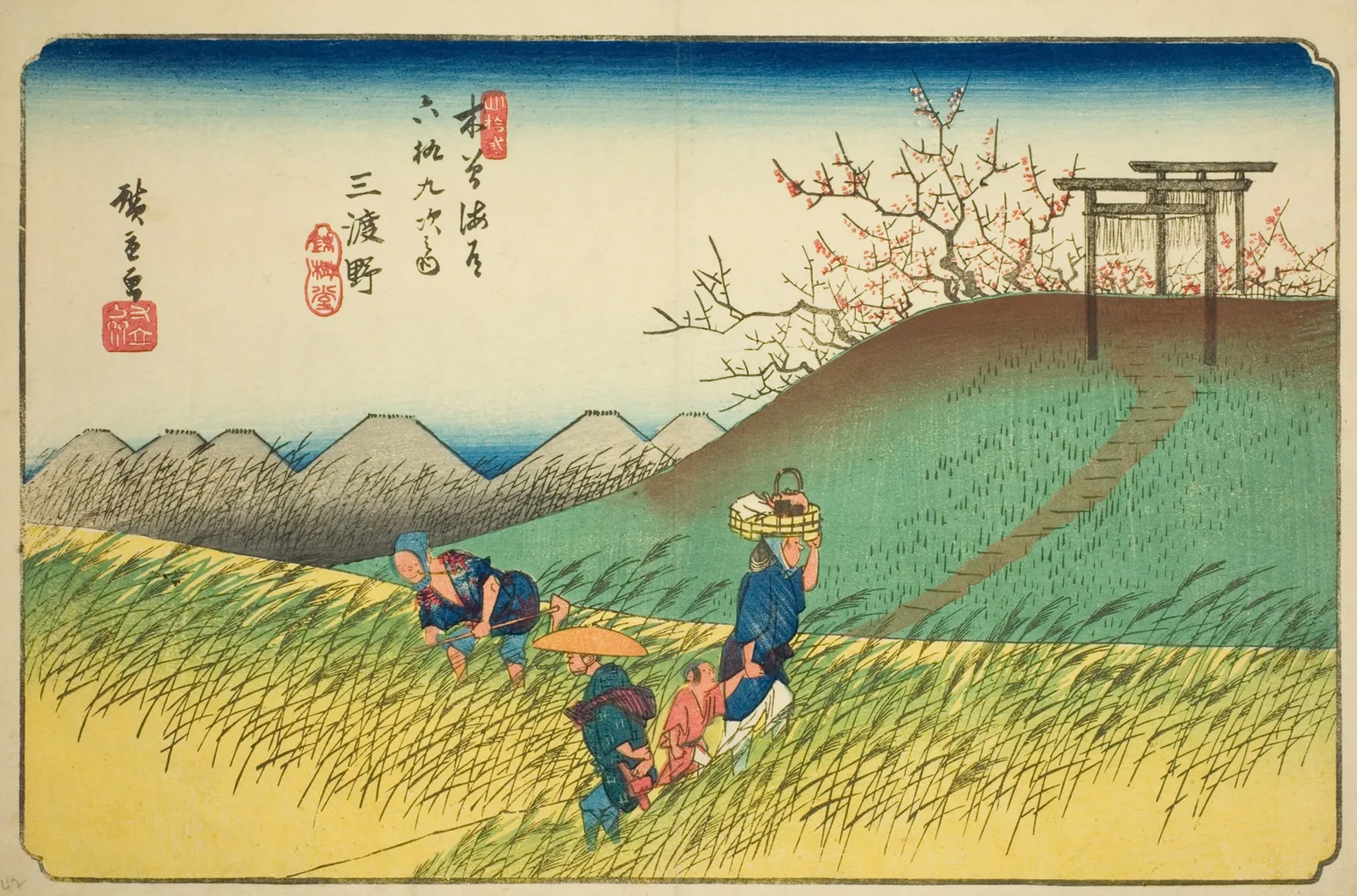
The Sixty-nine Stations of the Kisokaido ・ 42
Midono
木曽海道六拾九次之内 三渡野
Travelers walk through a windblown meadow at Midono. On a small hill stand a torii gate and a plum tree in full bloom, with gray mountains stretching into the distance. It is a bright, light design that conveys the strong winds of early spring.
- Artist
- Utagawa Hiroshige
- Date
- c. 1835-38 (Tenpo 6-9)
- Medium / format
- Woodblock print (ukiyo-e)
- Series
- The Sixty-nine Stations of the Kisokaido 71 prints
- Place depicted
- Midono-juku(Nagano)
About this work
In the meadow in the foreground, tall grass bends all together to the right in the wind. Moving through it are a woman with a basket on her head and a child, a person in a broad hat, and a man bent at the waist. On the hill at right a stone-stepped path climbs to a torii gate and red and white plum blossoms at the top.
The grass is drawn by overlapping fine lines of yellow and green, so the direction of the wind is clearly conveyed. The indigo gradation of the sky, the green of the hill, and the red of the plum blossoms harmonize brightly, and the gray mountains at left rear give the picture depth.
Midono was a post town along the Kiso River, which in the Edo period bustled alongside Tsumago. Its name is said to derive from the medieval residence of the Kiso clan, called a "gooden (midono)." A record of 1843 (Tenpo 14) gives about 77 houses and 32 inns, making it a post town with many inns. It is also where Princess Kazunomiya stayed on her way down to Edo.
This is by Hiroshige, and its title writes the name with different characters. Depicting not the post town itself but a nearby hill and meadow, it is thought to have chosen the simple scenery of the Kiso Road. The figures advancing against the wind also express the strength of a spring storm.
The place today
Midono-juku lost many houses, including the honjin, in the great fire of 1881, and the present townscape was rebuilt afterward. At the honjin site north of Nagiso Station remain an old weeping plum that survived the fire and a memorial stone for the Meiji Emperor's temporary residence. The townscape dates from the Meiji era onward.
Where can I see it?
Exhibitions change over time. Check each museum's exhibition information before you visit.
Museums that hold this work
- Tokyo National MuseumMuseum's page for this work (opens in a new tab)
Taito City, Tokyo Accession no. A-12499-109
- National Diet LibraryMuseum's page for this work (opens in a new tab)
Chiyoda City, Tokyo Accession no. 寄別2-2-1-5
Included in Kisokaido Rokujukyu-tsugi
Museums abroad
- Art Institute of ChicagoMuseum's page for this work (opens in a new tab)
Chicago Accession no. 1963.702
Frequently asked questions
- Who painted The Sixty-nine Stations of the Kisokaido: Midono, and when?
- The Sixty-nine Stations of the Kisokaido: Midono is by Utagawa Hiroshige, made in c. 1835-38 (Tenpo 6-9). Medium: Woodblock print (ukiyo-e).
- What place does The Sixty-nine Stations of the Kisokaido: Midono show?
- It shows Midono-juku (Nagano).
- Where can I see The Sixty-nine Stations of the Kisokaido: Midono?
- It is held by Tokyo National Museum, National Diet Library. Exhibitions change, so check each museum's information before you visit.
Sources and references
- Art Institute of Chicago: No. 42: Midono, from the series "Sixty-nine Stations of the Kisokaido (Kisokaido rokujukyu tsugi no uchi)" (opens in a new tab) (checked 2026-10-19)
- ColBase(東京国立博物館): 木曽海道六拾九次之内 三渡野 (opens in a new tab) (checked 2026-10-19)
- 国立国会図書館デジタルコレクション: 四十弐 木曽海道六拾九次之内三渡野 (opens in a new tab) (checked 2026-10-19)
- Wikipedia: 木曽海道六十九次 (opens in a new tab) (checked 2026-10-19)
You may also like
More from Nagano
Discover more of the same region on our sister sites.