The Sixty-nine Stations of the Kisokaido ・ 33
Motoyama
木曽海道六拾九次之内 本山
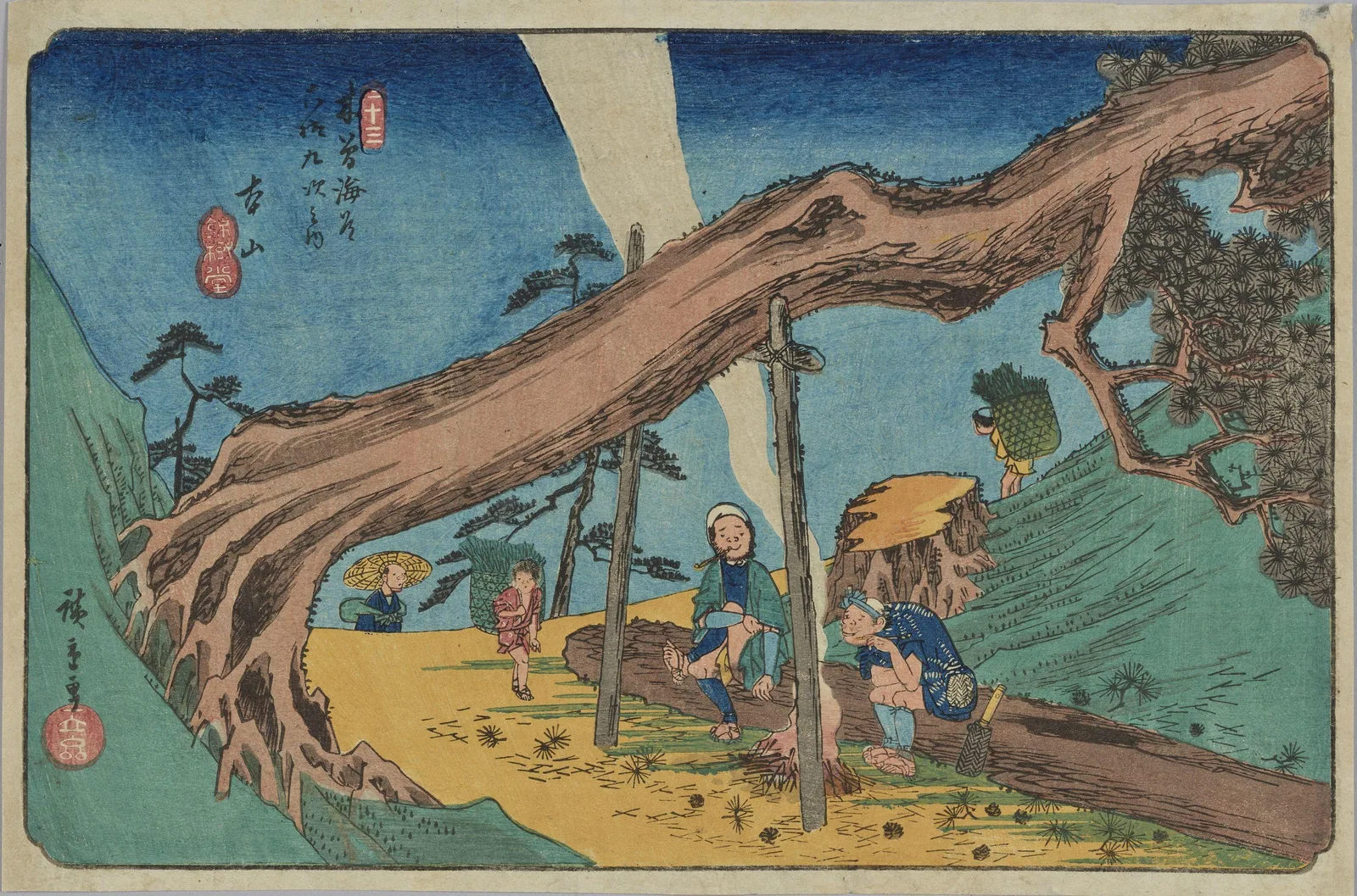
Hiroshige's print shows a huge pine leaning over a mountain road near Motoyama and people warming themselves at a bonfire beneath it. A thick trunk braced with props crosses the picture, presenting a simple scene of rest in the mountains.
- Artist
- Utagawa Hiroshige
- Date
- c. 1835-38 (Tenpo 6-9)
- Medium / format
- Woodblock print (ukiyo-e)
- Series
- The Sixty-nine Stations of the Kisokaido 71 prints
- Place depicted
- Motoyama-juku(Nagano)
About this work
A huge pine, about to fall, crosses the top of the picture from left to right. The trunk is supported by two logs, and beneath it men gather around a bonfire, one sitting with a pipe in his mouth. From the road at left come a traveler in a broad hat and a child, and on the slope at right a person carrying brushwood climbs up.
The sky is a deep indigo gradation, and white smoke rising from the bonfire splits the picture vertically. The ocher ground, the red-brown of the pine trunk, and the green of the slope are painted in clear contrast, and the curve of the great trunk encloses the whole picture like a frame. The figures are tucked small beneath it.
Motoyama was a post town between Niekawa and Seba, located near the northern entrance to the Kiso Road. The area is also said to be the birthplace of soba-kiri (cut buckwheat noodles), and a book of the mid-Edo period records that Motoyama's soba-kiri spread throughout the provinces.
This is a design by Utagawa Hiroshige. The way the fallen pine is propped up and kept in use is thought to depict a piece of mountain-dwellers' wisdom. The composition of dividing the picture with a large tree is related to the Karuizawa print and others, and it was a device Hiroshige used repeatedly in this series.
The place today
The site of Motoyama-juku is in Motoyama, Soga, Shiojiri, where along the old road remain rows of inns built with projecting beams. Claiming to be the birthplace of soba-kiri, the post town has shops serving handmade soba. It is a quiet settlement between Seba and Niekawa, and a place where people walking the Nakasendo stop by.
Where can I see it?
Exhibitions change over time. Check each museum's exhibition information before you visit.
Museums that hold this work
- Tokyo National MuseumMuseum's page for this work (opens in a new tab)
Taito City, Tokyo Accession no. A-12499-100
- National Diet LibraryMuseum's page for this work (opens in a new tab)
Chiyoda City, Tokyo Accession no. 寄別2-2-1-5
Included in Kisokaido Rokujukyu-tsugi
Museums abroad
Frequently asked questions
- Who painted The Sixty-nine Stations of the Kisokaido: Motoyama, and when?
- The Sixty-nine Stations of the Kisokaido: Motoyama is by Utagawa Hiroshige, made in c. 1835-38 (Tenpo 6-9). Medium: Woodblock print (ukiyo-e).
- What place does The Sixty-nine Stations of the Kisokaido: Motoyama show?
- It shows Motoyama-juku (Nagano).
- Where can I see The Sixty-nine Stations of the Kisokaido: Motoyama?
- It is held by Tokyo National Museum, National Diet Library. Exhibitions change, so check each museum's information before you visit.
Sources and references
- ColBase(東京国立博物館): 木曽海道六拾九次之内 本山 (opens in a new tab) (checked 2026-10-19)
- 国立国会図書館デジタルコレクション: 三十三 木曽海道六拾九次之内本山 (opens in a new tab) (checked 2026-10-19)
- Wikipedia: 木曽海道六十九次 (opens in a new tab) (checked 2026-10-19)
You may also like
More from Nagano
Discover more of the same region on our sister sites.