The Sixty-nine Stations of the Kisokaido ・ 47
Oi
木曽海道六拾九次之内 大井
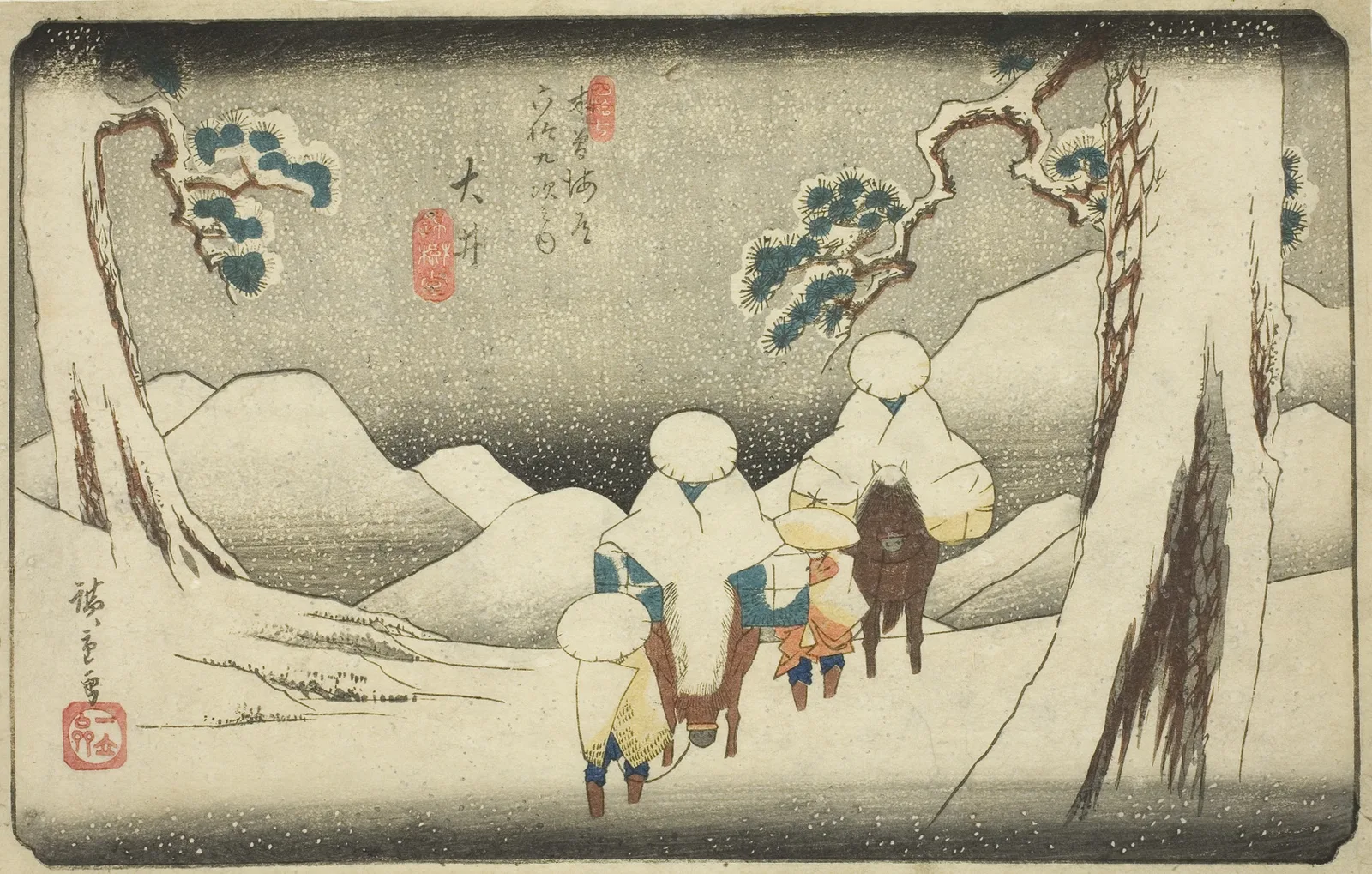
A party of snow-covered packhorses advances through falling snow at Oi. Snow-white mountains and snow-laden pine branches surround the picture, conveying at once the severity of winter travel and the stillness of a snowscape.
- Artist
- Utagawa Hiroshige
- Date
- c. 1835-38 (Tenpo 6-9)
- Medium / format
- Woodblock print (ukiyo-e)
- Series
- The Sixty-nine Stations of the Kisokaido 71 prints
- Place depicted
- Oi-juku(Gifu)
About this work
In the center of the picture, two horses loaded with snow-covered cargo and travelers wrapped in straw capes and hats proceed up the slope with their backs to the viewer. Large snow-laden trees stand at left and right, and pine branches hang down from above.
The sky is painted gray, and falling snow is shown with white dots. The mountains are drawn only with outlines and pale gradations, so most of the picture is occupied by white and gray. Within it, the brown of the horses and the blue and yellow of the robes add a little warmth.
Oi was a post town in Mino, corresponding to today's Ena. Beyond it the road continues over mountainous ground toward Okute and Hosokute, and it was probably a hard stage for winter travelers. One honjin and one waki-honjin were placed there, and the post town is known for a layout in which the road turns at right angles several times.
This is by Hiroshige and is regarded as one of the masterpieces of snow scenes. The Metropolitan Museum of Art holds three impressions, with differences in the sky gradation and the handling of snow. By not showing the travelers' faces and drawing only their backs, it conveys the weight of a journey silently advancing along a snowy road.
The place today
Oi-juku is in the center of today's Ena, Gifu Prefecture, and the site of the honjin is designated a Gifu Prefecture historic site. A honjin gate said to date from that time remains, and the right-angled course of the road is also preserved as in the post-town era. Buildings of inns and merchant houses are scattered about, conveying the atmosphere of the past.
Where can I see it?
Exhibitions change over time. Check each museum's exhibition information before you visit.
Museums that hold this work
- Tokyo National MuseumMuseum's page for this work (opens in a new tab)
Taito City, Tokyo Accession no. A-12499-115
- National Diet LibraryMuseum's page for this work (opens in a new tab)
Chiyoda City, Tokyo Accession no. 寄別2-2-1-5
Included in Kisokaido Rokujukyu-tsugi
Museums abroad
- Art Institute of ChicagoMuseum's page for this work (opens in a new tab)
Chicago Accession no. 1928.349
- The Metropolitan Museum of ArtMuseum's page for this work (opens in a new tab)
New York Accession no. JP33
- The Metropolitan Museum of ArtMuseum's page for this work (opens in a new tab)
New York Accession no. JP2501
- The Metropolitan Museum of ArtMuseum's page for this work (opens in a new tab)
New York Accession no. JP2872
Frequently asked questions
- Who painted The Sixty-nine Stations of the Kisokaido: Oi, and when?
- The Sixty-nine Stations of the Kisokaido: Oi is by Utagawa Hiroshige, made in c. 1835-38 (Tenpo 6-9). Medium: Woodblock print (ukiyo-e).
- What place does The Sixty-nine Stations of the Kisokaido: Oi show?
- It shows Oi-juku (Gifu).
- Where can I see The Sixty-nine Stations of the Kisokaido: Oi?
- It is held by Tokyo National Museum, National Diet Library. Exhibitions change, so check each museum's information before you visit.
Sources and references
- Art Institute of Chicago: No. 47: Oi, from the series "Sixty-nine Stations of the Kisokaido (Kisokaido rokujukyu tsugi no uchi)" (opens in a new tab) (checked 2026-10-19)
- ColBase(東京国立博物館): 木曽海道六拾九次之内 大井 (opens in a new tab) (checked 2026-10-19)
- 国立国会図書館デジタルコレクション: 四拾七 木曽海道六拾九次之内大井 (opens in a new tab) (checked 2026-10-19)
- The Metropolitan Museum of Art: Ōi Station (opens in a new tab) (checked 2026-10-19)
- The Metropolitan Museum of Art: Ōi Station (opens in a new tab) (checked 2026-10-19)
- The Metropolitan Museum of Art: Ōi (opens in a new tab) (checked 2026-10-19)
- Wikipedia: 木曽海道六十九次 (opens in a new tab) (checked 2026-10-19)
You may also like
More from Gifu
Discover more of the same region on our sister sites.
Matsuri Biyori
Festivals in Gifu
- Takayama Festival Yatai Float Event
- Furukawa Festival Okoshi-daiko and Yatai Float Event
- Ogaki Festival Yama Float Event
- Gujo Odori