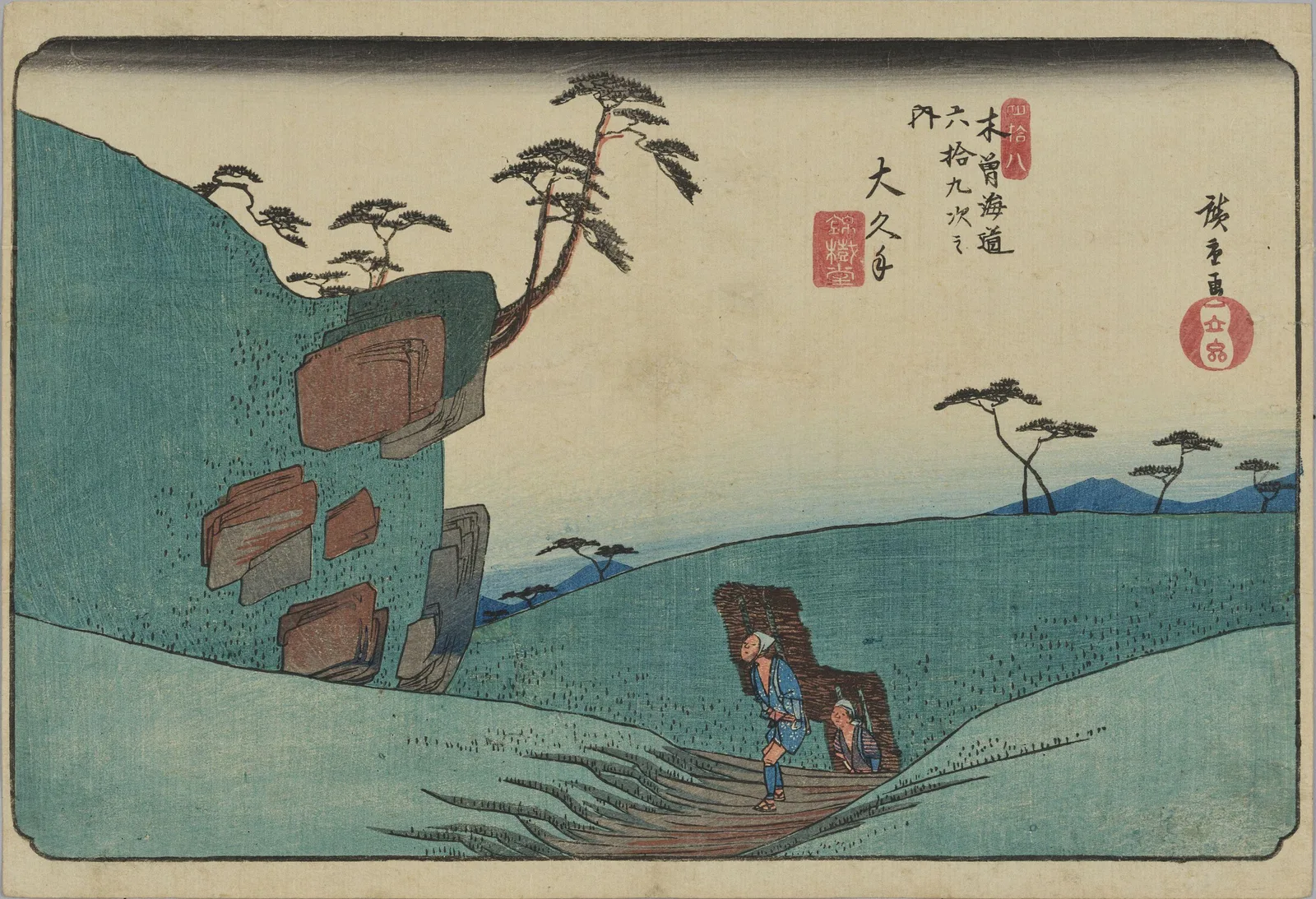
The Sixty-nine Stations of the Kisokaido ・ 48
Okute
木曽海道六拾九次之内 大久手
A road crossing a mountain ridge near Okute. A moss-covered rocky mountain rises at left, and beneath it travelers carrying brushwood walk along a sunken road. Hills dotted with pines continue in the distance.
- Artist
- Utagawa Hiroshige
- Date
- c. 1835-38 (Tenpo 6-9)
- Medium / format
- Woodblock print (ukiyo-e)
- Series
- The Sixty-nine Stations of the Kisokaido 71 prints
- Place depicted
- Okute-juku(Gifu)
About this work
At the lower center of the picture, two people carrying large bundles of brushwood climb a narrow, gouged-out road. At left rises a large mountain showing reddish-brown rock, with pines spreading their branches at its summit. At right rear gentle hills continue, with slender pines standing here and there.
The mountains and hills are broadly painted in a single blue-green, with fine dots indicating grass, making a simple and bold picture. The figures are drawn small, and the pale yellow of the sky and the indigo of the horizon convey the breadth of the road over the mountains.
Okute was a post town in the mountains of Mino, and its title is written with different characters. The road from Oi to Okute is a rolling section called the Thirteen Passes, said to have been a hard stretch for travelers. One honjin and one waki-honjin were placed there, serving as a resting place for travelers on the mountain road.
This is by Hiroshige. Without drawing the rows of houses of the post town, the composition expresses the mountain post town with only a rocky mountain and road, and the shape of the mountain occupying most of the picture leaves a strong impression. From the figures of local people carrying brushwood, the lives of those who live in the mountains, not only travelers, come across.
The place today
The site of the Okute-juku honjin corresponds to the grounds of the former Okute Elementary School, closed in 2005. The building of the waki-honjin, the Hobo family residence, remains, and a stone-paved road has been restored on the way to Hosokute-juku. The quiet townscape of the mountain post town is still preserved. It is a small post town high in the mountains.
Where can I see it?
Exhibitions change over time. Check each museum's exhibition information before you visit.
Museums that hold this work
- Tokyo National MuseumMuseum's page for this work (opens in a new tab)
Taito City, Tokyo Accession no. A-12499-116
- National Diet LibraryMuseum's page for this work (opens in a new tab)
Chiyoda City, Tokyo Accession no. 寄別2-2-1-5
Included in Kisokaido Rokujukyu-tsugi
Museums abroad
Frequently asked questions
- Who painted The Sixty-nine Stations of the Kisokaido: Okute, and when?
- The Sixty-nine Stations of the Kisokaido: Okute is by Utagawa Hiroshige, made in c. 1835-38 (Tenpo 6-9). Medium: Woodblock print (ukiyo-e).
- What place does The Sixty-nine Stations of the Kisokaido: Okute show?
- It shows Okute-juku (Gifu).
- Where can I see The Sixty-nine Stations of the Kisokaido: Okute?
- It is held by Tokyo National Museum, National Diet Library. Exhibitions change, so check each museum's information before you visit.
Sources and references
- ColBase(東京国立博物館): 木曽海道六拾九次之内 大久手 (opens in a new tab) (checked 2026-10-19)
- 国立国会図書館デジタルコレクション: 四拾八 木曽海道六拾九次之内大久手 (opens in a new tab) (checked 2026-10-19)
- Wikipedia: 木曽海道六十九次 (opens in a new tab) (checked 2026-10-19)
You may also like
More from Gifu
Discover more of the same region on our sister sites.
Matsuri Biyori
Festivals in Gifu
- Takayama Festival Yatai Float Event
- Furukawa Festival Okoshi-daiko and Yatai Float Event
- Ogaki Festival Yama Float Event
- Gujo Odori