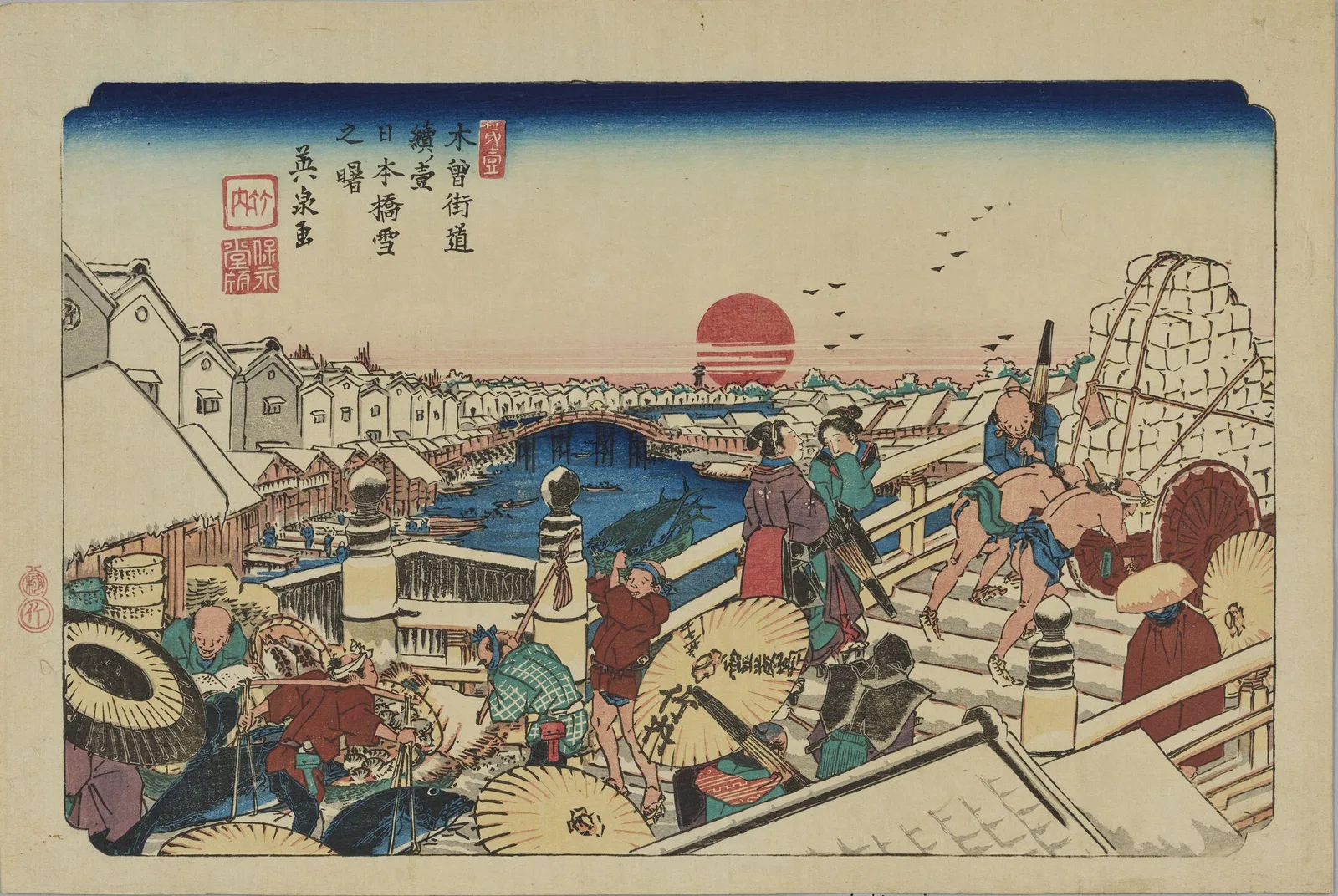
The Sixty-nine Stations of the Kisokaido ・ 1
Nihonbashi: Dawn after Snow
木曽街道続ノ壹 日本橋雪之曙
The first print of the series depicts Nihonbashi, the starting point of the Nakasendo, on a snowy morning. Fish-market workers and men carrying loads cross the snow-covered bridge, and a red rising sun climbs above the white-walled warehouses lining the river.
- Artist
- Keisai Eisen
- Date
- c. 1835-36 (Tenpo 6-7)
- Medium / format
- Woodblock print (ukiyo-e)
- Series
- The Sixty-nine Stations of the Kisokaido 71 prints
- Place depicted
- Nihonbashi(Tokyo)
About this work
In the foreground, men carrying tubs of fish and shoulder poles jostle each other, bending low under their large hats. On the bridge, women holding umbrellas have stopped, and at right a barefoot porter pushes a big load upward. Snow lies even on the giboshi finials of the railing, and boats float on the river beneath the bridge.
Snow-covered white-walled warehouses line the riverbank all the way back, and in the distance another bridge forms an arc. The sky is graded from indigo above to pale crimson below, and the red disk of the sunrise and a flock of birds flying on a diagonal convey the cold morning air. The composition places a large crowd in the foreground and leads the eye into the distance.
Nihonbashi was the starting point of the Five Highways, including the Tokaido and the Nakasendo, and at the foot of the bridge stood the fish market known as the kitchen of Edo. Travelers heading for Kyoto along the Nakasendo also first crossed this bridge and went north.
Keisai Eisen began this series, and the "Zoku no ichi" (Sequel, No. 1) in the title is thought to indicate that it was issued as a sequel to the Tokaido series. The print bears the seal of the publisher Hoeido. The Tokyo National Museum holds both a signed impression and an unsigned one. Utagawa Hiroshige later joined, and the two completed 70 prints, one for each station.
The place today
The present Nihonbashi is a stone double-arch bridge built in 1911 (Meiji 44) and is designated an Important Cultural Property. The Metropolitan Expressway runs directly overhead, but work is under way to move it underground. The Japan Road Origin Marker is embedded in the center of the bridge.
Where can I see it?
Exhibitions change over time. Check each museum's exhibition information before you visit.
Museums that hold this work
- Tokyo National MuseumMuseum's page for this work (opens in a new tab)
Taito City, Tokyo Accession no. A-12499-64
- National Diet LibraryMuseum's page for this work (opens in a new tab)
Chiyoda City, Tokyo Accession no. 寄別7-8-2-2
Held separately as Kisokaido Zoku no Ichi
Museums abroad
Frequently asked questions
- Who painted The Sixty-nine Stations of the Kisokaido: Nihonbashi: Dawn after Snow, and when?
- The Sixty-nine Stations of the Kisokaido: Nihonbashi: Dawn after Snow is by Keisai Eisen, made in c. 1835-36 (Tenpo 6-7). Medium: Woodblock print (ukiyo-e).
- What place does The Sixty-nine Stations of the Kisokaido: Nihonbashi: Dawn after Snow show?
- It shows Nihonbashi (Tokyo).
- Where can I see The Sixty-nine Stations of the Kisokaido: Nihonbashi: Dawn after Snow?
- It is held by Tokyo National Museum, National Diet Library. Exhibitions change, so check each museum's information before you visit.
Sources and references
- ColBase(東京国立博物館): 木曽街道続ノ壹 日本橋雪之曙 (opens in a new tab) (checked 2026-10-19)
- 国立国会図書館デジタルコレクション: 木曽街道続ノ壱 (opens in a new tab) (checked 2026-10-19)
You may also like
More from Tokyo
Discover more of the same region on our sister sites.