The Sixty-nine Stations of the Kisokaido ・ 2
Itabashi Station
木曽街道 板橋之駅
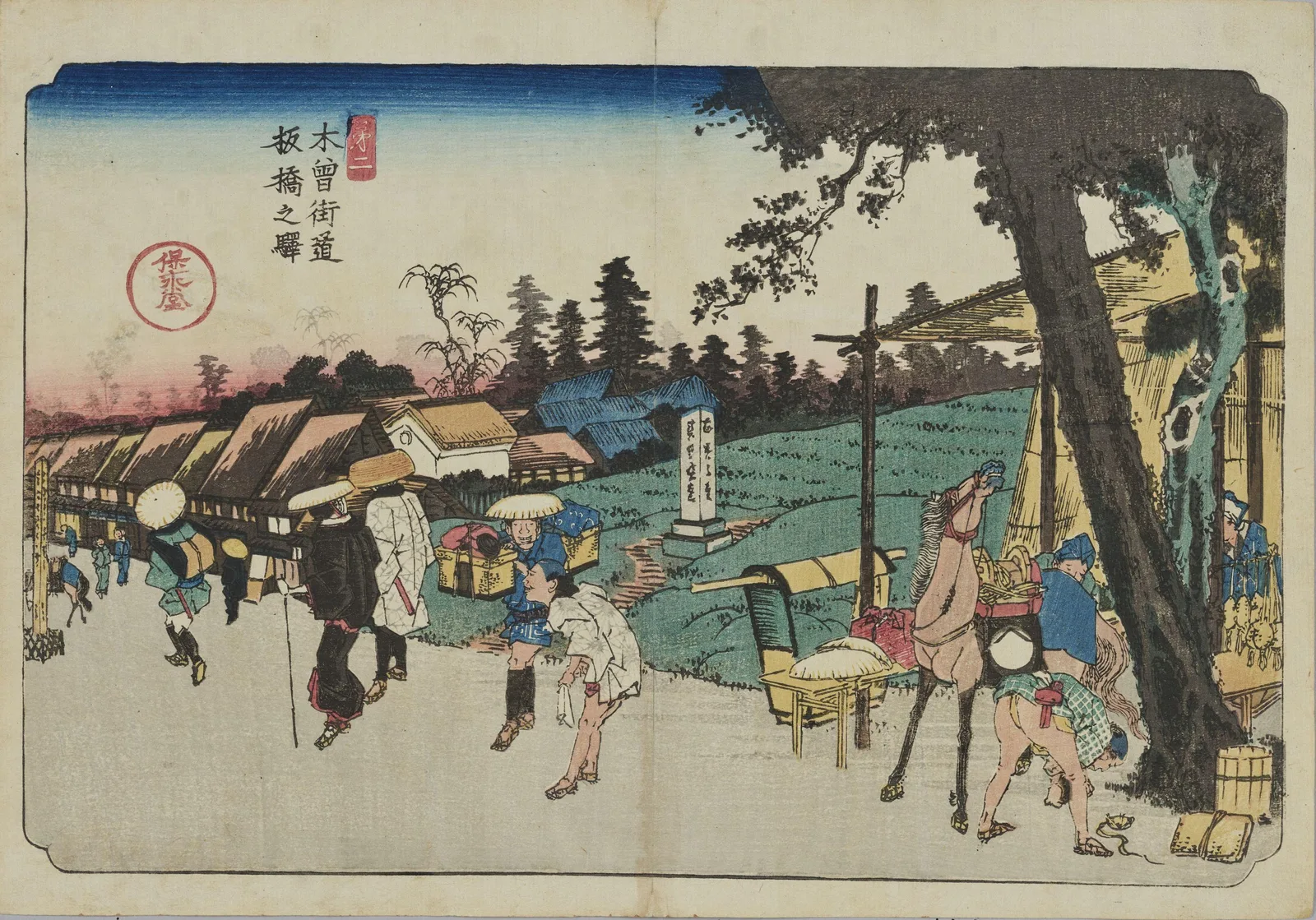
A print of the entrance to Itabashi, the first post station out of Edo. Travelers and horses come and go on the road toward the straw-roofed houses, and beneath a big tree at right, people who have set down their palanquin rest in front of a teahouse's reed screen.
- Artist
- Keisai Eisen
- Date
- c. 1835-36 (Tenpo 6-7)
- Medium / format
- Woodblock print (ukiyo-e)
- Series
- The Sixty-nine Stations of the Kisokaido 71 prints
- Place depicted
- Itabashi-juku(Tokyo)
About this work
A great tree with a thick trunk towers in the right foreground, and in its shade stands a teahouse with a reed screen. An empty palanquin sits in front of the teahouse, and at the horse's feet a packhorse driver crouches, fixing something. In the middle of the road, a traveler with a staff and a man carrying a load pass each other, and small figures line the row of houses leading to the back left.
In the field beyond the road stands a stone pillar that looks like a signpost, and behind it can be seen a cedar grove and a house with a blue roof. The lower part of the sky is stained red, which suggests dusk or dawn. The composition scatters people and horses over the wide white surface of the road and closes the picture with the great tree on the right.
Itabashi-juku was the first station on the Nakasendo and, together with Shinagawa, Senju, and Naito-Shinjuku, was known as one of the Four Stations of Edo. It bustled with departing travelers and those seeing them off, and the station's name comes from the plank bridge over the Shakujii River. Some also see the great tree on the right as the Enkiri Enoki (Divorce Nettle Tree) that stood in Kamishuku.
This is a print by Eisen, with the title written as "Kiso Kaido." It has no signature, and the Tokyo National Museum also regards it as an unsigned Eisen print. The signatures on Eisen's prints are said to have been removed in later impressions, and Eisen drew the first 11 prints of the series in succession.
The place today
The site of Itabashi-juku is around Nakajuku and Honcho in Itabashi Ward, Tokyo, where the old Nakasendo continues as a shopping street. The plank bridge from which the station took its name lives on in the present bridge over the Shakujii River, and in Nakajuku stands the site of the Iida Honjin, where Princess Kazunomiya spent the night before entering Edo.
Where can I see it?
Exhibitions change over time. Check each museum's exhibition information before you visit.
Museums that hold this work
- Tokyo National MuseumMuseum's page for this work (opens in a new tab)
Taito City, Tokyo Accession no. A-12499-66
- National Diet LibraryMuseum's page for this work (opens in a new tab)
Chiyoda City, Tokyo Accession no. 寄別2-2-1-5
Included in Kisokaido Rokujukyu-tsugi
Museums abroad
Frequently asked questions
- Who painted The Sixty-nine Stations of the Kisokaido: Itabashi Station, and when?
- The Sixty-nine Stations of the Kisokaido: Itabashi Station is by Keisai Eisen, made in c. 1835-36 (Tenpo 6-7). Medium: Woodblock print (ukiyo-e).
- What place does The Sixty-nine Stations of the Kisokaido: Itabashi Station show?
- It shows Itabashi-juku (Tokyo).
- Where can I see The Sixty-nine Stations of the Kisokaido: Itabashi Station?
- It is held by Tokyo National Museum, National Diet Library. Exhibitions change, so check each museum's information before you visit.
Sources and references
- ColBase(東京国立博物館): 木曽街道 板橋之駅 (opens in a new tab) (checked 2026-10-19)
- 国立国会図書館デジタルコレクション: 第二 木曽街道板橋之駅 (opens in a new tab) (checked 2026-10-19)
You may also like
More from Tokyo
Discover more of the same region on our sister sites.