The Sixty-nine Stations of the Kisokaido ・ 67
Musa
木曽海道六拾九次之内 武佐
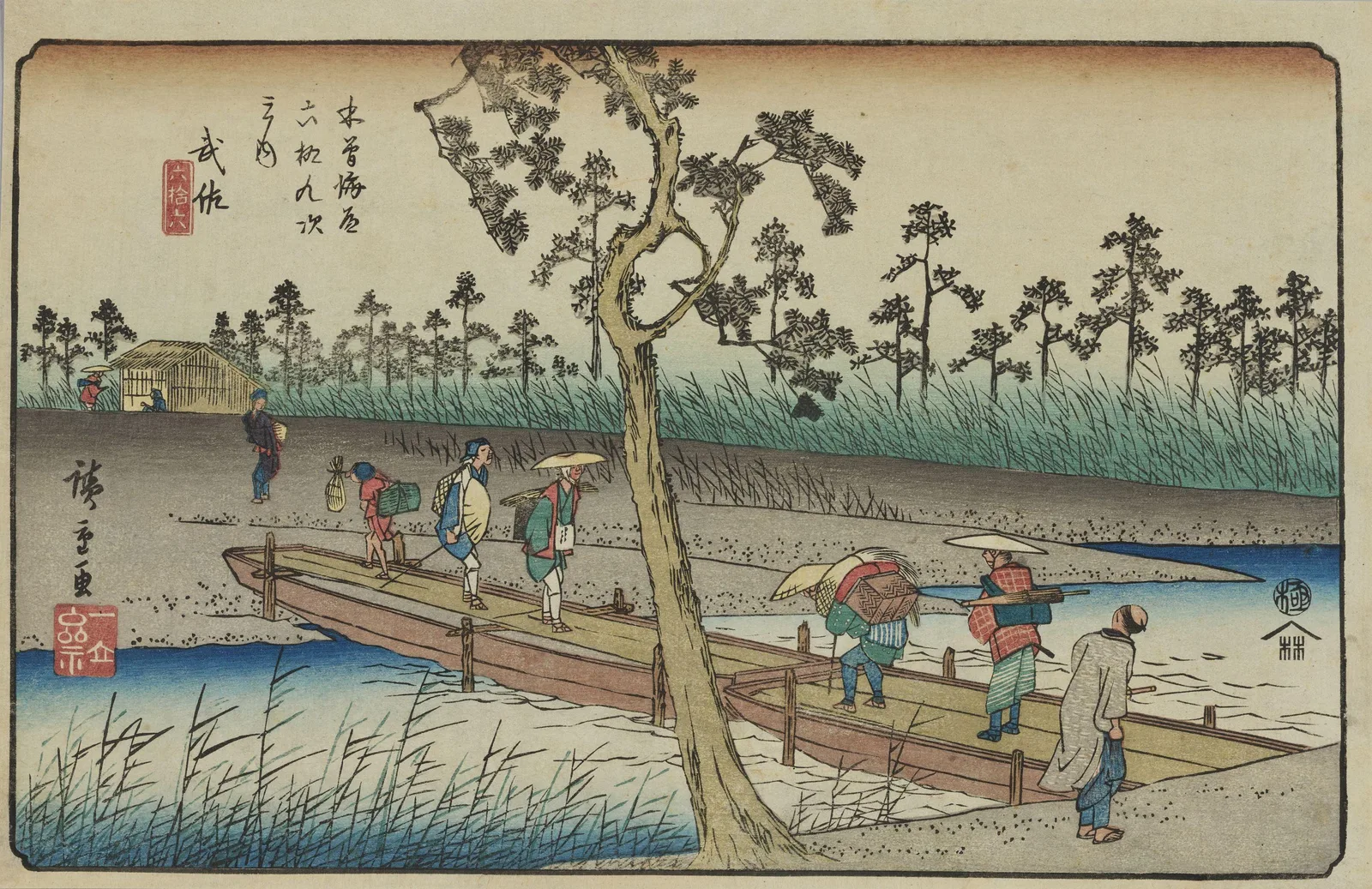
This shows travelers crossing a boat bridge over a river near Musa-juku. Reeds grow on the bank, and beyond a row of slender pines the roof of a teahouse is visible, conveying the leisurely journey along a calm waterside.
- Artist
- Utagawa Hiroshige
- Date
- c. 1835-38 (Tenpo 6-9)
- Medium / format
- Woodblock print (ukiyo-e)
- Series
- The Sixty-nine Stations of the Kisokaido 71 prints
- Place depicted
- Musa-juku(Shiga)
About this work
Across the river in the foreground lies a boat bridge, boats tied together with planks laid across, and travelers cross in a line. Some carry loads, some hold their hats, and others stand at the foot of the bridge seeing them off. In the middle of the picture stands a tree with a bent trunk, and on the far bank are a field of reeds, a row of slender pines, and a teahouse roof. The boat bridge is narrow, and the travelers advance carefully in single file.
The diagonal line of the riverbank and the line of the boat bridge crossing it create depth. The reeds in front and the distant pine row are drawn in fine lines, and the quiet picture is unified in pale green and indigo tones. The water surface is left white, suggesting the shallowness of the river.
Musa-juku was a post town in Gamo District, Omi Province, at the fork of roads leading to Ise and Yokaichi. The Yokoseki River (now the Hino River) flowing west of the town had a ferry, and the picture is said to show that crossing.
This is a design by Hiroshige, and the vermilion seal is mistakenly stamped "sixty-six." Naming the station in the title but drawing a nearby crossing rather than the townscape is a choice often seen in Hiroshige's designs for this series.
The place today
Musa-juku corresponds to today's Musa-cho in Omihachiman City, Shiga Prefecture, where the sites of the honjin and secondary honjin and the Western-style building of the former Musa branch of the Hachiman Police Station remain. A signpost reading "Ise, Minakuchi, Hino, Yokaichi road," erected in the fourth year of Bunsei (1821), also stands along the highway.
Where can I see it?
Exhibitions change over time. Check each museum's exhibition information before you visit.
Museums that hold this work
- Tokyo National MuseumMuseum's page for this work (opens in a new tab)
Taito City, Tokyo Accession no. A-12499-135
- National Diet LibraryMuseum's page for this work (opens in a new tab)
Chiyoda City, Tokyo Accession no. 寄別2-2-1-5
Included in Kisokaido Rokujukyu-tsugi
Museums abroad
Frequently asked questions
- Who painted The Sixty-nine Stations of the Kisokaido: Musa, and when?
- The Sixty-nine Stations of the Kisokaido: Musa is by Utagawa Hiroshige, made in c. 1835-38 (Tenpo 6-9). Medium: Woodblock print (ukiyo-e).
- What place does The Sixty-nine Stations of the Kisokaido: Musa show?
- It shows Musa-juku (Shiga).
- Where can I see The Sixty-nine Stations of the Kisokaido: Musa?
- It is held by Tokyo National Museum, National Diet Library. Exhibitions change, so check each museum's information before you visit.
Sources and references
- ColBase(東京国立博物館): 木曽海道六拾九次之内 武佐 (opens in a new tab) (checked 2026-10-19)
- 国立国会図書館デジタルコレクション: 六拾六 木曽海道六拾九次之内武佐 (opens in a new tab) (checked 2026-10-19)
- Wikipedia: 木曽海道六十九次 (opens in a new tab) (checked 2026-10-19)
You may also like
More from Shiga
Discover more of the same region on our sister sites.
Matsuri Biyori
Festivals in Shiga
- Nagahama Hikiyama Festival Float Event
- Otsu Festival Hikiyama Float Event
- Omi Konan no San'yare Odori
- Omi no Kenketo Matsuri Naginata Furi