The Sixty-nine Stations of the Kisokaido ・ 68
Moriyama
木曽海道六拾九次之内 守山
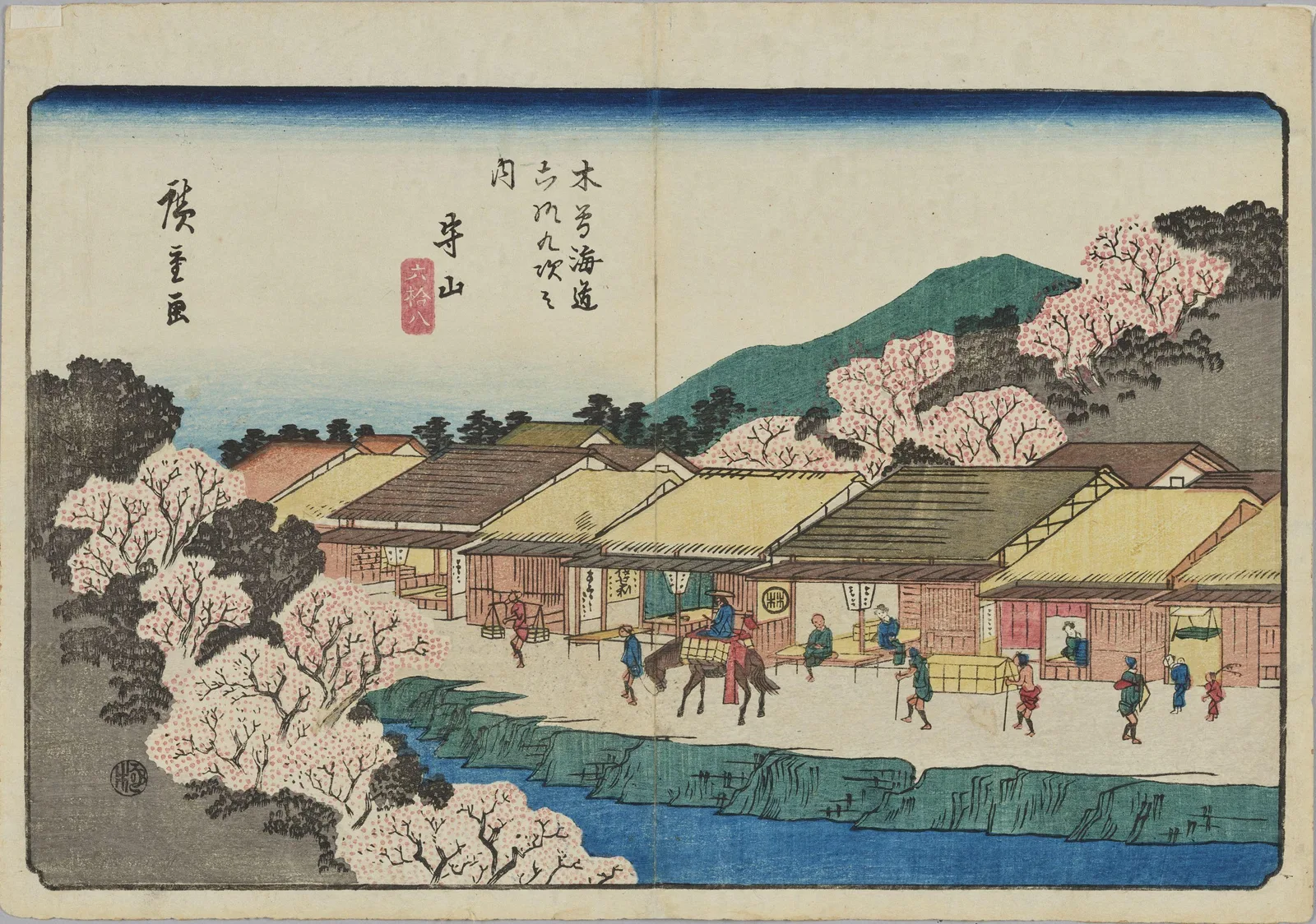
This shows the townscape of Moriyama-juku adorned with cherry trees in full bloom. Inns and teahouses line the street along the river, and the mountain behind is also covered in blossoms, conveying the festive air of a spring post town. It has the brightness of a post town close to Kyoto.
- Artist
- Utagawa Hiroshige
- Date
- c. 1835-38 (Tenpo 6-9)
- Medium / format
- Woodblock print (ukiyo-e)
- Series
- The Sixty-nine Stations of the Kisokaido 71 prints
- Place depicted
- Moriyama-juku(Shiga)
About this work
A river flows in the foreground, and cherry trees bloom in full glory on the left bank. Inns and teahouses line the street along the river, customers rest in front of the shops, and travelers on horseback and people carrying loads come and go. Beyond the houses a green mountain rises, its foot also wrapped in cherry blossoms. The riverbank is a green embankment that forms the boundary with the street.
The pale pink of the blossoms is placed at lower left and upper right, with the townscape sandwiched along a diagonal. The yellow and brown of the roofs, the indigo of the river, and the green of the mountain overlap brightly, making this one of the most splendid designs in the series.
Moriyama-juku was a post town in Yasu District, Omi Province, and as the first overnight stop for travelers leaving Kyoto it bustled, as in the saying "Leave Kyoto, stay at Moriyama." The name is said to come from Tomon-in, built as the eastern guardian of Mount Hiei. Later, adding Yoshimi in the east and Imajuku in the west made the town larger still.
This is a design by Hiroshige. The river drawn is the Yoshikawa (Sakai River) flowing through the town, and Hiroshige is said to have drawn the town from near the earthen bridge over it. He placed a spring scene near the end of the run of Omi post-town designs.
The place today
Moriyama-juku corresponds to the old town area of today's Moriyama City, Shiga Prefecture, and "Unoya," which makes use of the Uno family's sake brewery, serves as the base facility of the post town. The earthen bridge over the Sakai River, Tomon-in, and the Imajuku milestone, the only one remaining in Shiga Prefecture, are also along the highway. Tomon-in is one of the sacred sites of the Omi Saigoku Thirty-three Temples pilgrimage.
Where can I see it?
Exhibitions change over time. Check each museum's exhibition information before you visit.
Museums that hold this work
- Tokyo National MuseumMuseum's page for this work (opens in a new tab)
Taito City, Tokyo Accession no. A-12499-136
- National Diet LibraryMuseum's page for this work (opens in a new tab)
Chiyoda City, Tokyo Accession no. 寄別2-2-1-5
Included in Kisokaido Rokujukyu-tsugi
Museums abroad
Frequently asked questions
- Who painted The Sixty-nine Stations of the Kisokaido: Moriyama, and when?
- The Sixty-nine Stations of the Kisokaido: Moriyama is by Utagawa Hiroshige, made in c. 1835-38 (Tenpo 6-9). Medium: Woodblock print (ukiyo-e).
- What place does The Sixty-nine Stations of the Kisokaido: Moriyama show?
- It shows Moriyama-juku (Shiga).
- Where can I see The Sixty-nine Stations of the Kisokaido: Moriyama?
- It is held by Tokyo National Museum, National Diet Library. Exhibitions change, so check each museum's information before you visit.
Sources and references
- ColBase(東京国立博物館): 木曽海道六拾九次之内 守山 (opens in a new tab) (checked 2026-10-19)
- 国立国会図書館デジタルコレクション: 六拾八 木曽海道六拾九次之内守山 (opens in a new tab) (checked 2026-10-19)
- Wikipedia: 木曽海道六十九次 (opens in a new tab) (checked 2026-10-19)
You may also like
More from Shiga
Discover more of the same region on our sister sites.
Matsuri Biyori
Festivals in Shiga
- Nagahama Hikiyama Festival Float Event
- Otsu Festival Hikiyama Float Event
- Omi Konan no San'yare Odori
- Omi no Kenketo Matsuri Naginata Furi