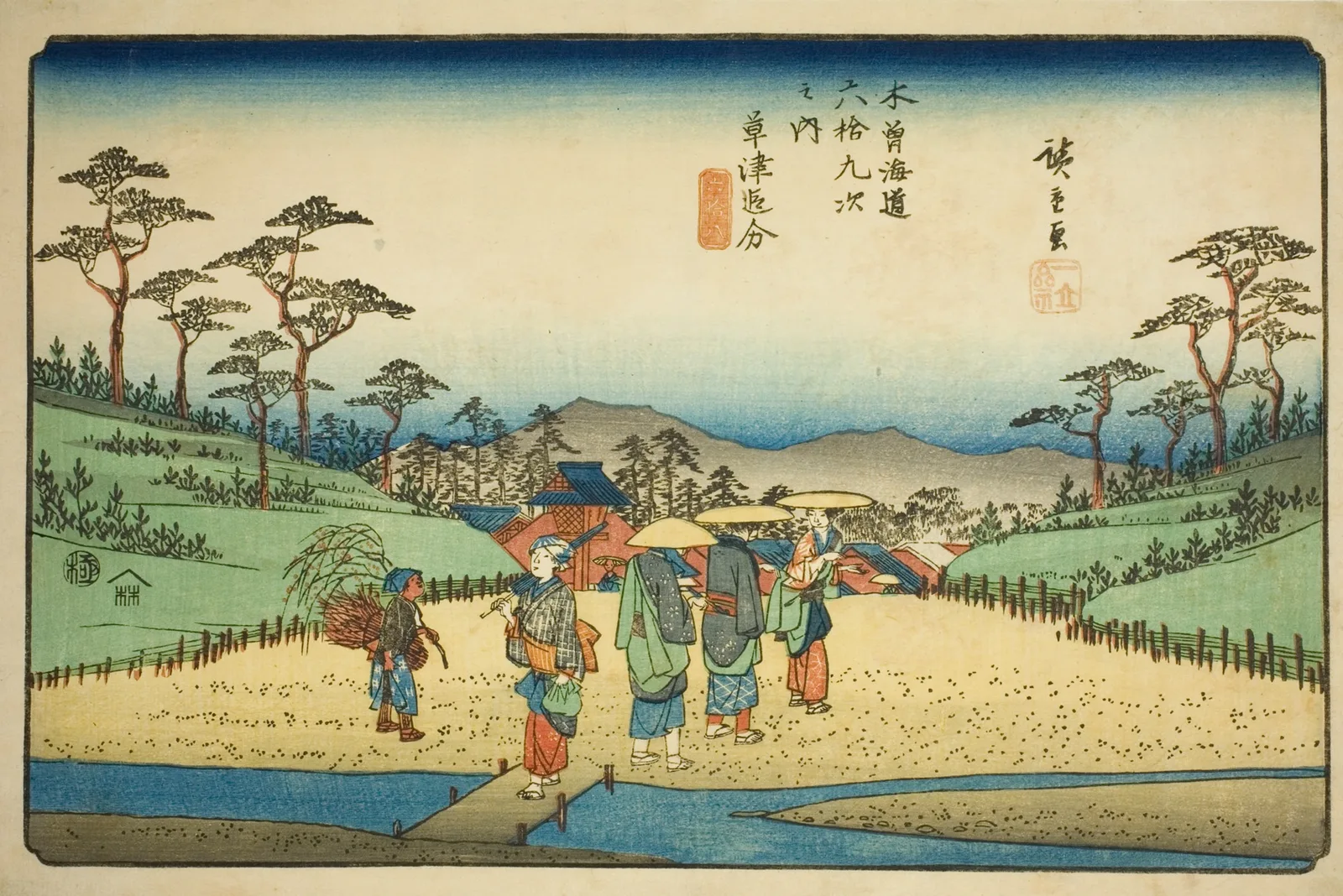
The Sixty-nine Stations of the Kisokaido ・ 69
Crossroad at Kusatsu
木曽海道六拾九次之内 草津追分
This shows travelers heading toward the fork at Kusatsu, where the Tokaido and Nakasendo merge. Crossing a plank bridge over a stream, the roofs of the post town peek out between pine-covered hills, and mountains lie hazy in the distance.
- Artist
- Utagawa Hiroshige
- Date
- c. 1835-38 (Tenpo 6-9)
- Medium / format
- Woodblock print (ukiyo-e)
- Series
- The Sixty-nine Stations of the Kisokaido 71 prints
- Place depicted
- Kusatsu-juku(Shiga)
About this work
A stream flows in the foreground, and a woman is about to cross a narrow plank bridge. On the wide road beyond, travelers in straw hats stop to talk, and at left a person carrying brushwood walks by. Green hills with pines stand on both sides of the road, the roofs of the post town's houses appear at the end of it, and mountains lie hazy farther away.
The hills at left and right open in a figure-eight shape, focusing the eye on the road in the center. The bright ocher of the road, the green of the hills, and the indigo of the sky and distant mountains overlap softly, suggesting the calm mood of a journey nearing its end. The fence line on the hill continues along the road, strengthening the perspective.
Kusatsu-juku was a post town on the Tokaido, where the Nakasendo merged with it. A signpost stands at the fork, and from here to Otsu and Kyoto the two highways follow the same road. It was a large post town with two honjin and over seventy inns. For Nakasendo travelers too, Kyoto's Sanjo Bridge was now just a short distance away.
This is a design by Hiroshige, and the vermilion seal is mistakenly stamped "sixty-eight." Hiroshige also drew Kusatsu in his Hoeido edition of the Tokaido, a picture of the bustle of a rest stop selling the local specialty Ubagamochi.
The place today
Kusatsu-juku corresponds to the urban area of today's Kusatsu City, Shiga Prefecture, where the Tanaka Shichizaemon honjin remains as a national historic site and is open to the public. It is one of the largest surviving honjin buildings. A fork signpost still stands where the Tokaido and Nakasendo part.
Where can I see it?
Exhibitions change over time. Check each museum's exhibition information before you visit.
Museums that hold this work
- Tokyo National MuseumMuseum's page for this work (opens in a new tab)
Taito City, Tokyo Accession no. A-12499-137
Museums that hold this series (please check the museum's website for whether it holds this print)
- National Diet LibraryMuseum's page for this work (opens in a new tab)
Chiyoda City, Tokyo Accession no. 寄別2-2-1-5
67 views (lacking Nihonbashi, Kusatsu, Otsu and the rainy Nakatsugawa; Nihonbashi is held separately under Yoribetsu 7-8-2-2)
Museums abroad
- Art Institute of ChicagoMuseum's page for this work (opens in a new tab)
Chicago Accession no. 1939.2220
Frequently asked questions
- Who painted The Sixty-nine Stations of the Kisokaido: Crossroad at Kusatsu, and when?
- The Sixty-nine Stations of the Kisokaido: Crossroad at Kusatsu is by Utagawa Hiroshige, made in c. 1835-38 (Tenpo 6-9). Medium: Woodblock print (ukiyo-e).
- What place does The Sixty-nine Stations of the Kisokaido: Crossroad at Kusatsu show?
- It shows Kusatsu-juku (Shiga).
- Where can I see The Sixty-nine Stations of the Kisokaido: Crossroad at Kusatsu?
- It is held by Tokyo National Museum, National Diet Library. Exhibitions change, so check each museum's information before you visit.
Sources and references
You may also like
More from Shiga
Discover more of the same region on our sister sites.
Matsuri Biyori
Festivals in Shiga
- Nagahama Hikiyama Festival Float Event
- Otsu Festival Hikiyama Float Event
- Omi Konan no San'yare Odori
- Omi no Kenketo Matsuri Naginata Furi