The Sixty-nine Stations of the Kisokaido ・ 70
Otsu
木曽海道六拾九次之内 大津
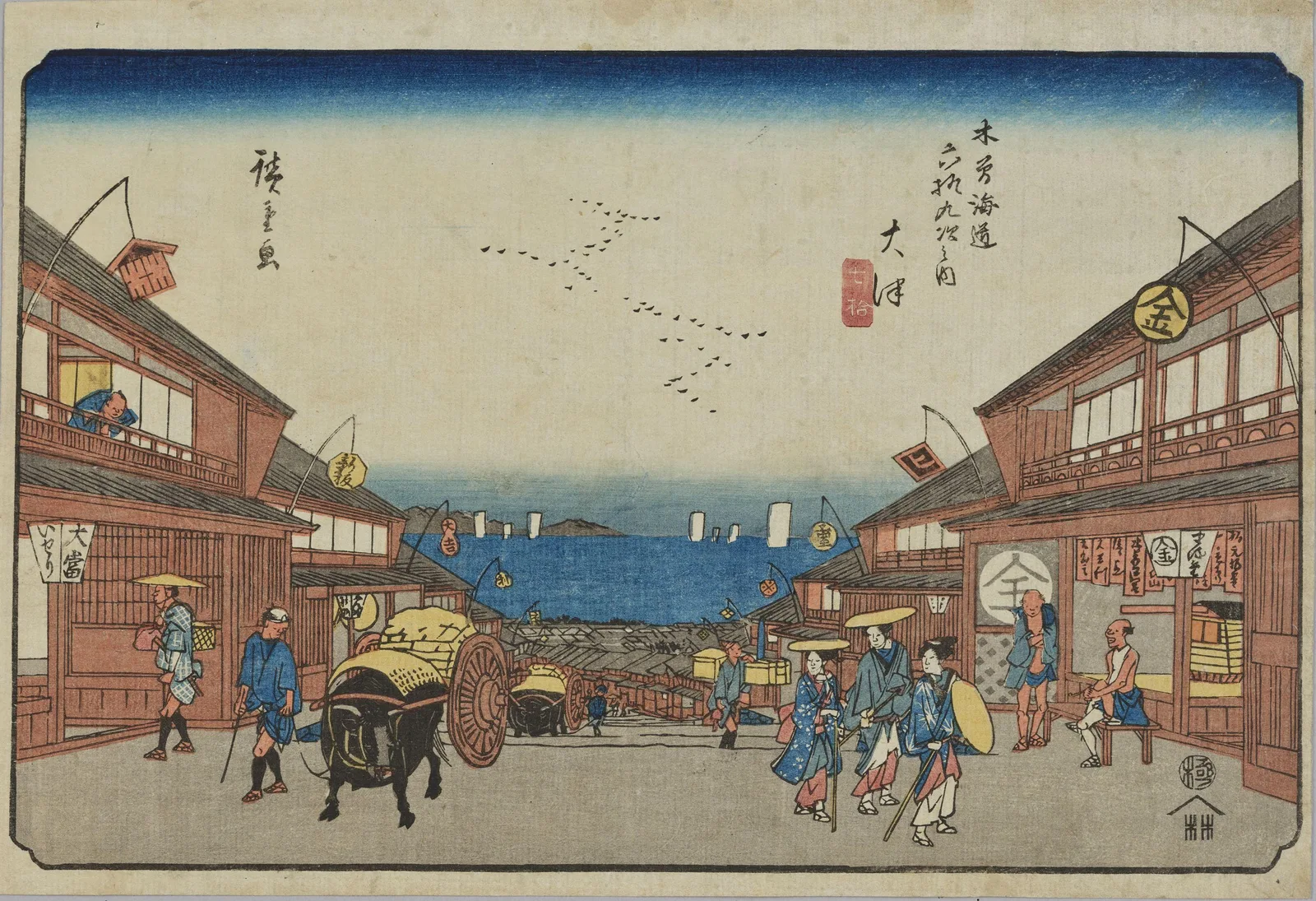
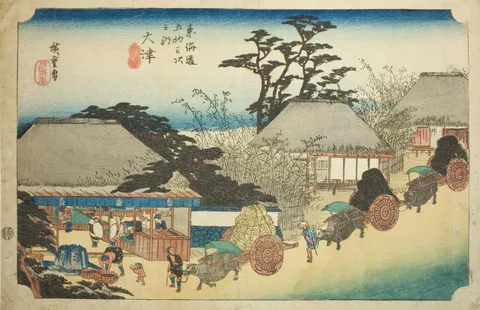
This looks down on Lake Biwa from a street in Otsu-juku, the end of the Nakasendo. Ox carts and travelers go up and down a sloping road lined with shops on both sides, white-sailed boats float on the lake ahead, and a flock of wild geese crosses the sky.
- Artist
- Utagawa Hiroshige
- Date
- c. 1835-38 (Tenpo 6-9)
- Medium / format
- Woodblock print (ukiyo-e)
- Series
- The Sixty-nine Stations of the Kisokaido 71 prints
About this work
Two-story shops line both sides, with signboards and lanterns hanging from their eaves. On the road in the foreground, a man leads an ox cart loaded with goods, and travelers in straw hats walk by. At right, someone sits resting in front of a shop. Beyond the slope the roofs of the town continue, and past them Lake Biwa spreads out, with several white-sailed boats floating on it.
Rows of houses at left and right frame the center road, at the end of which the lake appears, in a composition of strong perspective. Between the indigo of the lake and the pale colors of the sky, a line of geese flies in a V shape, adding movement to the picture.
Otsu was the largest post town on the Tokaido. Because the Nakasendo merges with the Tokaido at Kusatsu, this is the last station in the series. For the ox carts carrying goods to Kyoto, stones called kuruma-ishi (cart stones) were laid along the road from Otsu to Kyoto. Goods from the Hokuriku region and east of the lake gathered at the lake port, and the town bustled with trade.
This is a design by Hiroshige, the seventieth in the series and the last of the station designs. Hiroshige closes the series Eisen began with a snow scene at Nihonbashi with a view of Otsu looking out over the lake. The set held by the National Diet Library lacks this design.
The place today
Otsu-juku corresponds to the center of today's Otsu City, Shiga Prefecture, and a stone monument recording the Meiji Emperor's visit stands at the site of the honjin. Fuda-no-tsuji, where public notices were posted, is the fork of the Tokaido and the Hokkoku Highway, and nearby is a monument marking the scene of the Otsu Incident. Otsu-e, the town's specialty, is still painted today.
Where can I see it?
Exhibitions change over time. Check each museum's exhibition information before you visit.
Museums that hold this work
- Tokyo National MuseumMuseum's page for this work (opens in a new tab)
Taito City, Tokyo Accession no. A-12499-138
Museums that hold this series (please check the museum's website for whether it holds this print)
- National Diet LibraryMuseum's page for this work (opens in a new tab)
Chiyoda City, Tokyo Accession no. 寄別2-2-1-5
67 views (lacking Nihonbashi, Kusatsu, Otsu and the rainy Nakatsugawa; Nihonbashi is held separately under Yoribetsu 7-8-2-2)
Museums abroad
Frequently asked questions
- Who painted The Sixty-nine Stations of the Kisokaido: Otsu, and when?
- The Sixty-nine Stations of the Kisokaido: Otsu is by Utagawa Hiroshige, made in c. 1835-38 (Tenpo 6-9). Medium: Woodblock print (ukiyo-e).
- What place does The Sixty-nine Stations of the Kisokaido: Otsu show?
- It shows Otsu-juku, Lake Biwa (Shiga).
- Where can I see The Sixty-nine Stations of the Kisokaido: Otsu?
- It is held by Tokyo National Museum, National Diet Library. Exhibitions change, so check each museum's information before you visit.
Sources and references
- ColBase(東京国立博物館): 木曽海道六拾九次之内 大津 (opens in a new tab) (checked 2026-10-19)
- Wikipedia: 木曽海道六十九次 (opens in a new tab) (checked 2026-10-19)
You may also like
More from Shiga
Discover more of the same region on our sister sites.
Matsuri Biyori
Festivals in Shiga
- Nagahama Hikiyama Festival Float Event
- Otsu Festival Hikiyama Float Event
- Omi Konan no San'yare Odori
- Omi no Kenketo Matsuri Naginata Furi