Thirty-six Views of Mount Fuji ・ 27
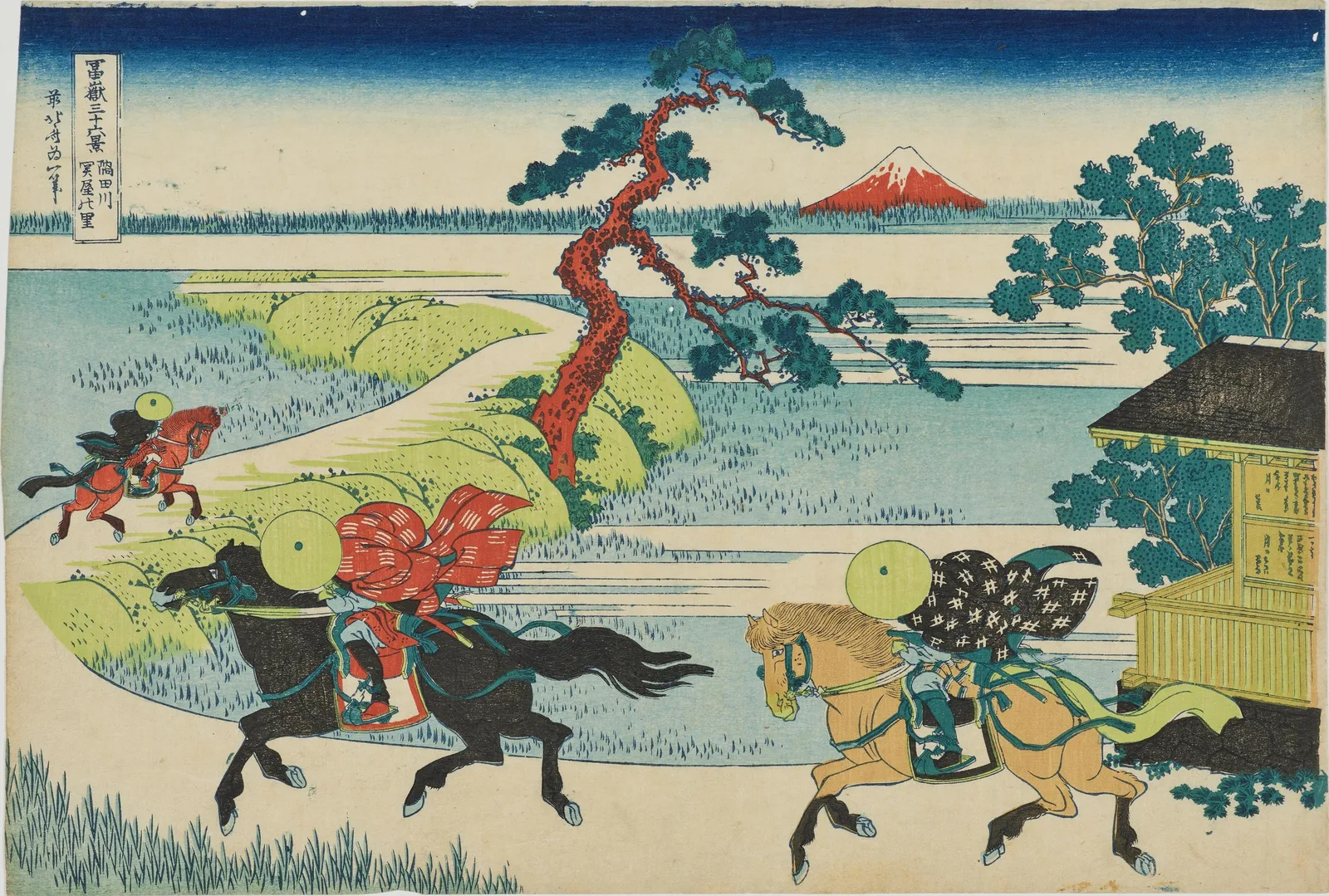
Sekiya Village on the Sumida River
冨嶽三十六景 隅田川関屋の里
Three couriers on horseback gallop along an embankment road as distant Fuji glows red in the morning light. The sweeping curve of the road, garments filled with wind, and a pine leaning diagonally give the picture a sense of driving motion.
- Artist
- Katsushika Hokusai
- Date
- c. 1830-33 (Tenpo 1-4)
- Medium / format
- Woodblock print (ukiyo-e)
- Series
- Thirty-six Views of Mount Fuji 46 prints
- Seen in the distance
- Mount Fuji
About this work
The road on the embankment draws a great arc, along which three riders gallop at full speed. The two in front pass each other in opposite directions, the one behind rides on down the road, and on each rider the garment on the back swells with wind. The gait of each horse is drawn differently, so that you can almost hear the hooves. The riders wear large round hats, and their faces are hidden.
A red-trunked pine rises diagonally from the inside of the road, and beyond it in the sky a small red Fuji floats. Mist hangs over the lowland of rice fields, suggesting an early-morning scene. The building at the far right is a kosatsuba, a notice board where laws and edicts were posted. The embankment along the road is painted bright yellow-green, set apart from the bluish tone of the low fields.
According to Adachi Ward materials, "Sekiya no Sato" takes its name from a checkpoint (seki) set up on the banks of the Sumida River in the Kamakura period. The Adachi City Local History Museum regards the road where the horsemen run as the Kamon Embankment, built in the early Edo period. Where other artists portrayed Sekiya serenely, Hokusai depicted it forcefully with galloping horses.
The place today
According to the Adachi City Local History Museum, Sekiya no Sato refers to the area from today's Senju Nakacho to Senju Sekiyacho. The Kamon Embankment, where the riders run, survives as the route of Bokutei-dori, and the grounds of Hikawa Shrine in Senju Nakacho enshrine Sekiya Tenmangu, which was moved from Sekiya no Sato.
Where can I see it?
Exhibitions change over time. Check each museum's exhibition information before you visit.
Museums that hold this work
- Tokyo National MuseumMuseum's page for this work (opens in a new tab)
Taito City, Tokyo Accession no. A-11177
From the set of 34 sheets of Thirty-six Views of Mount Fuji
- Edo-Tokyo MuseumMuseum's page for this work (opens in a new tab)
Sumida City, Tokyo Accession no. 92202774
Museums that hold this series (please check the museum's website for whether it holds this print)
Frequently asked questions
- Who painted Thirty-six Views of Mount Fuji: Sekiya Village on the Sumida River, and when?
- Thirty-six Views of Mount Fuji: Sekiya Village on the Sumida River is by Katsushika Hokusai, made in c. 1830-33 (Tenpo 1-4). Medium: Woodblock print (ukiyo-e).
- What place does Thirty-six Views of Mount Fuji: Sekiya Village on the Sumida River show?
- It shows Sekiya Village, Sumida River (Tokyo).
- Where can I see Thirty-six Views of Mount Fuji: Sekiya Village on the Sumida River?
- It is held by Tokyo National Museum, Tokyo Fuji Art Museum, Edo-Tokyo Museum. Exhibitions change, so check each museum's information before you visit.
Sources and references
- ColBase 東京国立博物館 冨嶽三十六景(34枚) (opens in a new tab) (checked 2026-10-18)
- 山梨県立博物館「博物館資料のなかの『富士山』 葛飾北斎 冨嶽三十六景」 (opens in a new tab) (checked 2026-10-18)
- 江戸東京博物館デジタルアーカイブス 冨嶽三十六景 隅田川関屋の里 (opens in a new tab) (checked 2026-10-18)
You may also like
More from Tokyo
Discover more of the same region on our sister sites.