Thirty-six Views of Mount Fuji ・ 26
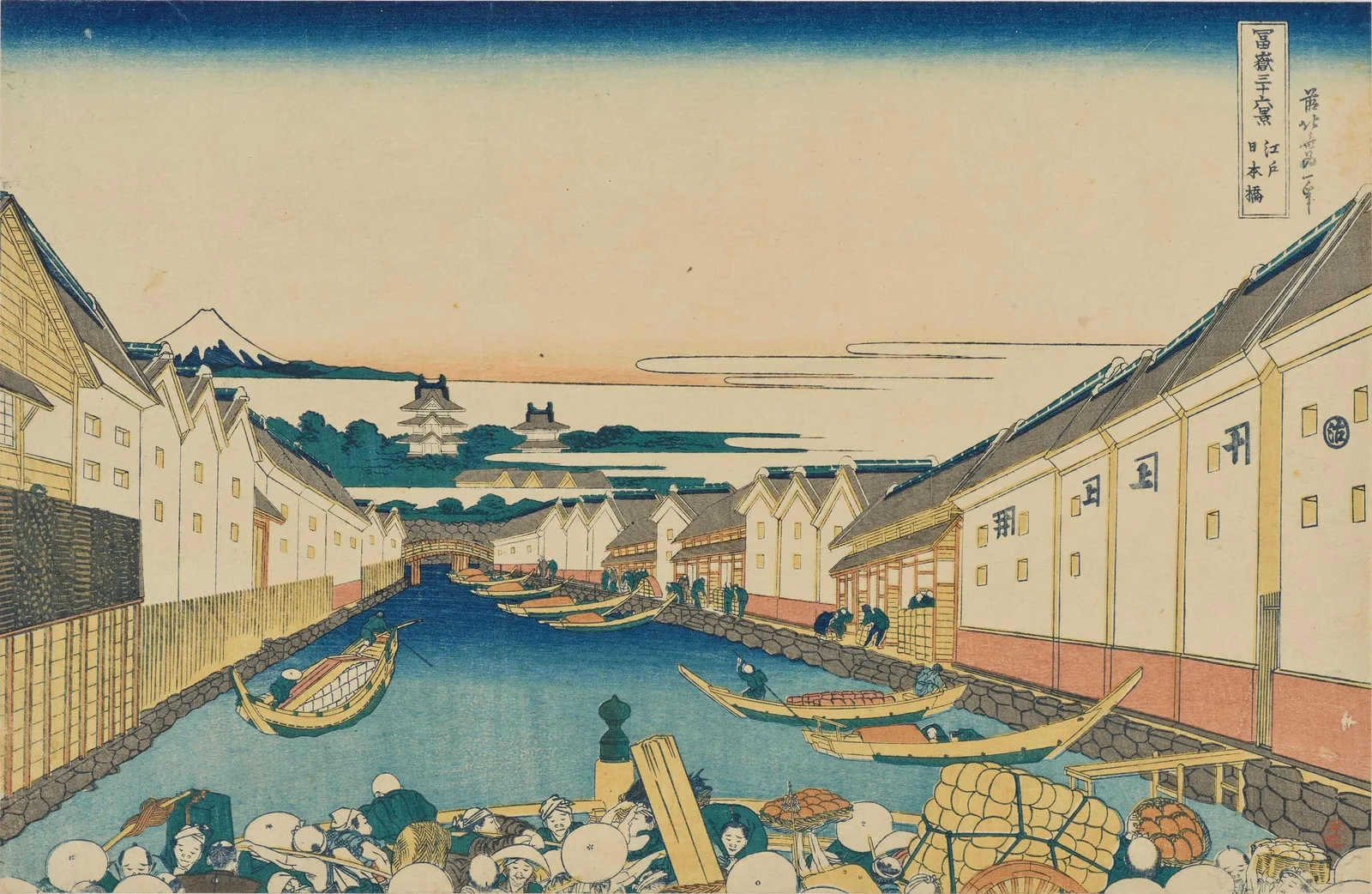
Nihonbashi in Edo
冨嶽三十六景 江戸日本橋
The crowd on Nihonbashi is shown only along the bottom edge of the picture, while white-walled warehouses lining the river lead the eye toward Edo Castle and Fuji beyond. The bold cropping, which barely shows the bridge itself, is the highlight.
- Artist
- Katsushika Hokusai
- Date
- c. 1830-33 (Tenpo 1-4)
- Medium / format
- Woodblock print (ukiyo-e)
- Series
- Thirty-six Views of Mount Fuji 46 prints
- Place depicted
- Nihonbashi(Tokyo)
- Seen in the distance
- Mount Fuji
About this work
The title is "Nihonbashi," yet the bridge itself is almost invisible. Only the giboshi (ornamental finials on the posts) of the railing, the hats and heads of passersby, and the loads they carry line the bottom edge of the picture. The viewer stands in the crowd on the bridge, looking west.
On both banks of the Nihonbashi River, white-walled warehouses continue without a gap, and the lines of their roofs converge toward a single point in the distance. The composition adopts Western linear perspective, in which things shrink with distance and lines meet at one point. At the point where the lines converge stands a turret of Edo Castle, and beyond it, Fuji. Boats laden with cargo line the river, and porters work along the banks. A wooden fence runs along the left bank, and the white walls of the warehouses on the right bear the marks of merchant houses. The sky near the horizon is faintly tinged with vermilion.
Nihonbashi was the starting point of the highways and, with its merchants' warehouses lining the river, the center of Edo's distribution. By capturing both the jostling noise in the foreground and the calm of the castle and Fuji in the distance, the print shows at once the bustle of the town and the face of Edo as a capital.
The place today
The present Nihonbashi is a stone double-arch bridge completed in 1911 (Meiji 44) and is designated an Important Cultural Property. A project is under way to move the Metropolitan Expressway, which covers the sky above it, underground; according to Chuo Ward materials, it aims for completion in 2040.
Where can I see it?
Exhibitions change over time. Check each museum's exhibition information before you visit.
Museums that hold this work
- Tokyo National MuseumMuseum's page for this work (opens in a new tab)
Taito City, Tokyo Accession no. A-11176
From the set of 12 sheets of Thirty-six Views of Mount Fuji
- Edo-Tokyo MuseumMuseum's page for this work (opens in a new tab)
Sumida City, Tokyo Accession no. 92202773
Museums that hold this series (please check the museum's website for whether it holds this print)
Frequently asked questions
- Who painted Thirty-six Views of Mount Fuji: Nihonbashi in Edo, and when?
- Thirty-six Views of Mount Fuji: Nihonbashi in Edo is by Katsushika Hokusai, made in c. 1830-33 (Tenpo 1-4). Medium: Woodblock print (ukiyo-e).
- What place does Thirty-six Views of Mount Fuji: Nihonbashi in Edo show?
- It shows Nihonbashi (Tokyo).
- Where can I see Thirty-six Views of Mount Fuji: Nihonbashi in Edo?
- It is held by Tokyo National Museum, Tokyo Fuji Art Museum, Edo-Tokyo Museum. Exhibitions change, so check each museum's information before you visit.
Sources and references
- ColBase 東京国立博物館 冨嶽三十六景(12枚) (opens in a new tab) (checked 2026-10-18)
- 山梨県立博物館「博物館資料のなかの『富士山』 葛飾北斎 冨嶽三十六景」 (opens in a new tab) (checked 2026-10-18)
- 江戸東京博物館デジタルアーカイブス 冨嶽三十六景 江戸日本橋 (opens in a new tab) (checked 2026-10-18)
You may also like
More from Tokyo
Discover more of the same region on our sister sites.