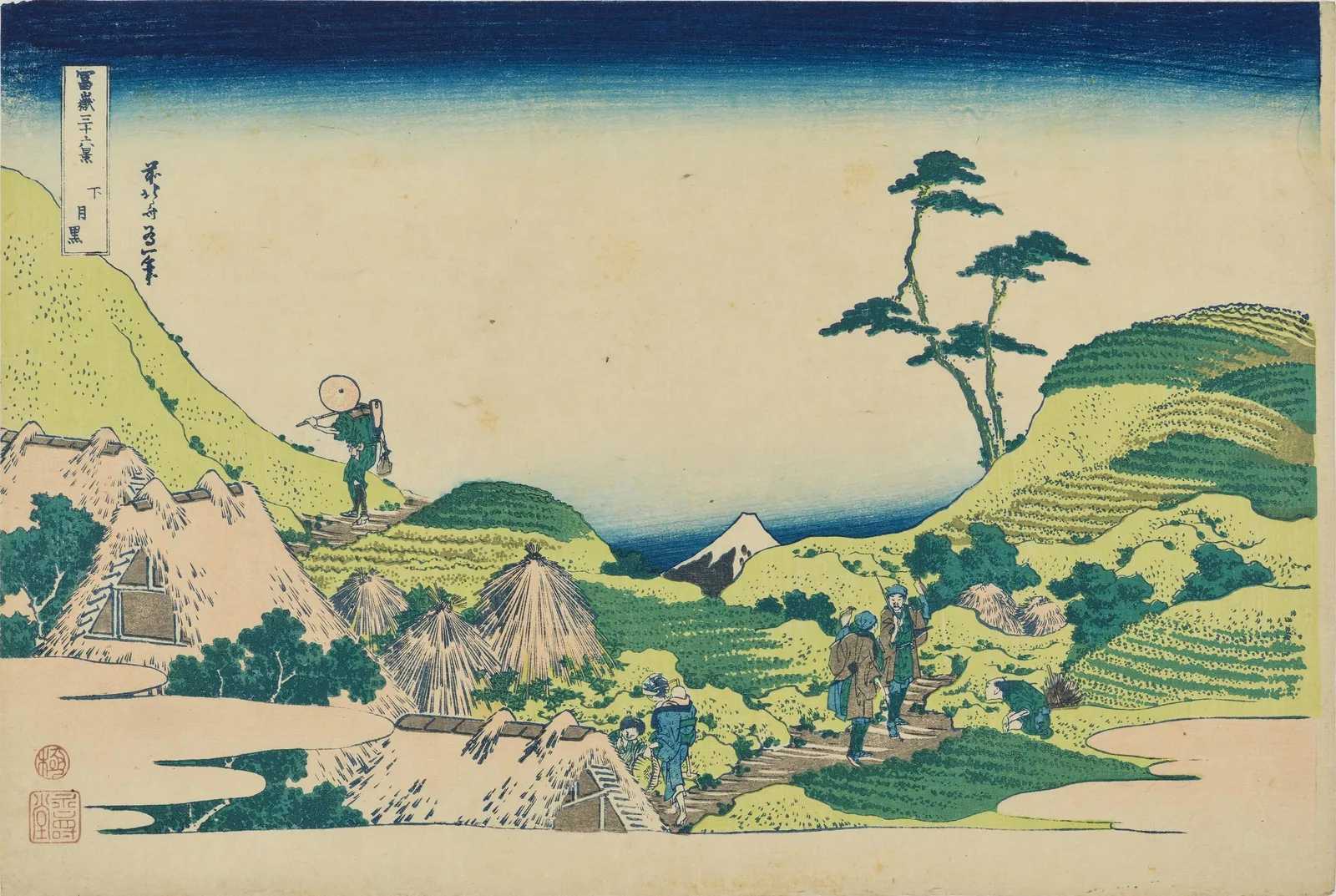
Thirty-six Views of Mount Fuji ・ 22
Lower Meguro
冨嶽三十六景 下目黒
A path winds among undulating hills and fields, and beyond a thatched farmhouse a small Fuji shows itself at the bottom of a hollow. Falconers and farmers come and go in this peaceful farming village of Meguro, once the shogun's falconry ground.
- Artist
- Katsushika Hokusai
- Date
- c. 1830-33 (Tenpo 1-4)
- Medium / format
- Woodblock print (ukiyo-e)
- Series
- Thirty-six Views of Mount Fuji 46 prints
- Place depicted
- Shimomeguro(Tokyo)
- Seen in the distance
- Mount Fuji
About this work
Many round hills overlap in the picture, and on the slope at right spread fields with neatly ordered furrows. Following the path from the thatched farmhouse at lower left, the summit of Fuji can be seen at the bottom of a hollow, and from there the path turns and climbs a hill. On top of the hill two pines rise tall, conveying the breadth of the sky.
The figures are also finely drawn. In the middle of the path are two falconers with hawks perched on their hands, and a farmer in the field listens to their talk. A person heading to the field with a hoe on his shoulder and a farm mother and child are also drawn, conveying the daily life of the village. Fuji merely peeps modestly between the hills, and the protagonists are Meguro's undulations and its life.
Meguro, in Edo's southwestern suburbs, was a farming village with many fields and also a hunting ground where the shogun went hawking. It is also known as the setting of the rakugo story "Meguro no Sanma." Because falconers are depicted, the Yamanashi Prefectural Museum surmises that this is a view from Shimo-Meguro toward Hiyomon Village, where the falconers' quarters stood. According to Meguro Ward, of the hunting grounds along the Meguro route, Komabano was the most frequently used, and Hiyomon-hara was also used for falconry.
The place today
Shimo-Meguro corresponds to today's Meguro Ward, Tokyo. According to Meguro Ward, in the Edo period Meguro was the center of the shogun's falconry ground, the "Meguro-suji." One theory holds that the place name "Takaban" east of Gakugei-daigaku Station derives from the falconry ground's guardhouse, and the area is now a shopping street and residential district.
Where can I see it?
Exhibitions change over time. Check each museum's exhibition information before you visit.
Museums that hold this work
- Tokyo National MuseumMuseum's page for this work (opens in a new tab)
Taito City, Tokyo Accession no. A-11177
From the set of 34 sheets of Thirty-six Views of Mount Fuji
- Edo-Tokyo MuseumMuseum's page for this work (opens in a new tab)
Sumida City, Tokyo Accession no. 92202767
Museums that hold this series (please check the museum's website for whether it holds this print)
Frequently asked questions
- Who painted Thirty-six Views of Mount Fuji: Lower Meguro, and when?
- Thirty-six Views of Mount Fuji: Lower Meguro is by Katsushika Hokusai, made in c. 1830-33 (Tenpo 1-4). Medium: Woodblock print (ukiyo-e).
- What place does Thirty-six Views of Mount Fuji: Lower Meguro show?
- It shows Shimomeguro (Tokyo).
- Where can I see Thirty-six Views of Mount Fuji: Lower Meguro?
- It is held by Tokyo National Museum, Tokyo Fuji Art Museum, Edo-Tokyo Museum. Exhibitions change, so check each museum's information before you visit.
Sources and references
- ColBase 東京国立博物館 冨嶽三十六景(34枚) (opens in a new tab) (checked 2026-10-18)
- 山梨県立博物館「博物館資料のなかの『富士山』 葛飾北斎 冨嶽三十六景」 (opens in a new tab) (checked 2026-10-18)
- 江戸東京博物館デジタルアーカイブス 冨嶽三十六景 下目黒 (opens in a new tab) (checked 2026-10-18)
You may also like
More from Tokyo
Discover more of the same region on our sister sites.