Thirty-six Views of Mount Fuji ・ 21
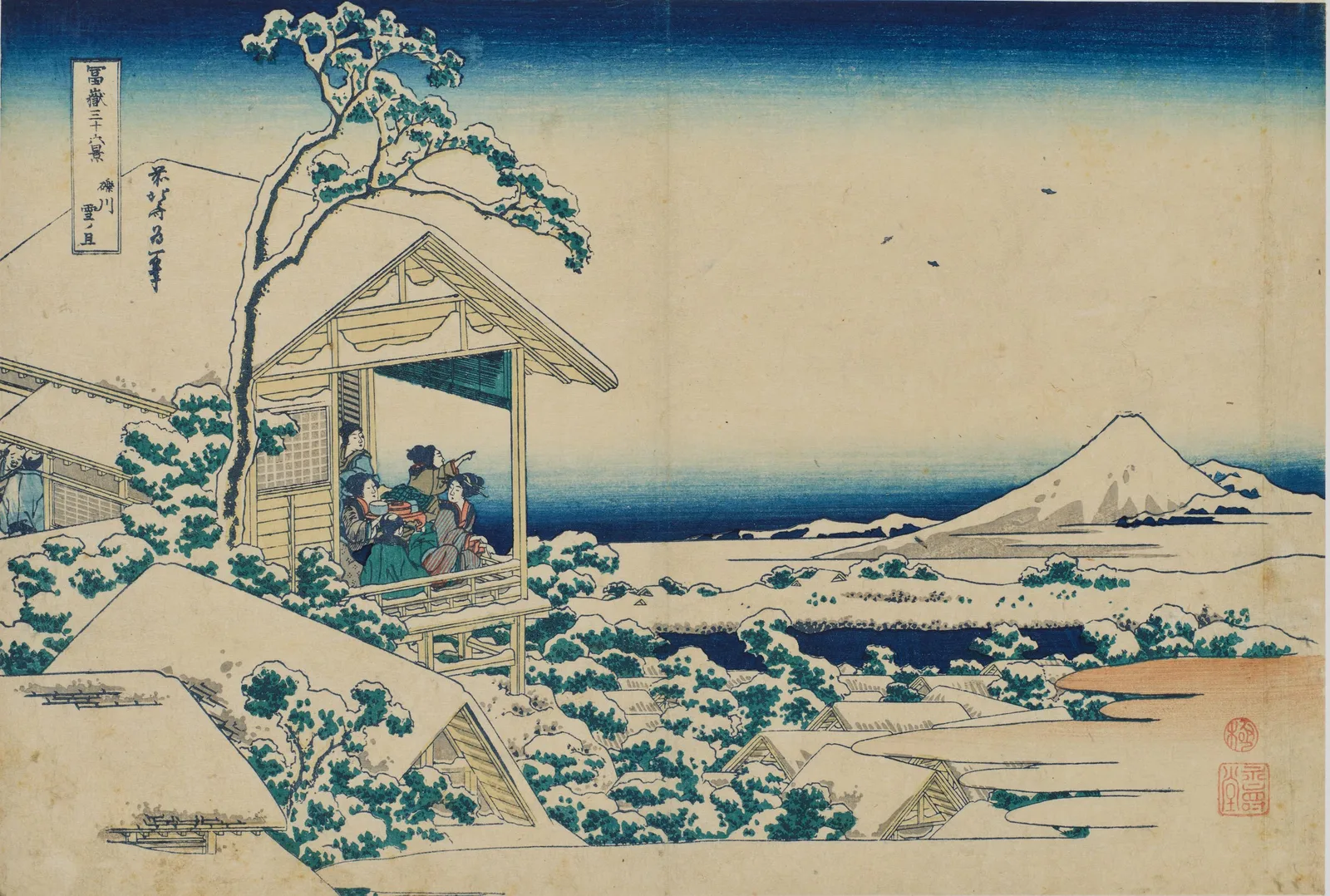
Morning after a Snowfall at Koishikawa
冨嶽三十六景 礫川雪ノ旦
A morning when snow fallen overnight has turned the Koishikawa townscape white. On the second floor of a teahouse on the heights, women customers enjoy the snow, pointing at three birds in the sky, and beyond them a snow-covered Fuji is visible.
- Artist
- Katsushika Hokusai
- Date
- c. 1830-33 (Tenpo 1-4)
- Medium / format
- Woodblock print (ukiyo-e)
- Series
- Thirty-six Views of Mount Fuji 46 prints
- Place depicted
- Koishikawa(Tokyo)
- Seen in the distance
- Mount Fuji
About this work
This is the only print in Thirty-six Views of Mount Fuji that depicts a snow scene. Roofs and trees are thickly covered with snow, and the sky is graded from deep indigo to a bright color. Among the snowfields, a thin strip of indigo water peeps through, and a white Fuji rises beyond the clear air. Snow also lies thick on the roofs of the houses lined up in the left foreground.
On the second floor of the teahouse at left, women who have come to see the snow are gathered. One of them points at the sky, where three birds wheel small. The smallness of the birds conveys the height and breadth of the sky on a snowy morning. The women gather near the railing, each looking at the snowy view in her own way.
"Reki-sen" in the title is a Chinese-style name for Koishikawa, and "tan" means morning. Koishikawa was a hilly area with teahouses offering fine views. Denzuin was established there in the early Edo period, and residences of the Mito Tokugawa family and townhouses were also opened. The Yamanashi Prefectural Museum considers the view to be from a teahouse near Denzuin or Kitano Shrine (Ushi Tenjin). Koishikawa, where marshland once spread, was thus absorbed into Edo's urban area.
The place today
Koishikawa is a place name in today's Bunkyo Ward, Tokyo. Regarding Ushi Tenjin Kitano Shrine in Kasuga 1-chome, Bunkyo Ward introduces it as the place from which Katsushika Hokusai is said to have drawn the view in "Morning after a Snowfall at Koishikawa." In front of the shrine buildings is a stone in the shape of an ox that is said to grant wishes when stroked.
Where can I see it?
Exhibitions change over time. Check each museum's exhibition information before you visit.
Museums that hold this work
- Tokyo National MuseumMuseum's page for this work (opens in a new tab)
Taito City, Tokyo Accession no. A-11176
From the set of 12 sheets of Thirty-six Views of Mount Fuji
- Edo-Tokyo MuseumMuseum's page for this work (opens in a new tab)
Sumida City, Tokyo Accession no. 92202766
Museums that hold this series (please check the museum's website for whether it holds this print)
Frequently asked questions
- Who painted Thirty-six Views of Mount Fuji: Morning after a Snowfall at Koishikawa, and when?
- Thirty-six Views of Mount Fuji: Morning after a Snowfall at Koishikawa is by Katsushika Hokusai, made in c. 1830-33 (Tenpo 1-4). Medium: Woodblock print (ukiyo-e).
- What place does Thirty-six Views of Mount Fuji: Morning after a Snowfall at Koishikawa show?
- It shows Koishikawa (Tokyo).
- Where can I see Thirty-six Views of Mount Fuji: Morning after a Snowfall at Koishikawa?
- It is held by Tokyo National Museum, Tokyo Fuji Art Museum, Edo-Tokyo Museum. Exhibitions change, so check each museum's information before you visit.
Sources and references
- ColBase 東京国立博物館 冨嶽三十六景(12枚) (opens in a new tab) (checked 2026-10-18)
- 山梨県立博物館「博物館資料のなかの『富士山』 葛飾北斎 冨嶽三十六景」 (opens in a new tab) (checked 2026-10-18)
- 江戸東京博物館デジタルアーカイブス 冨嶽三十六景 礫川雪ノ旦 (opens in a new tab) (checked 2026-10-18)
You may also like
More from Tokyo
Discover more of the same region on our sister sites.