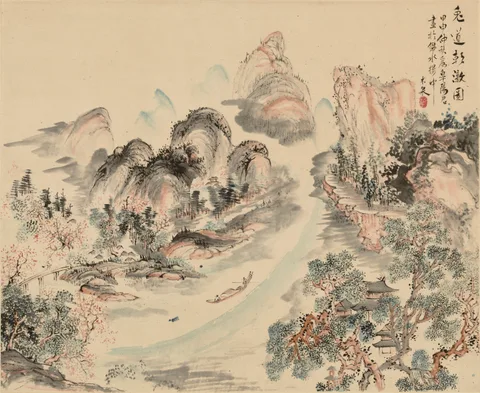
Aoki Mokubei · 1767–1833
Aoki Mokubei
Aoki Mokubei was a potter and painter active in Kyoto in the late Edo period. Known as a master of Kyoto ware, he also painted in the literati style from about the age of 50. His Dawn at Uji is an Important Cultural Property.
Aoki Mokubei was born in Kyoto in 1767 (Meiwa 4). His family home is said to have been a teahouse in Gion. In his youth he studied calligraphy under Ko Fuyo; at 29, he read the Chinese ceramics book Taoshuo in the library of Kimura Kenkado and was so impressed that he resolved to become a potter and entered the studio of Okuda Eisen.
Around the age of 30 he opened a kiln in Awataguchi, Kyoto, and gained a reputation; at 39 he was ordered to run the official kiln of the Awata Palace (Shoren-in Imperial Prince). In 1807 he was invited by the Maeda family of the Kaga domain and worked to revive Kutani ware, which had died out. He mainly made sencha tea utensils and is counted with Nonomura Ninsei and Ogata Kenzan among the master potters of Kyoto ware.
From about fifty he began painting in the literati (Nanga) tradition, mostly as gifts for friends, and he associated with Rai San'yo and Tanomura Chikuden. Because he judged the kiln temperature by the sound of the fire, he is said to have lost his hearing in later life and also used the name Robei (deaf rice). He died in 1833 (Tenpo 4).