Kishida Ryusei
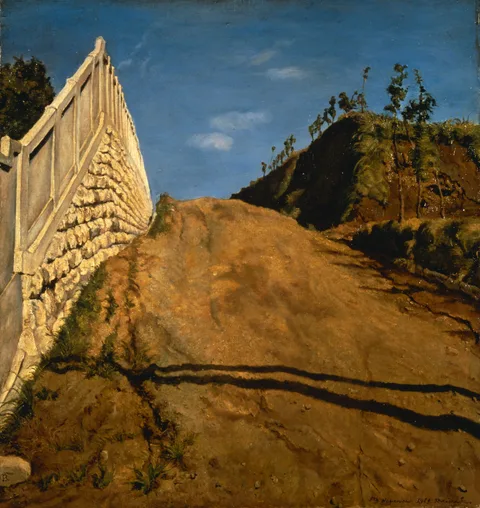
A Western-style painter born in Ginza, Tokyo. With a realism that painted down to the smallest detail, he made portraits of his daughter Reiko and painted roads in the Tokyo suburbs. "Road Cut through a Hill" at the National Museum of Modern Art, Tokyo, is an Important Cultural Property.
Kishida Ryusei was born in 1891 (Meiji 24) in Ginza, Tokyo. His father was Kishida Ginko, known as a newspaper reporter and a seller of eye medicine. In 1908 (Meiji 41) he entered Kuroda Seiki's Western painting institute and learned oil painting. In 1912 (Taisho 1) he formed the Fusain Society with Takamura Kotaro and others, painting with intense color and brushwork learned from van Gogh and Cezanne.
Before long he was drawn to Northern Renaissance painters such as Durer and moved toward a realism that rendered detail with care. In 1915 (Taisho 4) he formed the Sodosha with Kimura Shohachi and others. "Road Cut through a Hill," painted that same year, shows a slope in Yoyogi and conveys even the texture of the dry earth. From 1918 (Taisho 7) he kept painting portraits with his daughter Reiko as model.
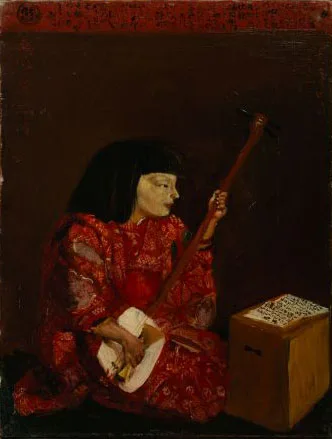
The Great Kanto Earthquake of 1923 (Taisho 12) damaged his house in Kugenuma (Fujisawa, Kanagawa Prefecture), and he moved to Kyoto. In Kyoto he deepened his interest in early ukiyo-e and in Chinese paintings of the Song and Yuan dynasties, and in "Reiko Playing Shamisen" (National Museum of Modern Art, Kyoto), painted that same year, he gave the figure of Reiko plucking strings a feel reminiscent of old Eastern painting. In 1926 (Taisho 15) he moved to Kamakura, and in 1929 (Showa 4), on the way home from a trip to Manchuria (northeast China), he died suddenly at Tokuyama in Yamaguchi Prefecture.