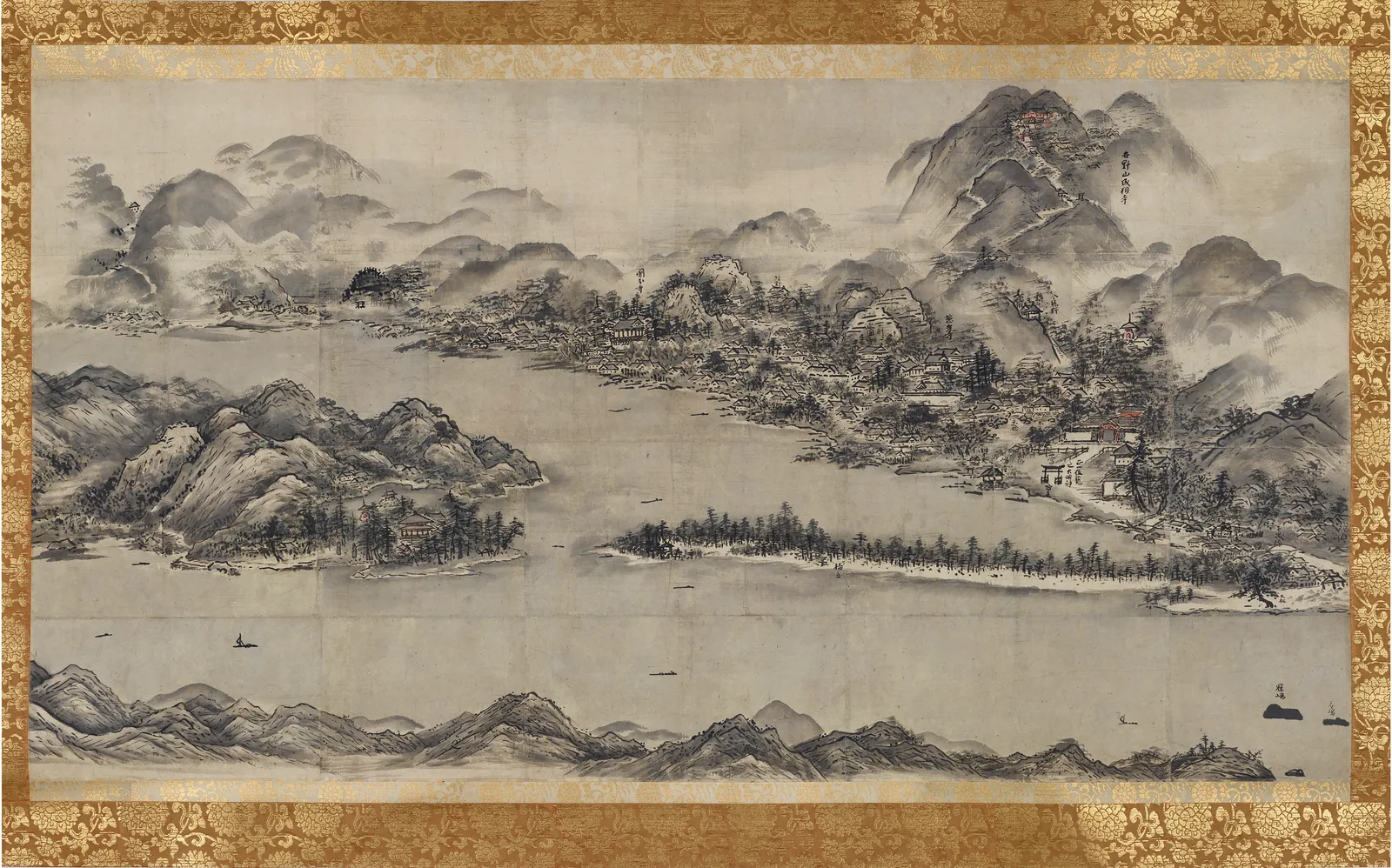
View of Amanohashidate
天橋立図
A National Treasure in which Sesshu depicted Amanohashidate and the surrounding temples, shrines and townscape in a composition looking down from a high sky. Based on the real view, he made the mountains rise high and stretched the townscape sideways, reassembling the scene into a spacious setting.
- Artist
- Sesshu Toyo
- Date
- Muromachi period, 15th-16th century
- Medium / format
- Hanging scroll
- Place depicted
- Amanohashidate(Kyoto)
About this work
Near the center of the picture are Amanohashidate, with its white sand and green pines, and Chionji Temple. Above it, across Aso Sea, lie the townscape of Fuchu with its temples and shrines, and further back a great mountain and the buildings of Nariaiji Temple. Below the sandbar spreads Miyazu Bay, and the mountains of the Kurita Peninsula lie gently along the bottom edge. Place names are also written into the picture.
It is based on the actual scenery, but is not simply a record of it. The mountain on which Nariaiji stands is made extremely high, and the townscape of Fuchu is stretched sideways. In fact, there is no place from which Hashidate can be seen from such a height. It has been pointed out that this reflects Sesshu's awareness of the methods of composing landscapes he acquired in his study of Chinese painting, especially the bird's-eye (looking-down) composition of pictures of West Lake, a famous place in China.
The picture has no signature or seal, but it is attributed to Sesshu from its brushwork, composition and the style of the place-name lettering. The brushwork is rough and carries the momentum of having been painted in one go. It is painted on paper made of twenty-one small sheets of differing sizes pasted together irregularly, and as there are also traces of repainting, it is thought likely to have been a preliminary sketch rather than a finished picture. It is held by the Kyoto National Museum.
The place today
Amanohashidate is a sandbar extending into Miyazu Bay, about 3.6 kilometers long and about 20 to 170 meters wide, covered with about 5,400 pine trees, and counted as one of the Three Views of Japan. Chionji Temple, which Sesshu painted, and Nariaiji Temple on the mountain across Aso Sea both survive today, so you can visit them while comparing them with the painting.
Where can I see it?
Exhibitions change over time. Check each museum's exhibition information before you visit.
Museums that hold this work
- Kyoto National MuseumMuseum's page for this work (opens in a new tab)
Higashiyama Ward, Kyoto Accession no. A甲228
Frequently asked questions
- Who painted View of Amanohashidate, and when?
- View of Amanohashidate is by Sesshu Toyo, made in Muromachi period, 15th-16th century. Medium: Hanging scroll.
- What place does View of Amanohashidate show?
- It shows Amanohashidate (Kyoto).
- Where can I see View of Amanohashidate?
- It is held by Kyoto National Museum. Exhibitions change, so check each museum's information before you visit.
Sources and references
- ColBase 京都国立博物館 天橋立図(国宝) (opens in a new tab) (checked 2026-10-18)
- ジャパンサーチ 京都国立博物館 天橋立図(国宝) (opens in a new tab) (checked 2026-10-18)
You may also like
More from Kyoto
Discover more of the same region on our sister sites.
Matsuri Biyori
Festivals in Kyoto
- Yamahoko, the float ceremony of the Kyoto Gion festival
- Kyoto no Rokusai Nenbutsu
- Yasuraibana
- Kuta no Hanagasa Odori