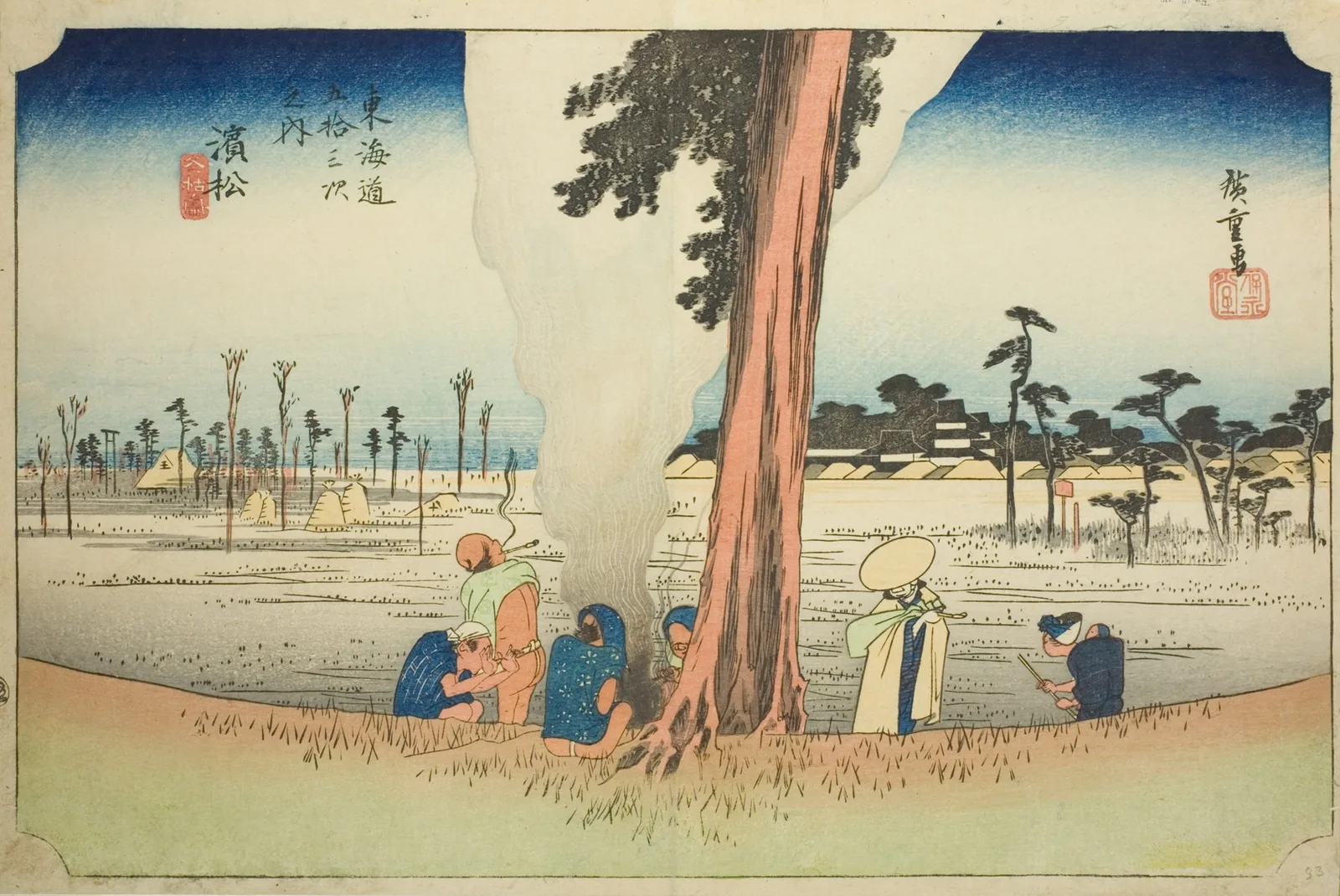
The Fifty-three Stations of the Tokaido (Hoeido edition) ・ 30
Desolate Winter Scene at Hamamatsu
東海道五拾三次之内 浜松 冬枯ノ図
Travelers and local people warm themselves at a bonfire at the foot of a large cedar, before harvested winter fields. The rising smoke overlaps the cedar trunk, and in the back right the post station of Hamamatsu and the keep of Hamamatsu Castle can be seen small.
- Artist
- Utagawa Hiroshige
- Date
- c. 1833-34 (Tenpo 4-5)
- Medium / format
- Woodblock print (ukiyo-e)
- Series
- The Fifty-three Stations of the Tokaido (Hoeido edition) 55 prints
- Place depicted
- Hamamatsu-juku(Shizuoka)
About this work
A thick cedar trunk runs vertically through the center of the picture. At its foot, travelers and local people gather around a bonfire and hold out their hands to warm themselves. The smoke changes color gradually from black to white as it rises along the trunk into the sky. The cedar trunk is painted in a reddish color and stands out against the dull winter fields.
A little apart from the circle of fire, a man in traveling dress and a hat stands alone, looking toward the bonfire. Behind him spread harvested fields, dotted with mounds of rice straw. In the pine grove in the field is a notice board, which the Tokyo Fuji Art Museum identifies as the historic site known as the Zazanza Pine. It is said that the Muromachi shogun Ashikaga Yoshinori held a drinking party under this pine. The people around the fire huddle with rounded backs, and their postures convey the severity of the cold.
At the back right are drawn the townscape of Hamamatsu and the keep of Hamamatsu Castle. Hamamatsu was the largest post station in Totomi, and according to Hamamatsu City materials there were six honjin and 94 hatago in the Tenpo era. The print holds in one sheet the cold of the withered winter fields and the warmth of people around a fire. The sky is printed in deep indigo only at the top edge and left white below, expressing the dry winter air. Near the horizon stand slender trees that have lost their leaves.
The place today
Hamamatsu-juku lay in the center of present-day Chuo Ward, Hamamatsu City. The site of Hamamatsu Castle is now Hamamatsu Castle Park, where nozurazumi stone walls (built by stacking natural stones almost as they are) remain in the keep enclosure. The present keep was restored in 1958 (Showa 33) with donations from citizens.
Where can I see it?
Exhibitions change over time. Check each museum's exhibition information before you visit.
Museums that hold this work
- Tokyo National MuseumMuseum's page for this work (opens in a new tab)
Taito City, Tokyo Accession no. A-12499-34
Museums that hold this series (please check the museum's website for whether it holds this print)
- Shizuoka City Tokaido Hiroshige Museum of Art
Shimizu Ward, Shizuoka
All prints of the Hoeido edition were shown in the museum's collection exhibition Fifty-three Stations of the Tokaido (2024-25)
Museums abroad
- Art Institute of ChicagoMuseum's page for this work (opens in a new tab)
Chicago Accession no. 1925.3532
Frequently asked questions
- Who painted The Fifty-three Stations of the Tokaido: Desolate Winter Scene at Hamamatsu, and when?
- The Fifty-three Stations of the Tokaido: Desolate Winter Scene at Hamamatsu is by Utagawa Hiroshige, made in c. 1833-34 (Tenpo 4-5). Medium: Woodblock print (ukiyo-e).
- What place does The Fifty-three Stations of the Tokaido: Desolate Winter Scene at Hamamatsu show?
- It shows Hamamatsu-juku (Shizuoka).
- Where can I see The Fifty-three Stations of the Tokaido: Desolate Winter Scene at Hamamatsu?
- It is held by Tokyo National Museum, Tokyo Fuji Art Museum, National Diet Library. Exhibitions change, so check each museum's information before you visit.
Sources and references
- Art Institute of Chicago: Hamamatsu: Winter Scene (Hamamatsu, fuyugare no zu) (opens in a new tab) (checked 2026-10-18)
- ColBase(東京国立博物館): A-12499-34 (opens in a new tab) (checked 2026-10-18)
- 東京富士美術館 収蔵品: 東海道五拾三次之内 濱松 冬枯ノ図 (opens in a new tab) (checked 2026-10-18)
- 国立国会図書館デジタルコレクション: 東海道五拾三次 浜松・冬枯ノ図 (opens in a new tab) (checked 2026-10-18)
You may also like
More from Shizuoka
Discover more of the same region on our sister sites.