The Sixty-nine Stations of the Kisokaido ・ 58
Tarui
木曽海道六拾九次之内 垂井
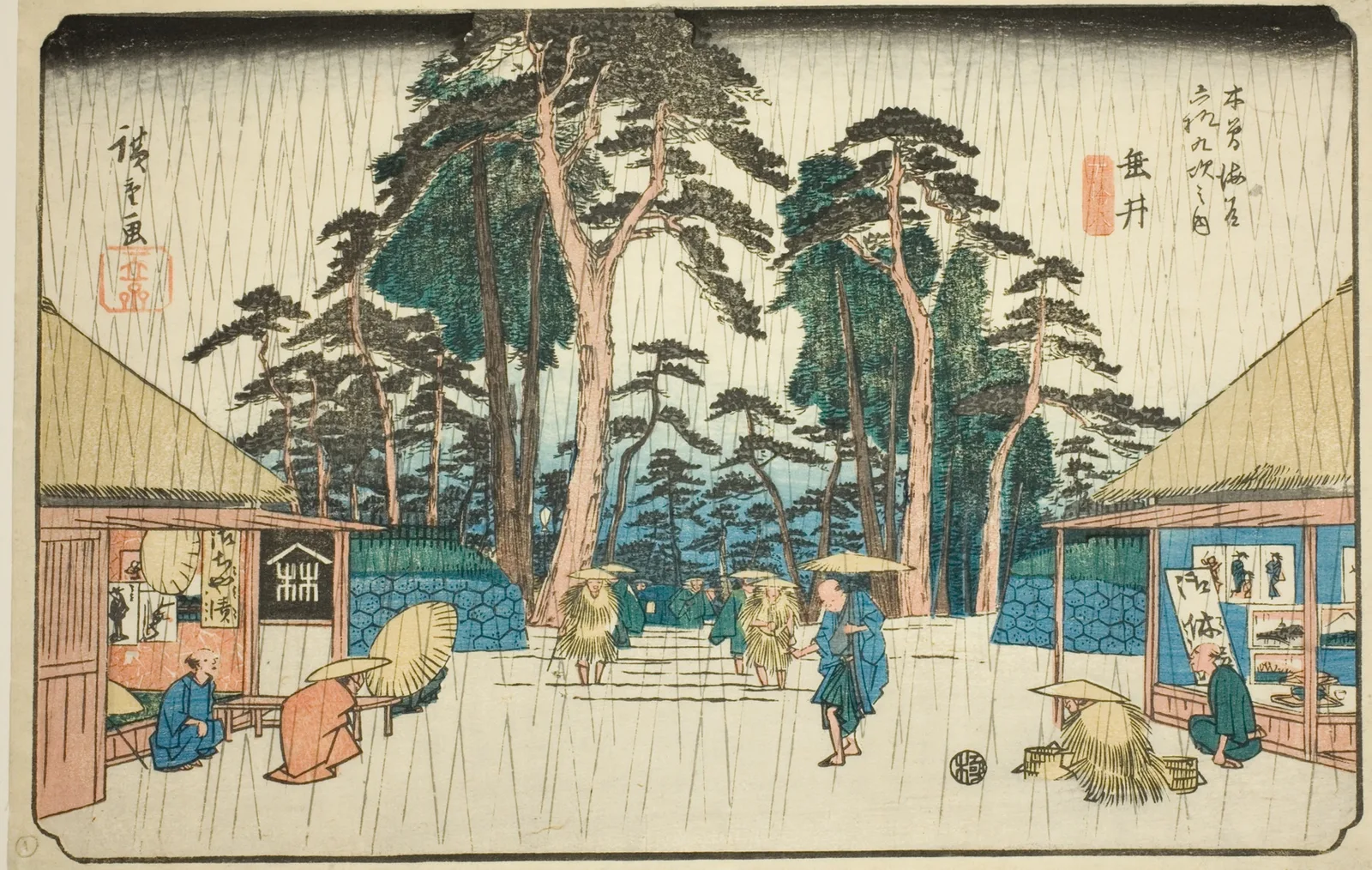
In pouring rain, a party thought to be a daimyo's procession enters the post town along a pine-lined road. People wait respectfully at the teahouses on both sides, and fine lines of rain wrap the whole picture in damp atmosphere.
- Artist
- Utagawa Hiroshige
- Date
- c. 1835-38 (Tenpo 6-9)
- Medium / format
- Woodblock print (ukiyo-e)
- Series
- The Sixty-nine Stations of the Kisokaido 71 prints
- Place depicted
- Tarui-juku(Gifu)
About this work
From the end of the pine-lined road ahead, a line of people in straw rain capes and hats approaches. In the middle you can see a samurai holding an umbrella. There are teahouses on both sides in the foreground, and the people in front of them bow toward the procession or crouch down in deference. Rain falls white on the ground.
The composition is nearly symmetrical, with teahouses framing the picture on both sides and a road running through the center into the distance. The reddish-brown trunks and green needles of the tall pines and the blue of the teahouses are seen through fine lines of rain. The dark stone wall in the background deepens the road along which the procession advances.
Tarui-juku was a post town in Fuwa District, Mino Province, and the junction where the Mino Road leading to Miya-juku on the Tokaido branched off. The name comes from a spring within the town, and the town stood in front of Nangu Taisha. Pine trees continue along the west of the town, and the picture is thought to show that area.
This is a design by Hiroshige. The rain scene ranks with the famous "Nakatsugawa in the Rain" as one of the weather effects Hiroshige displayed in this series. The figures at the teahouses welcoming the procession convey a moment of everyday life in a post town along the highway.
The place today
Tarui-juku corresponds to today's Tarui in Fuwa District, Gifu Prefecture, and the spring for which the place is named, the "Tarui Spring," still flows. The building of the former inn Kamemaruya remains, keeping the atmosphere of the post town in the streetscape. West of the town is the Tarui Milestone, a national historic site, and the pine-lined road also remains.
Where can I see it?
Exhibitions change over time. Check each museum's exhibition information before you visit.
Museums that hold this work
- Tokyo National MuseumMuseum's page for this work (opens in a new tab)
Taito City, Tokyo Accession no. A-12499-126
- National Diet LibraryMuseum's page for this work (opens in a new tab)
Chiyoda City, Tokyo Accession no. 寄別2-2-1-5
Included in Kisokaido Rokujukyu-tsugi
Museums abroad
- Art Institute of ChicagoMuseum's page for this work (opens in a new tab)
Chicago Accession no. 1961.155
Frequently asked questions
- Who painted The Sixty-nine Stations of the Kisokaido: Tarui, and when?
- The Sixty-nine Stations of the Kisokaido: Tarui is by Utagawa Hiroshige, made in c. 1835-38 (Tenpo 6-9). Medium: Woodblock print (ukiyo-e).
- What place does The Sixty-nine Stations of the Kisokaido: Tarui show?
- It shows Tarui-juku (Gifu).
- Where can I see The Sixty-nine Stations of the Kisokaido: Tarui?
- It is held by Tokyo National Museum, National Diet Library. Exhibitions change, so check each museum's information before you visit.
Sources and references
- Art Institute of Chicago: No. 58: Tarui, from the series "Sixty-nine Stations of the Kisokaido (Kisokaido rokujukyu tsugi no uchi)" (opens in a new tab) (checked 2026-10-19)
- ColBase(東京国立博物館): 木曽海道六拾九次之内 垂井 (opens in a new tab) (checked 2026-10-19)
- 国立国会図書館デジタルコレクション: 五拾八 木曽海道六拾九次之内垂井 (opens in a new tab) (checked 2026-10-19)
You may also like
More from Gifu
Discover more of the same region on our sister sites.
Matsuri Biyori
Festivals in Gifu
- Takayama Festival Yatai Float Event
- Furukawa Festival Okoshi-daiko and Yatai Float Event
- Ogaki Festival Yama Float Event
- Gujo Odori