The Sixty-nine Stations of the Kisokaido ・ 57
Akasaka
木曽海道六拾九次之内 赤坂
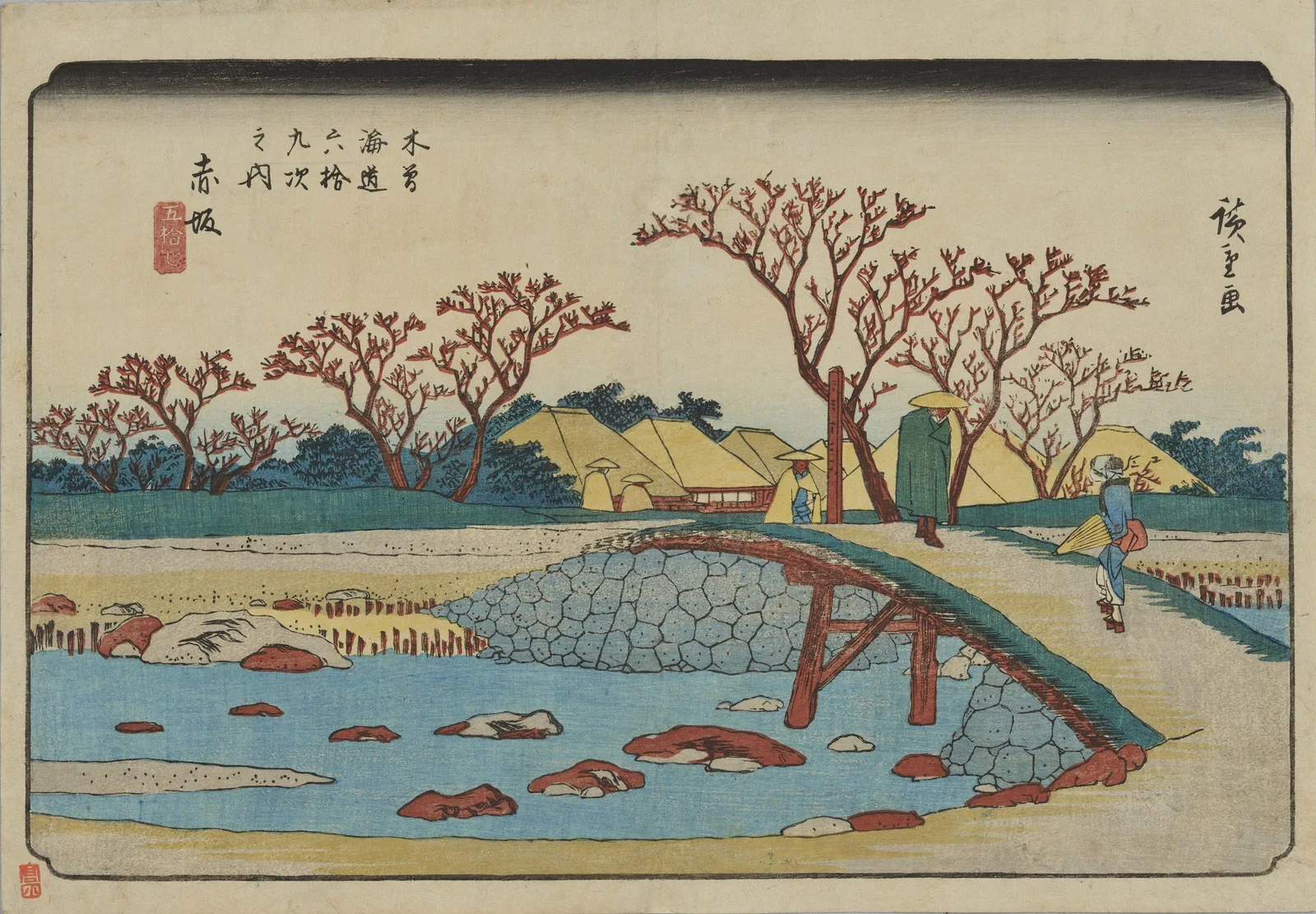
This view of Akasaka in Mino shows a traveler crossing a bridge supported by a stone wall, with bare trees and thatched houses behind. Red rocks poking out of the river and the blue of the water add color to the quiet winter landscape.
- Artist
- Utagawa Hiroshige
- Date
- c. 1835-38 (Tenpo 6-9)
- Medium / format
- Woodblock print (ukiyo-e)
- Series
- The Sixty-nine Stations of the Kisokaido 71 prints
- Place depicted
- Akasaka-juku (Mino)(Gifu)
About this work
A shallow river flows in the foreground, with red and white rocks emerging here and there. Across it is a wooden bridge, one end resting on a stone wall, and a traveler in a straw hat crosses it. On the far bank stand rows of leafless trees, and thatched houses and a teahouse peek out behind them.
The arc of the bridge and the gray of the stone wall cut across the middle of the picture, dividing the sky above from the river below. The tree branches are drawn in thin reddish-brown lines, suggesting the season between winter and early spring. There are few figures, conveying the calm atmosphere of the edge of the post town.
Akasaka-juku was a post town in Fuwa District, Mino Province, and the nearby Kuise River had a river port that bustled with boat traffic. Some hold that the river shown is the Kuise River. Limestone is quarried from Mount Kinsei to the north of the town, and lime making flourished there from the Edo period.
This is a design by Hiroshige. The Tokaido also has a post town of the same name, Akasaka in Mikawa, which Hiroshige drew in his Hoeido edition of the Tokaido. Its picture of the inside of an inn is entirely different in feeling, and comparing the two shows well how the two series differ.
The place today
Akasaka-juku corresponds to today's Akasaka-cho in Ogaki City, Gifu Prefecture, and the former honjin site is now a park. The Akasaka Port Hall stands on the site of the Kuise River port, and old family houses remain in the townscape. Every November the Nakasendo Akasaka-juku Festival is held, reenacting the procession of Princess Kazunomiya.
Where can I see it?
Exhibitions change over time. Check each museum's exhibition information before you visit.
Museums that hold this work
- Tokyo National MuseumMuseum's page for this work (opens in a new tab)
Taito City, Tokyo Accession no. A-12499-125
- National Diet LibraryMuseum's page for this work (opens in a new tab)
Chiyoda City, Tokyo Accession no. 寄別2-2-1-5
Included in Kisokaido Rokujukyu-tsugi
Museums abroad
Frequently asked questions
- Who painted The Sixty-nine Stations of the Kisokaido: Akasaka, and when?
- The Sixty-nine Stations of the Kisokaido: Akasaka is by Utagawa Hiroshige, made in c. 1835-38 (Tenpo 6-9). Medium: Woodblock print (ukiyo-e).
- What place does The Sixty-nine Stations of the Kisokaido: Akasaka show?
- It shows Akasaka-juku (Mino) (Gifu).
- Where can I see The Sixty-nine Stations of the Kisokaido: Akasaka?
- It is held by Tokyo National Museum, National Diet Library. Exhibitions change, so check each museum's information before you visit.
Sources and references
- ColBase(東京国立博物館): 木曽海道六拾九次之内 赤坂 (opens in a new tab) (checked 2026-10-19)
- 国立国会図書館デジタルコレクション: 五拾七 木曽海道六拾九次之内赤坂 (opens in a new tab) (checked 2026-10-19)
- Wikipedia: 木曽海道六十九次 (opens in a new tab) (checked 2026-10-19)
You may also like
More from Gifu
Discover more of the same region on our sister sites.
Matsuri Biyori
Festivals in Gifu
- Takayama Festival Yatai Float Event
- Furukawa Festival Okoshi-daiko and Yatai Float Event
- Ogaki Festival Yama Float Event
- Gujo Odori