The Sixty-nine Stations of the Kisokaido ・ 59
Sekigahara
木曽海道六拾九次之内 関か原
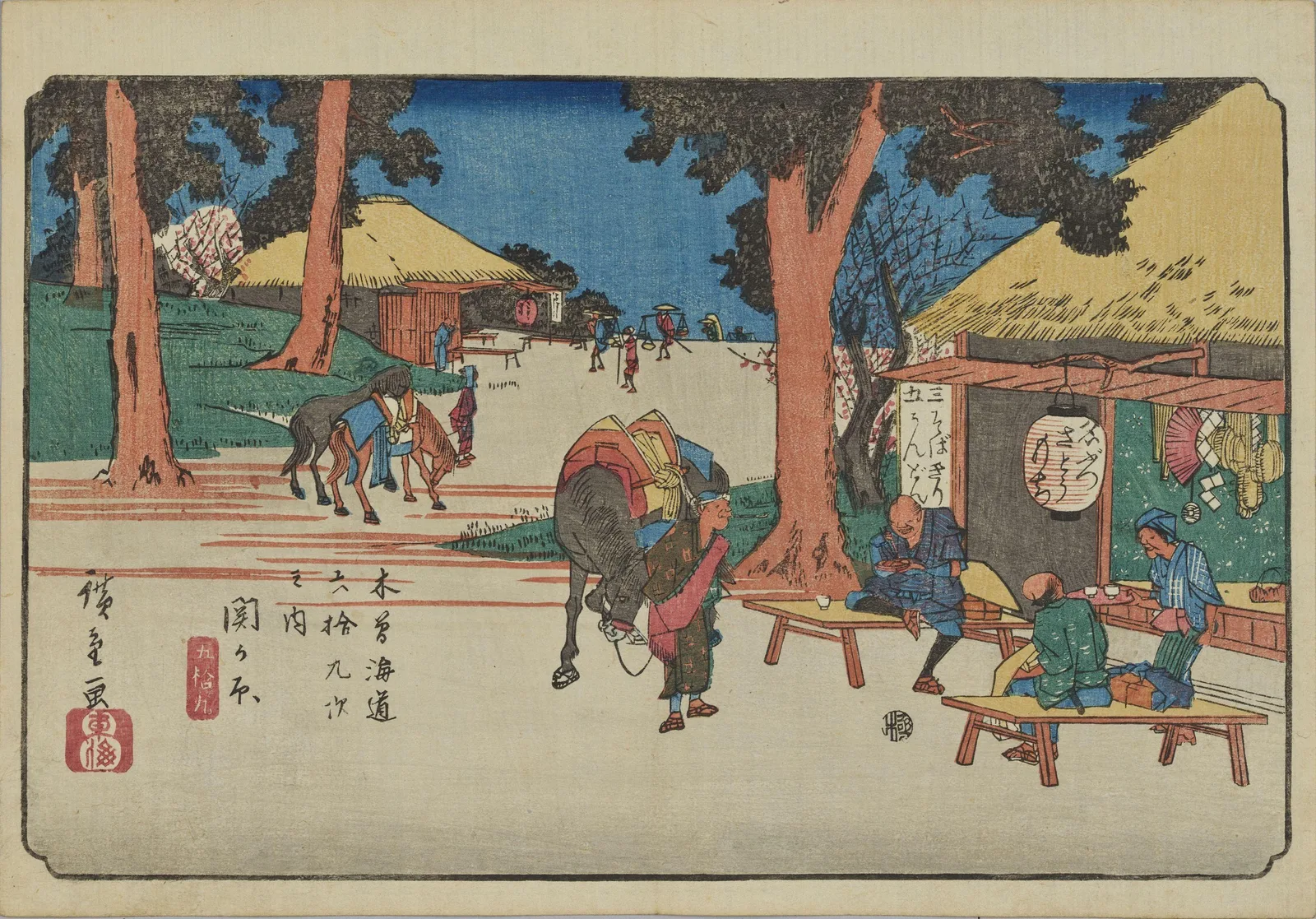
In front of a teahouse at Sekigahara-juku, travelers rest their horses and sit on benches to take a smoke. The blue sky seen between tall trees and the teahouse's lanterns and menu boards convey the easygoing bustle of the highway.
- Artist
- Utagawa Hiroshige
- Date
- c. 1835-38 (Tenpo 6-9)
- Medium / format
- Woodblock print (ukiyo-e)
- Series
- The Sixty-nine Stations of the Kisokaido 71 prints
- Place depicted
- Sekigahara-juku(Gifu)
About this work
On the right is a thatched-roof teahouse, where travelers on the benches under the eaves smoke long pipes or drink tea. A large lantern hangs beneath the eaves. In the center a man leads a horse loaded with baggage, and farther back at left another horse is resting. Down the road, houses and passersby appear small.
Thick-trunked trees stand at left and right, letting a deep indigo sky show between their branches. The earthen road is broad and bright, with people and horses gathered in the foreground, giving a sense of the relaxed time of a post town. A tree in bloom is also drawn beside the teahouse.
Sekigahara-juku was a post town in Fuwa District, Mino Province. In ancient times the Fuwa Barrier stood here, and it was the stage of the Jinshin War and the Battle of Sekigahara in the fifth year of Keicho (1600). In the Edo period it was also a key traffic point where roads such as the Hokkoku Wakikan branched off.
This is a design by Hiroshige. Though this was the site of the battle that decided the fate of the realm, he chose not to show traces of the fighting but a scene at a highway teahouse. The station name in the title is written "Sekigahara" (関か原), and the Tokyo National Museum and the National Diet Library both hold the same design.
The place today
Sekigahara-juku corresponds to today's Sekigahara-cho in Fuwa District, Gifu Prefecture, and the site of the secondary honjin remains. Battle camp sites of the Battle of Sekigahara are scattered around it, and the whole battlefield can be seen from Ishida Mitsunari's camp site. The Gifu-Sekigahara Battlefield Memorial Museum opened in 2020. West of the town, the site of the Fuwa Barrier also has a museum.
Where can I see it?
Exhibitions change over time. Check each museum's exhibition information before you visit.
Museums that hold this work
- Tokyo National MuseumMuseum's page for this work (opens in a new tab)
Taito City, Tokyo Accession no. A-12499-127
- National Diet LibraryMuseum's page for this work (opens in a new tab)
Chiyoda City, Tokyo Accession no. 寄別2-2-1-5
Included in Kisokaido Rokujukyu-tsugi
Museums abroad
Frequently asked questions
- Who painted The Sixty-nine Stations of the Kisokaido: Sekigahara, and when?
- The Sixty-nine Stations of the Kisokaido: Sekigahara is by Utagawa Hiroshige, made in c. 1835-38 (Tenpo 6-9). Medium: Woodblock print (ukiyo-e).
- What place does The Sixty-nine Stations of the Kisokaido: Sekigahara show?
- It shows Sekigahara-juku (Gifu).
- Where can I see The Sixty-nine Stations of the Kisokaido: Sekigahara?
- It is held by Tokyo National Museum, National Diet Library. Exhibitions change, so check each museum's information before you visit.
Sources and references
- ColBase(東京国立博物館): 木曽海道六拾九次之内 関か原 (opens in a new tab) (checked 2026-10-19)
- 国立国会図書館デジタルコレクション: 五拾九 木曽海道六拾九次之内関か原 (opens in a new tab) (checked 2026-10-19)
- Wikipedia: 木曽海道六十九次 (opens in a new tab) (checked 2026-10-19)
You may also like
More from Gifu
Discover more of the same region on our sister sites.
Matsuri Biyori
Festivals in Gifu
- Takayama Festival Yatai Float Event
- Furukawa Festival Okoshi-daiko and Yatai Float Event
- Ogaki Festival Yama Float Event
- Gujo Odori